Sharda Ispat (SHRDAIS) Q2 FY27 Profit Jumps 915% YoY as Steel Demand Lifts Revenue
The alloy steel maker's revenue more than doubled year-on-year, but a sequential dip in profit margin signals underlying cost pressures.
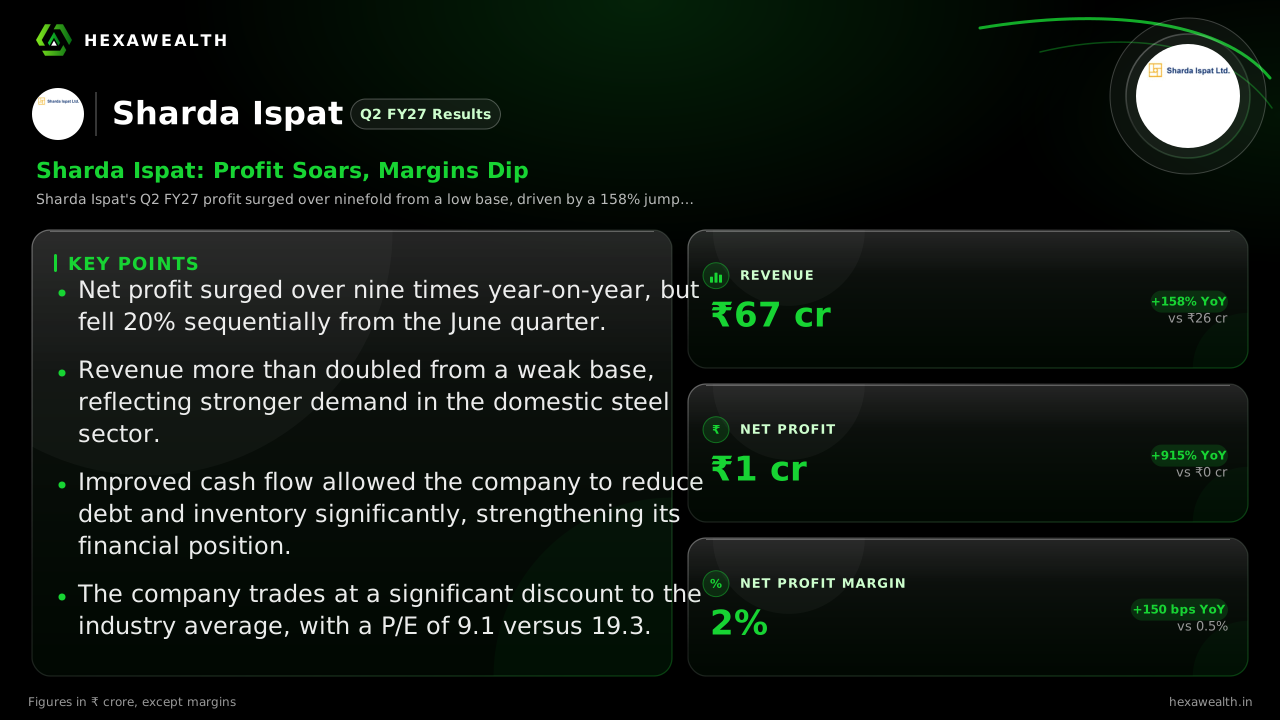
Sharda Ispat's Q2 FY27 profit surged over ninefold from a low base, driven by a 158% jump in revenue. However, profit fell 20% from the previous quarter as margins contracted slightly.
For Sharda Ispat, a supplier of alloy steel to automakers, the September quarter was a story of two distinct comparisons. The headline numbers show a powerful recovery from a weak prior-year period, but a look at the more recent trend reveals the ongoing squeeze of operating in a cyclical industry.
The company reported a net profit of ₹1.32 crore for Q2 FY27, a staggering 915% increase from a meagre ₹0.13 crore a year ago. Revenue from operations more than doubled to ₹67.47 crore. Sequentially, however, both revenue and profit softened, with profit down 20% from ₹1.64 crore in Q1 FY27.
Revenue & profit
Revenue (₹ Cr)
Profit (₹ Cr)
Net Profit Margin (%)
| Metric | CurrentQ2 FY27 (Sep 2026) | PreviousQ1 FY27 (Jun 2026) |
|---|---|---|
| Revenue (₹ Cr) | 67.47 | 71.15 |
| Profit (₹ Cr) | 1.32 | 1.64 |
| Net Profit Margin (%) | 2.0 | 2.3 |
The base effect and the cost reality
The explosive year-on-year growth is largely a base effect. According to analysis from StockFin.ai, the company was emerging from a period of operational volatility in the prior year. The recent surge aligns with a robust domestic steel market, where consumption grew 8% in the first half of FY27, as noted in sector reports.
The sequential decline points to persistent cost pressures. While the company benefited from operating leverage, raw material costs, as reported by scanx.trade, stood at ₹52.78 crore, up 165% year-on-year. This kept the net profit margin at 2%, a 30-basis-point dip from the June quarter.
A stronger financial position emerges
A bright spot is the improving balance sheet. The company generated a positive operating cash flow of ₹10.26 crore for the half-year, according to scanx.trade. It used this to reduce current borrowings by ₹7.72 crore and cut inventory levels sharply, indicating efficient working capital management.
This deleveraging is a critical shift. It provides a buffer against the margin volatility that StockFin.ai identifies as a key risk for the company. With no institutional investor presence and low liquidity, such financial discipline is essential for stability.
Key Points
- Net profit surged over nine times year-on-year, but fell 20% sequentially from the June quarter.
- Revenue more than doubled from a weak base, reflecting stronger demand in the domestic steel sector.
- Improved cash flow allowed the company to reduce debt and inventory significantly, strengthening its financial position.
- The company trades at a significant discount to the industry average, with a P/E of 9.1 versus 19.3.
Hexa Perspective
The quarter confirms Sharda Ispat's recovery trajectory is intact, yet its profitability remains fragile. The year-on-year leap is impressive but anchored to an exceptionally weak base. The more telling story is the sequential margin pressure, a reminder that for small-cap steel players, top-line growth does not automatically translate to bottom-line resilience.
The path forward hinges on its ability to maintain this new discipline. The deleveraging and inventory management are positive steps that mitigate its historical volatility. For the recovery to be sustainable, these financial gains must now be shielded from the next inevitable swing in input costs.
Also read
Want this applied to your portfolio?
Talk to a HexaWealth advisor, or sync your mutual fund data for insights tailored to your holdings.