John Cockerill India (COCKERILL) Q1 FY27's Loss Widens as Revenue Growth Meets Integration Costs
The engineering firm posted a consolidated net loss of ₹31.4 crore in Q1 FY27, more than doubling from a year ago, as a strategic acquisition and early-stage project costs pressured margins.
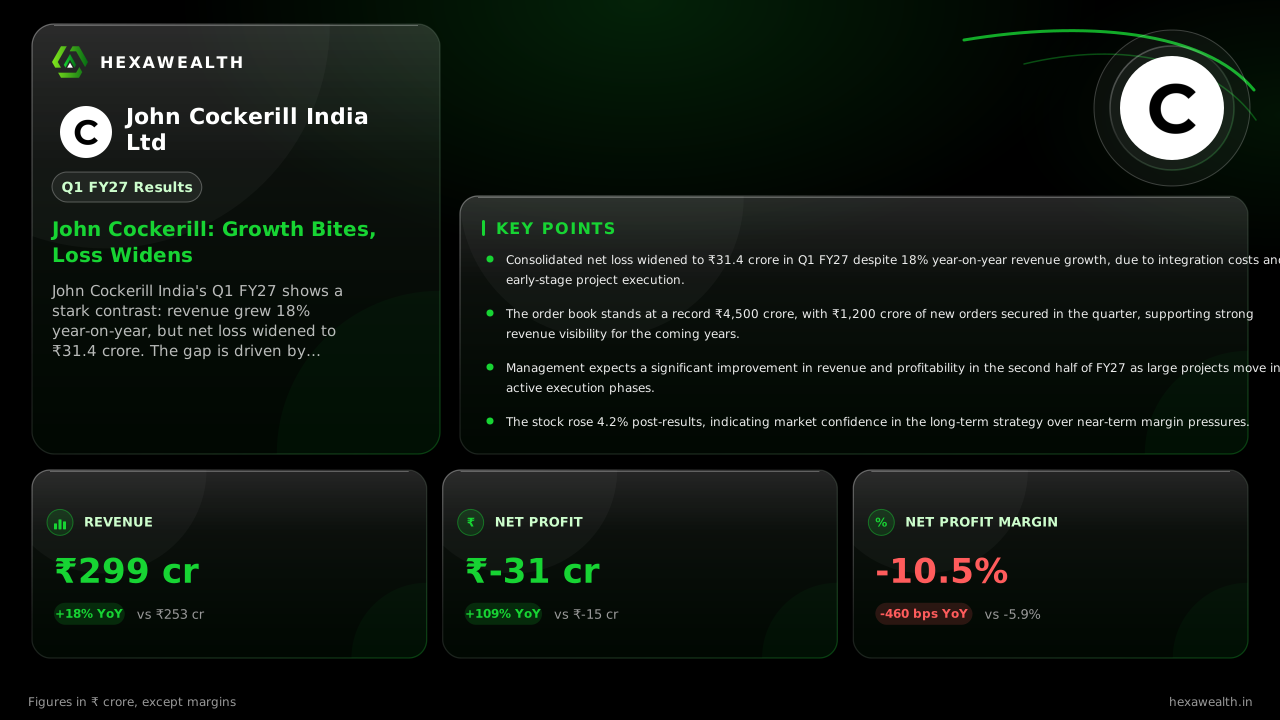
John Cockerill India's Q1 FY27 shows a stark contrast: revenue grew 18% year-on-year, but net loss widened to ₹31.4 crore. The gap is driven by integration costs from a global consolidation and a sequential slowdown in project execution.
For John Cockerill India, the quarter was a story of strategic ambition clashing with near-term financial reality. The company, now the global hub for its parent's metals business, saw revenue grow but profitability sink under the weight of its own transformation.
Consolidated revenue rose 17.9% year-on-year to ₹298.6 crore. Yet, the net loss deepened to ₹31.4 crore, more than double the ₹15 crore loss in Q1 FY26. Sequentially, revenue fell 13.3% from a strong Q4, turning a small profit into a significant loss.
Revenue & profit
Revenue (₹ Cr)
Net Profit (₹ Cr)
Net Profit Margin (%)
| Metric | CurrentQ1 FY27 | PreviousQ4 FY26 | Same quarter LYQ1 FY26 |
|---|---|---|---|
| Revenue (₹ Cr) | 298.56YoY +18% | 344.52 | 253.26 |
| Net Profit (₹ Cr) | -31.37YoY -109% | 7.36 | -15.03 |
| Net Profit Margin (%) | -10.5YoY -78% | 2.1 | -5.9 |
Why the growth didn't reach the bottom line
Two main forces drove the margin collapse. First, the company is digesting its acquisition of John Cockerill Metals International, a Belgian entity that consolidates the group's global metals operations. According to the Q1 earnings call, this brought one-time integration and consolidation costs.
Second, management cited the early-stage execution of recently won large projects. Revenue recognition for these is back-end loaded, meaning costs are incurred upfront before significant income is booked. Other income also plunged 89% year-on-year, removing a cushion.
A record backlog points to a second-half rebound
The underlying business momentum appears strong. The company secured about ₹1,200 crore in new orders during the quarter, as per the investor call summary on Inve. This lifted the consolidated order book to a robust ₹4,500 crore, providing visibility for nearly three years of execution.
Management, quoted in a Sovrenn report, guided for a significant ramp-up in project execution and revenue in the second half of FY27. They expect Q1 and Q2 to remain subdued as orders move from engineering to active site work.
The market looked past the loss
Investors focused on the long-term pipeline. Despite the wider loss, the stock closed 4.2% higher the day after the August 13 results, according to Inve data. The share price has delivered a 94.9% return over the past year, reflecting optimism around the company's consolidated global platform and its role in India's steel capacity expansion.
The key watchpoint is whether the promised H2 acceleration materializes to offset these upfront costs. The shift to share-based payments for parent company services, mentioned in the call, should also reduce cash outflows.
Key Points
- Consolidated net loss widened to ₹31.4 crore in Q1 FY27 despite 18% year-on-year revenue growth, due to integration costs and early-stage project execution.
- The order book stands at a record ₹4,500 crore, with ₹1,200 crore of new orders secured in the quarter, supporting strong revenue visibility for the coming years.
- Management expects a significant improvement in revenue and profitability in the second half of FY27 as large projects move into active execution phases.
- The stock rose 4.2% post-results, indicating market confidence in the long-term strategy over near-term margin pressures.
Hexa Perspective
The quarter underscores the classic transition phase of an integrator: growth is purchased with near-term profitability. The ₹4,500 crore order book is a powerful asset, but its value hinges on timely execution at healthy margins.
The promised second-half inflection is now critical. If project milestones are hit and integration costs taper as guided, the current losses could be a temporary cost of building a larger, more competitive global entity. If the ramp-up delays further, the strain on the bottom line may extend, testing investor patience with the strategic story.
Also read
Want this applied to your portfolio?
Talk to a HexaWealth advisor, or sync your mutual fund data for insights tailored to your holdings.