Caliber Mining (CMLL) Q2 FY27 Profit Slips Back Into Loss Despite 127% Revenue Surge
The mining contractor's revenue more than doubled year-on-year, but higher finance and depreciation costs from a post-IPO expansion pushed it back into a quarterly loss.
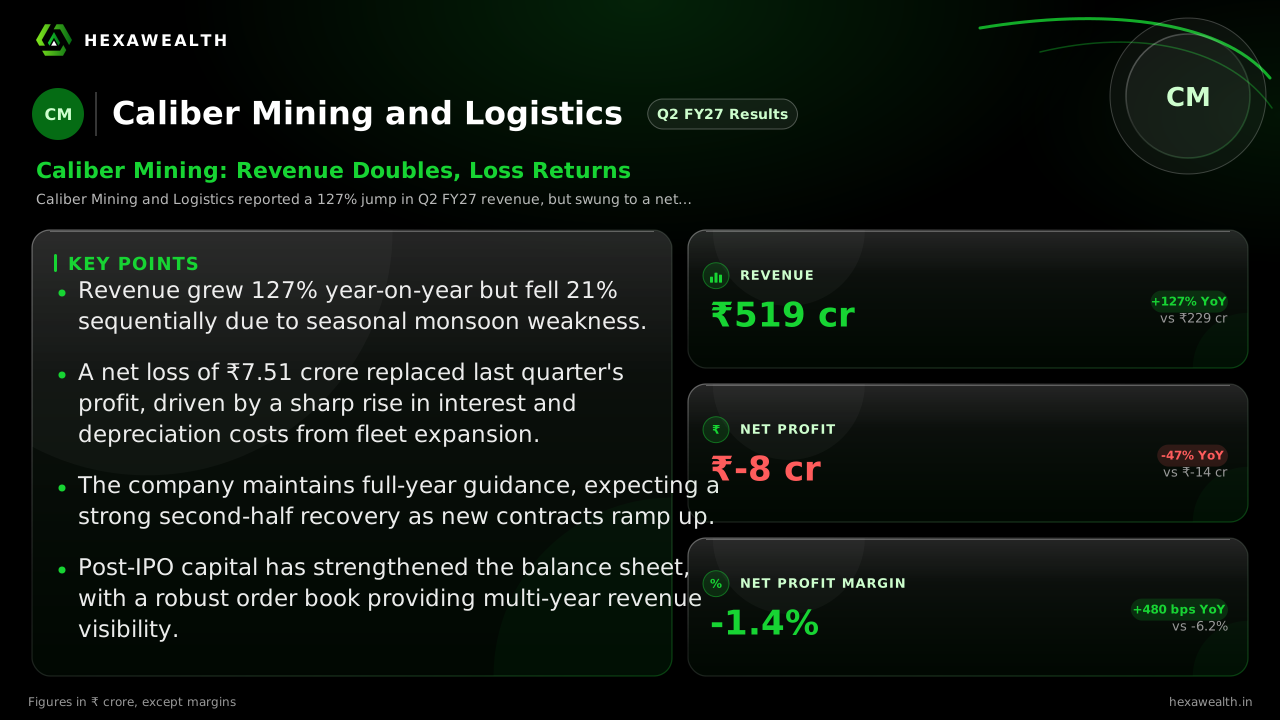
Caliber Mining and Logistics reported a 127% jump in Q2 FY27 revenue, but swung to a net loss of ₹7.51 crore. The loss was driven by a seasonal revenue dip and sharply higher interest and depreciation costs from aggressive fleet expansion.
For a mining contractor fresh from an IPO, the test is whether new capital can translate revenue growth into profit. Caliber Mining and Logistics delivered a stark split in its September quarter: revenue more than doubled from a year ago, but a net loss returned.
The numbers tell a story of top-line momentum colliding with a heavy cost structure. Revenue reached ₹519.45 crore, up 127% year-on-year but down 21% from the June quarter. The company swung to a net loss of ₹7.51 crore from a profit of ₹29.76 crore last quarter.
Revenue & profit
Revenue (₹ Cr)
Profit (₹ Cr)
| Metric | CurrentQ2 FY27 | PreviousQ1 FY27 | Same quarter LYQ2 FY26 |
|---|---|---|---|
| Revenue (₹ Cr) | 519.45YoY +127% | 657.05 | 228.86 |
| Profit (₹ Cr) | -7.51YoY +47% | 29.76 | -14.23 |
| PAT Margin (%) | -1.4YoY +77% | 4.5 | -6.2 |
Why the Profit Vanished
The sequential revenue drop is seasonal. MarketPing notes Q2 is the monsoon quarter, where mining volumes are typically lower. Yet the real pressure came from below the operating line.
Interest costs rose 16% sequentially to ₹32.40 crore, while depreciation jumped 17% to ₹52.74 crore. These costs, as reported by StockWatch, trace directly to a post-IPO capital expenditure push. The company spent ₹574.3 crore on property and equipment in just the first half, already exceeding its full-year guidance of ₹450 crore.
The Cost of Growth
This spending funded a fleet expansion to 2,226 units to mobilise three large new contracts won earlier in the year. While this builds a formidable ₹8,634 crore order book, the fixed costs of that expansion arrive before the revenue fully ramps up.
Management, cited by MarketPing, expects margins to recover in the second half as post-monsoon volumes normalise and new sites reach full utilisation. They have retained full-year guidance for 45-50% revenue growth and over 35% growth in both EBITDA and profit.
A Stronger Foundation, For Now
The aggressive investment has strengthened the balance sheet on paper. ScanX.Trade reports net worth rose 77% to ₹1,148 crore after the IPO, improving the net debt-to-equity ratio. Credit agency CRISIL upgraded its rating to 'A-/Positive' in October, seeing the deleveraging as sustainable.
Yet the stock fell 1.5% on the results day, according to MarketPing. For a newly listed company, the market is weighing visible growth against the immediate profit sacrifice required to achieve it.
Key Points
- Revenue grew 127% year-on-year but fell 21% sequentially due to seasonal monsoon weakness.
- A net loss of ₹7.51 crore replaced last quarter's profit, driven by a sharp rise in interest and depreciation costs from fleet expansion.
- The company maintains full-year guidance, expecting a strong second-half recovery as new contracts ramp up.
- Post-IPO capital has strengthened the balance sheet, with a robust order book providing multi-year revenue visibility.
Hexa Perspective
The quarter highlights the classic tension in a capital-intensive growth story. Operational metrics are strong, with volumes and the order book surging. But the accounting profit is being drowned by the front-loaded costs of expansion.
The investment case now hinges entirely on the second-half ramp-up. If post-monsoon volumes and new-site utilisation meet management's expectations, operating leverage should start to offset the high fixed costs. If that ramp is delayed or costs climb further, the full-year profit guidance will be difficult to achieve. Investors are being asked to fund growth today for profits tomorrow.
Also read
Want this applied to your portfolio?
Talk to a HexaWealth advisor, or sync your mutual fund data for insights tailored to your holdings.