Anjani Synthetics (ANJANI) Q2 FY27 Profit Holds as Cost Cuts Offset Falling Sales
The textile processor managed a 1% yearly profit rise despite a 13% revenue drop, as lower finance and employee costs provided a buffer against weak volumes.
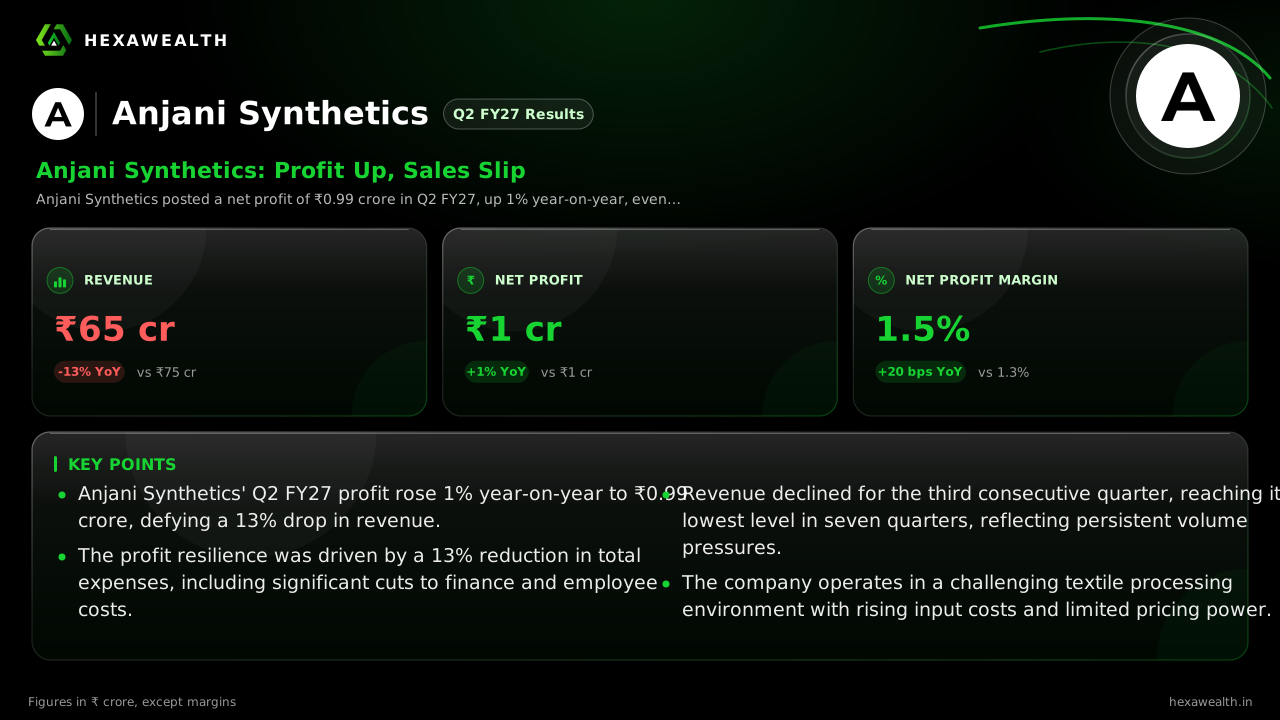
Anjani Synthetics posted a net profit of ₹0.99 crore in Q2 FY27, up 1% year-on-year, even as revenue fell 13% to ₹65.11 crore. The company demonstrated tight cost control to protect its bottom line amid a third consecutive quarter of declining sales.
For Anjani Synthetics, the September quarter was a test of its ability to manage what it can control. In a textile sector facing volatile raw material costs and patchy demand, the company's top line shrank for the third straight quarter. Yet, its profit held steady, a sign of disciplined cost management in a challenging environment.
The numbers tell a story of diverging trends. Revenue fell 6.3% from the June quarter to ₹65.11 crore, marking the lowest quarterly sales in seven periods. Compared to last year, the drop was 12.8%. Profit, however, inched up 1% year-on-year to ₹0.99 crore, though it was down 13.2% sequentially. The net profit margin improved by 20 basis points from a year ago but slipped 10 points from the prior quarter.
Revenue & profit
Revenue (₹ Cr)
Profit (₹ Cr)
| Metric | CurrentQ2 FY27 | PreviousQ1 FY27 | Same quarter LYQ2 FY26 |
|---|---|---|---|
| Revenue (₹ Cr) | 65.11YoY -13% | 69.51 | 74.64 |
| Profit (₹ Cr) | 0.99YoY +1% | 1.14 | 0.98 |
| PAT Margin (%) | 1.5YoY +15% | 1.6 | 1.3 |
How Cost Discipline Saved the Quarter
The marginal yearly profit gain came entirely from a sharp reduction in expenses. According to a report by ScanX.trade, total expenses fell 13% year-on-year, mirroring the revenue decline. Finance costs dropped 36% to ₹0.40 crore, and employee benefit expenses fell 20%. This aggressive cost-cutting allowed the company to maintain its bottom line despite the significant top-line pressure.
MarketsMojo notes the company's operating margin held stable at 3.41%, a sign of operational resilience. However, the low absolute margin level offers little buffer against further volume shocks. The sequential dip in net profit margin was primarily due to the revenue decline, as the cost base could not shrink fast enough to fully offset it.
A Sector Under Pressure
The backdrop for these results is a textile industry in flux. While sector exports showed a 10.3% yearly recovery from April to August 2026, manufacturers face a sharp 60% rise in cotton yarn prices. Anjani Synthetics, operating in the low-margin cloth processing segment, is exposed to these raw material swings and has limited pricing power in a fragmented, competitive market.
Management has not provided specific forward guidance, leaving the outlook unclear. The absence of institutional investors and analyst coverage, as highlighted by MarketsMojo, means there is little external validation for any turnaround thesis. The company's focus remains on operational efficiency and working capital management, with no recent announcements of capacity expansion or new growth initiatives.
Key Points
- Anjani Synthetics' Q2 FY27 profit rose 1% year-on-year to ₹0.99 crore, defying a 13% drop in revenue.
- The profit resilience was driven by a 13% reduction in total expenses, including significant cuts to finance and employee costs.
- Revenue declined for the third consecutive quarter, reaching its lowest level in seven quarters, reflecting persistent volume pressures.
- The company operates in a challenging textile processing environment with rising input costs and limited pricing power.
Hexa Perspective
This quarter underscores a company in defensive mode, successfully protecting profitability through cost control but unable to ignite sales growth. The improvement is more about financial engineering than operational strength. For the trend to reverse, a sustained recovery in textile demand is essential. Until then, the stock's deep valuation discount—trading at a P/E of 9.2 versus an industry average of 46.5—likely reflects these structural challenges more than a hidden opportunity. Investors are weighing cost discipline against the absence of a visible growth catalyst.
Also read
Want this applied to your portfolio?
Talk to a HexaWealth advisor, or sync your mutual fund data for insights tailored to your holdings.