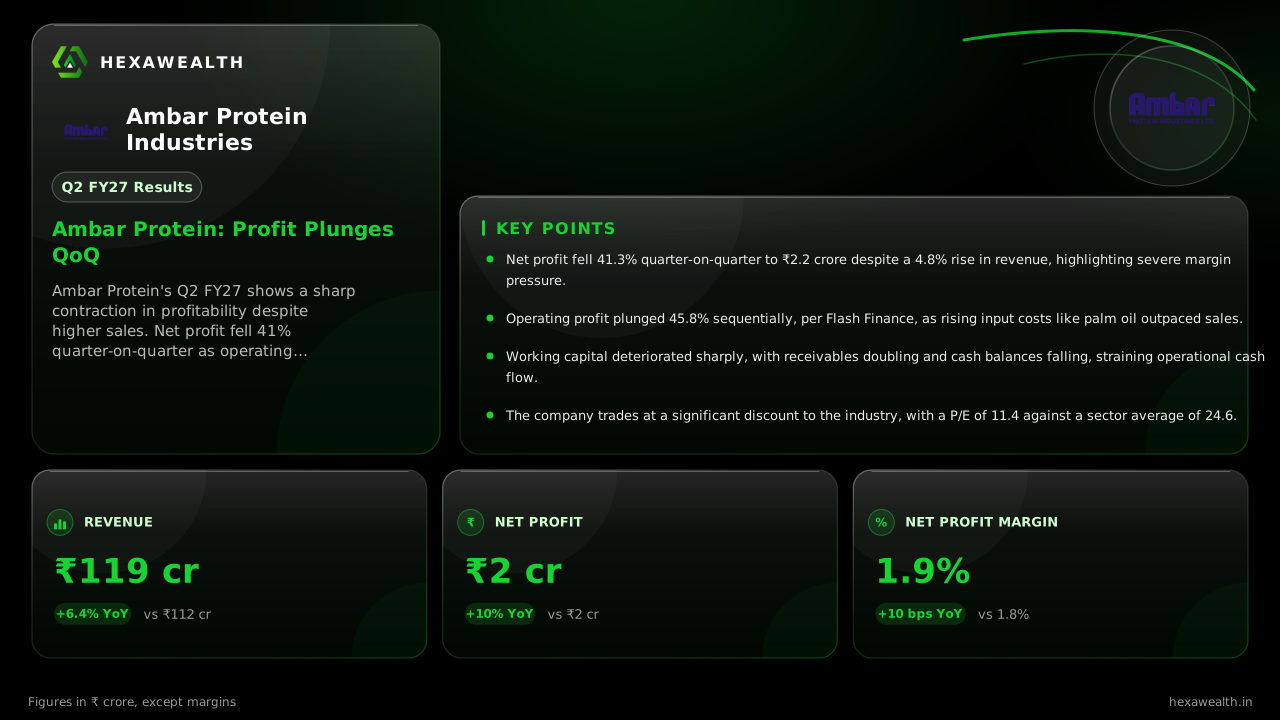
Ambar Protein (AMBARPIL) Q2 FY27 Profit Dives 41% as Margins Squeeze
Revenue grew 6.4% year-on-year, but profit before tax halved sequentially as costs rose faster than sales, compressing margins.
Ambar Protein's Q2 FY27 shows a sharp contraction in profitability despite higher sales. Net profit fell 41% quarter-on-quarter as operating margins narrowed, highlighting persistent cost pressures in the edible oil sector.
For Ambar Protein, a mid-sized edible oil refiner, the September quarter was a story of top-line resilience meeting a sharp cost squeeze. Revenue climbed to ₹118.8 crore, but profit before tax halved from the previous quarter, landing at ₹2.5 crore.
The numbers reveal the tension. Year-on-year, revenue grew 6.4% and net profit 10%. Sequentially, however, a 4.8% revenue rise was overwhelmed by a 7.4% jump in total expenses, sending net profit down 41%. The net profit margin compressed by 140 basis points to 1.9%.
Revenue & profit
Revenue (₹ Cr)
Profit (₹ Cr)
Net Profit Margin (%)
| Metric | CurrentQ2 FY27 (Sep 2026) | PreviousQ1 FY27 (Jun 2026) |
|---|---|---|
| Revenue (₹ Cr) | 118.84 | 113.45 |
| Profit (₹ Cr) | 2.20 | 3.75 |
| Net Profit Margin (%) | 1.9 | 3.3 |
Why margins collapsed
A key driver was a steep drop in operating profit, which fell 46% quarter-on-quarter according to Flash Finance. This suggests raw material costs, a persistent challenge flagged in the company's FY26 annual report, rose faster than selling prices could adjust. The sector-wide pressure was confirmed by a Grant Thornton Bharat report noting palm oil prices were about 21% higher year-on-year in September.
A working capital trade-off
Cash flow tells another part of the story. Scanx.trade reported a dramatic shift in working capital: inventories fell sharply while trade receivables more than doubled. This indicates the company cleared stock but may have extended credit, tying up cash. Operating cash flow covered only 56% of net profit for the half-year, per Flash Finance.
The outlook hinges on global prices
The near-term path is tied to volatile commodity markets. While Crisil projects healthy 10-12% revenue growth for refiners this fiscal, a government duty cut in September aims to lower consumer prices. This could pressure domestic realisations in the coming quarters. Management, according to StockFin.ai, has provided no explicit guidance, focusing instead on operational efficiency over expansion.
Key Points
- Net profit fell 41.3% quarter-on-quarter to ₹2.2 crore despite a 4.8% rise in revenue, highlighting severe margin pressure.
- Operating profit plunged 45.8% sequentially, per Flash Finance, as rising input costs like palm oil outpaced sales.
- Working capital deteriorated sharply, with receivables doubling and cash balances falling, straining operational cash flow.
- The company trades at a significant discount to the industry, with a P/E of 11.4 against a sector average of 24.6.
Hexa Perspective
The quarter underscores the fragile economics of a commodity processor in a volatile import-dependent sector. Profitability is hostage to global oil prices and domestic duty changes, with little operating leverage to show. The working capital shift from inventory to receivables may support near-term sales but weakens cash conversion, a critical quality metric. For the stock's deep valuation discount to narrow, investors need evidence of sustained margin discipline or a more favourable commodity cycle—neither of which the Q2 print delivers.
Also read
Want this applied to your portfolio?
Talk to a HexaWealth advisor, or sync your mutual fund data for insights tailored to your holdings.