Amrapali Fincap (AMRAFIN) Q4 FY26 Profit Jumps 1275% as Costs Fall Sharply
The small finance company posted a massive profit increase in Q4 FY26 despite lower revenue, driven by cost control and other income.
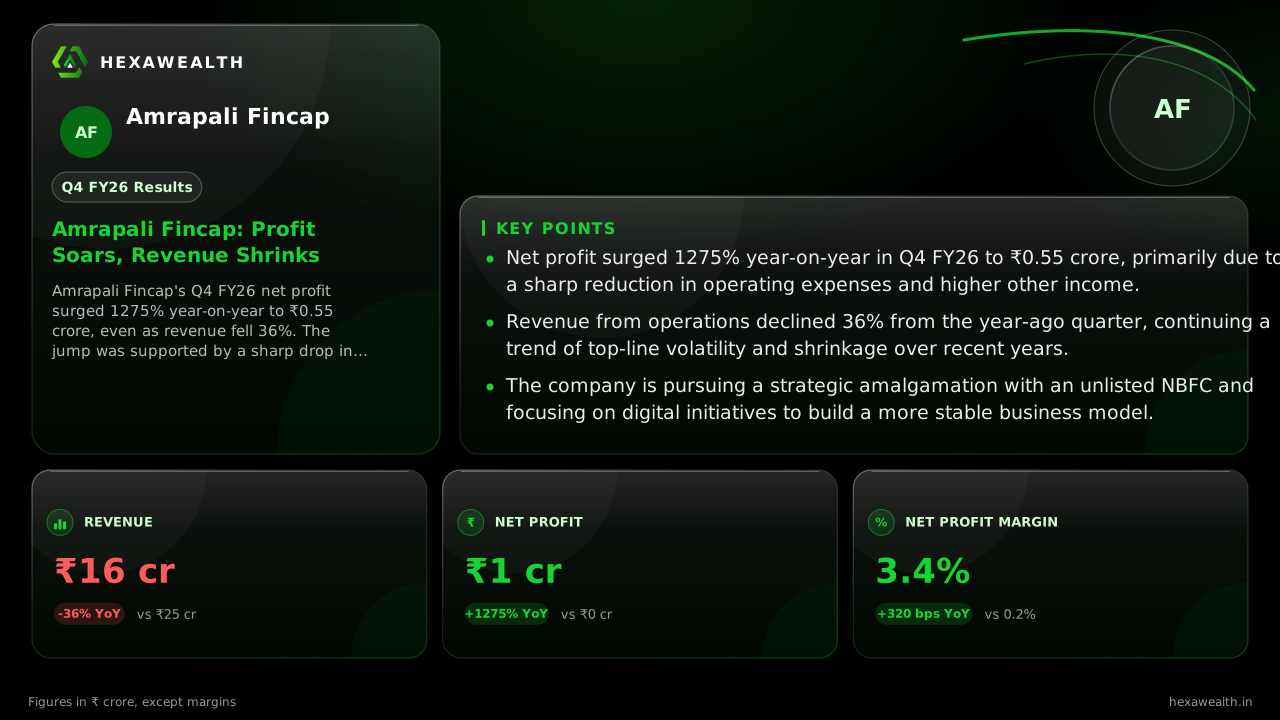
Amrapali Fincap's Q4 FY26 net profit surged 1275% year-on-year to ₹0.55 crore, even as revenue fell 36%. The jump was supported by a sharp drop in operating costs and higher other income.
For a small financial services firm, a quarter of massive profit growth on shrinking revenue tells a story of radical cost-cutting, not business expansion. Amrapali Fincap’s Q4 FY26 delivered exactly that, with net profit soaring over twelve-fold even as the top line contracted significantly.
The numbers reveal a stark split. Revenue from operations fell 36% year-on-year to ₹16 crore. Yet, net profit exploded to ₹0.55 crore from just ₹0.04 crore a year ago. Sequentially, revenue jumped 358% from a low base, but profit growth of 129% was outpaced, squeezing the net profit margin.
Revenue & profit
Revenue (₹ Cr)
Profit (₹ Cr)
Net Profit Margin
| Metric | CurrentQ4 FY26 | Same quarter LYQ4 FY25 |
|---|---|---|
| Revenue (₹ Cr) | 16.0YoY -36% | 24.99 |
| Profit (₹ Cr) | 0.55YoY +1275% | 0.04 |
| Net Profit Margin | 3.4%YoY +1600% | 0.2% |
Why profit surged on lower sales
The profit leap was not from core operations. According to a summary by MarketPing, it was supported by lower operating costs, higher other income, and MAT credit adjustments. Total expenses fell 34% year-on-year. This drastic cost reduction, alongside a 91% jump in other income, turned a thin 0.2% margin from last year into a 3.4% margin this quarter.
The persistent challenge of revenue
Cost cuts can only go so far. The company’s revenue has been volatile and declining, with FY26 sales down 25% from FY25. MarketPing notes this was driven by lower stock-in-trade purchases and trading volumes. The business remains small and susceptible to swings in financial market activity, with no clear, sustained growth engine in sight.
What comes next?
Management, as noted by StockFin.ai, is emphasizing digital transformation and retail investor growth. The board has also approved a scheme to amalgamate with an unlisted NBFC, Ampire Finance, which awaits regulatory approvals. This move could diversify the business beyond trading. For now, the company trades at a significant premium, with a P/E of 89.8 against an industry average of 20.6.
Key Points
- Net profit surged 1275% year-on-year in Q4 FY26 to ₹0.55 crore, primarily due to a sharp reduction in operating expenses and higher other income.
- Revenue from operations declined 36% from the year-ago quarter, continuing a trend of top-line volatility and shrinkage over recent years.
- The company is pursuing a strategic amalgamation with an unlisted NBFC and focusing on digital initiatives to build a more stable business model.
Hexa Perspective
This quarter highlights a turnaround in profitability, but one built on cost containment rather than revenue momentum. The core challenge remains: generating consistent, growing income from financial services. The proposed amalgamation could provide a new lending avenue, but integration and execution risks are high. Investors are paying a steep premium for a company that must prove it can grow its top line as effectively as it has recently controlled its costs.
Also read
Want this applied to your portfolio?
Talk to a HexaWealth advisor, or sync your mutual fund data for insights tailored to your holdings.