Worldwide Aluminium (WWALUM) Q2 FY27 Profit Triples on Low Base as Sales Continue to Slide
The aluminium trader's net profit jumped 300% sequentially despite a 6% drop in revenue, as margins improved from a near-zero base a year ago.
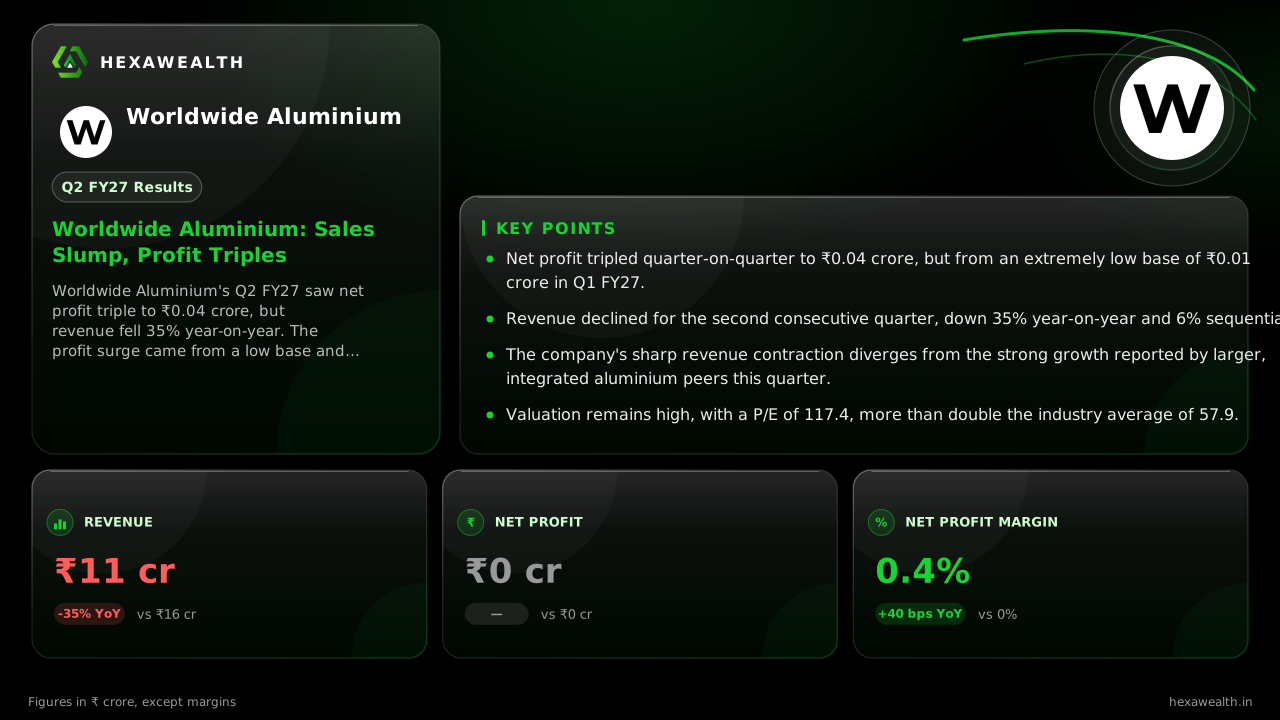
Worldwide Aluminium's Q2 FY27 saw net profit triple to ₹0.04 crore, but revenue fell 35% year-on-year. The profit surge came from a low base and cost control, while the broader aluminium sector reported strong growth.
For a small trading firm like Worldwide Aluminium, quarterly results often hinge on a few large deals. The September quarter saw the company's revenue shrink for the second straight time, falling 35% from a year earlier. Yet its net profit tripled from the prior quarter, a gain built on a wafer-thin base and strict cost management.
The numbers tell a story of divergence. Revenue fell to ₹10.55 crore, down 6% from June. Net profit, however, rose to ₹0.04 crore from ₹0.01 crore. The net profit margin improved to 0.4%, up from 0.1% last quarter and zero a year ago.
Revenue & profit
Revenue (₹ Cr)
Profit (₹ Cr)
Net Profit Margin (%)
| Metric | CurrentQ2 FY27 (Sep 2026) | PreviousQ1 FY27 (Jun 2026) |
|---|---|---|
| Revenue (₹ Cr) | 10.55 | 11.25 |
| Profit (₹ Cr) | 0.04 | 0.01 |
| Net Profit Margin (%) | 0.4 | 0.1 |
Why profit grew as sales fell
The profit jump is a function of scale. Starting from a base of near-zero profit in the year-ago quarter, even a small absolute gain translates into a large percentage increase. Total expenses fell in line with sales, down 35% year-on-year, preserving the margin.
This internal discipline stands in stark contrast to the sector's performance. According to Flash Finance, four other aluminium companies reported a median sales growth of 51% and profit growth of 92% for the quarter. Worldwide Aluminium's 35% revenue decline places it far outside that uptrend.
The outlook in a split market
The company's trading model leaves it exposed to volatile deal flows, unlike integrated producers. Industry reports point to robust demand in electrical and construction sectors, but also to rising input costs. Hindalco's management noted a 5% sequential cost increase in the September quarter, as reported by Business Standard.
For a trader, such cost pressures can squeeze margins if they cannot be passed on. With revenue already under pressure, the path to sustained profitability remains narrow. The stock has been thinly traded, closing at ₹18.79 on November 5.
Key Points
- Net profit tripled quarter-on-quarter to ₹0.04 crore, but from an extremely low base of ₹0.01 crore in Q1 FY27.
- Revenue declined for the second consecutive quarter, down 35% year-on-year and 6% sequentially.
- The company's sharp revenue contraction diverges from the strong growth reported by larger, integrated aluminium peers this quarter.
- Valuation remains high, with a P/E of 117.4, more than double the industry average of 57.9.
Hexa Perspective
The quarter underscores the fragility of earnings at this scale. Profitability improved, but the ₹0.04 crore net profit is less than 0.5% of revenue and follows a break-even year-ago period. The 102% premium to the industry P/E is hard to justify against a backdrop of shrinking sales while the sector expands.
The critical question is whether this is a cyclical trough or a structural decline in trading volumes. Without a visible order book or management commentary, the next few quarters will show if the company can recapture lost revenue while protecting its nascent margins from industry-wide cost inflation.
Also read
Want this applied to your portfolio?
Talk to a HexaWealth advisor, or sync your mutual fund data for insights tailored to your holdings.