Bikaji (BIKAJI) Q2 FY27 Profit Falls 11% Despite Record Revenue as Costs Squeeze Margins
The snack maker posted its highest-ever quarterly sales, but rising input and marketing costs pushed profitability to a multi-quarter low.
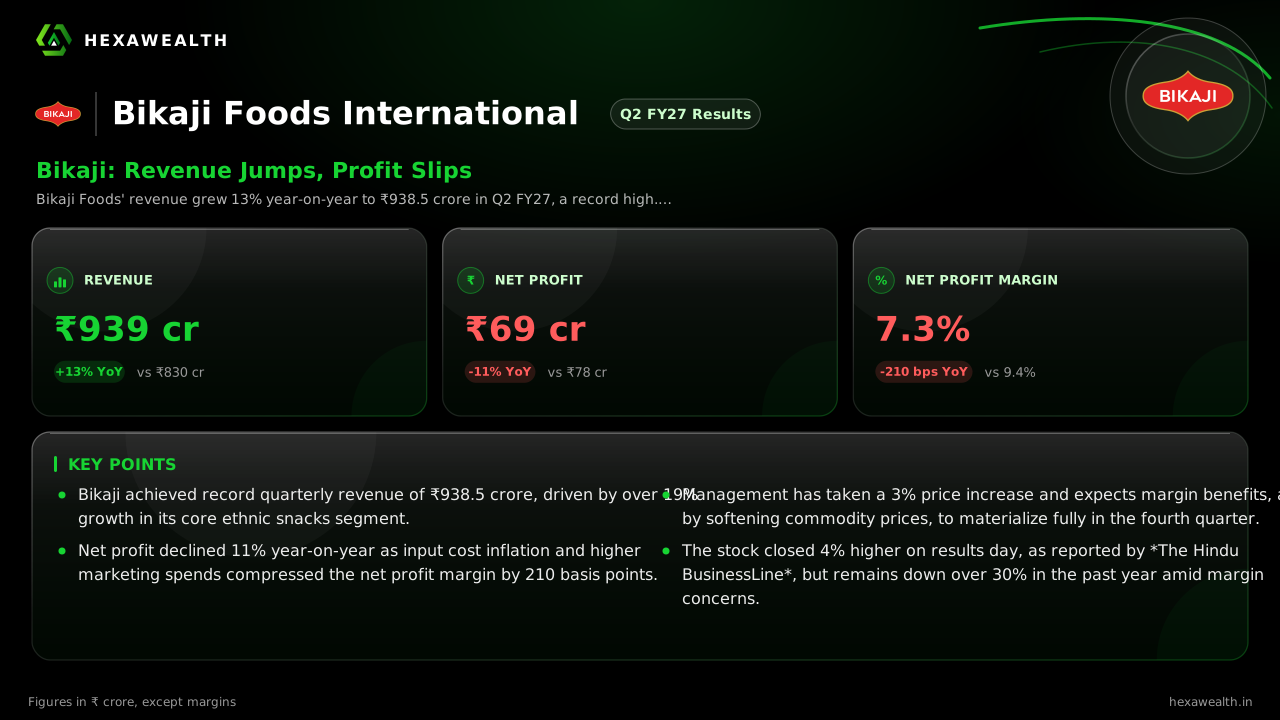
Bikaji Foods' revenue grew 13% year-on-year to ₹938.5 crore in Q2 FY27, a record high. However, net profit fell 11% to ₹69 crore as margins contracted sharply due to higher commodity and promotional costs.
For Bikaji Foods, the September quarter was a story of two diverging lines. The snack maker clocked its highest-ever quarterly revenue, driven by strong demand for its core ethnic and western snacks. Yet, the cost of achieving that growth was steep, with profit declining as margins compressed to their lowest level in recent quarters.
The numbers tell the split story clearly. Revenue rose 13% year-on-year to ₹938.5 crore, also marking a sharp 28% sequential jump. In contrast, net profit fell 11% to ₹69 crore. The net profit margin contracted by 210 basis points to 7.3% compared to the same period last year.
Revenue & profit
Revenue (₹ Cr)
Profit (₹ Cr)
Net Profit Margin
| Metric | CurrentQ2 FY27 (Sep 2026) | PreviousQ1 FY27 (Jun 2026) |
|---|---|---|
| Revenue (₹ Cr) | 938.53 | 734.26 |
| Profit (₹ Cr) | 68.96 | 59.47 |
| Net Profit Margin | 7.3% | 8.1% |
Why the Growth Didn't Reach the Bottom Line
Revenue strength was led by the snacks portfolio. According to The Hindu BusinessLine, the ethnic snacks segment grew nearly 20%, while western snacks surged over 44%. However, the packaged sweets segment declined 11%, which the company attributed to Diwali shifting into the subsequent quarter.
The profit drop was driven by a severe cost squeeze. Total expenses rose 17% year-on-year, outpacing revenue growth. Management, on an earnings call transcribed by AlphaStreet, cited a “bad crop” leading to higher pulse prices, elevated edible oil costs, and increased fuel and packaging expenses. Employee and interest costs also rose sharply.
The Outlook for Margin Recovery
Management has initiated a 3% price increase effective mid-November to counter these pressures. They expect the full benefit, along with softening input costs, to flow through only by the fourth quarter. CFO Rishabh Jain guided for a challenging Q3 but projected a normalized gross margin and EBITDA in Q4.
The company remains confident on demand, targeting high-teens revenue growth for the full year. However, the path to restoring last year's 9.4% net margin is contingent on both successful price realization and a sustained cool-down in commodity inflation.
Key Points
- Bikaji achieved record quarterly revenue of ₹938.5 crore, driven by over 19% growth in its core ethnic snacks segment.
- Net profit declined 11% year-on-year as input cost inflation and higher marketing spends compressed the net profit margin by 210 basis points.
- Management has taken a 3% price increase and expects margin benefits, aided by softening commodity prices, to materialize fully in the fourth quarter.
- The stock closed 4% higher on results day, as reported by The Hindu BusinessLine, but remains down over 30% in the past year amid margin concerns.
Hexa Perspective
The quarter underscores the classic FMCG tension between volume growth and margin protection. Bikaji is gaining market share, but at a significant cost to profitability. The promised margin recovery in Q4 is not just a hope but a necessity, given the stock's premium valuation at 60 times earnings. Investors are now weighing the company's strong distribution reach and brand equity against its ability to reclaim pricing power. The next few quarters will test whether this margin squeeze is a temporary phase or a new, more competitive normal for the ethnic snacks leader.
Also read
Want this applied to your portfolio?
Talk to a HexaWealth advisor, or sync your mutual fund data for insights tailored to your holdings.