Vikram Thermo (VIKRAMTH) Q2 FY27 Profit Growth Slows as Costs Rise Faster Than Sales
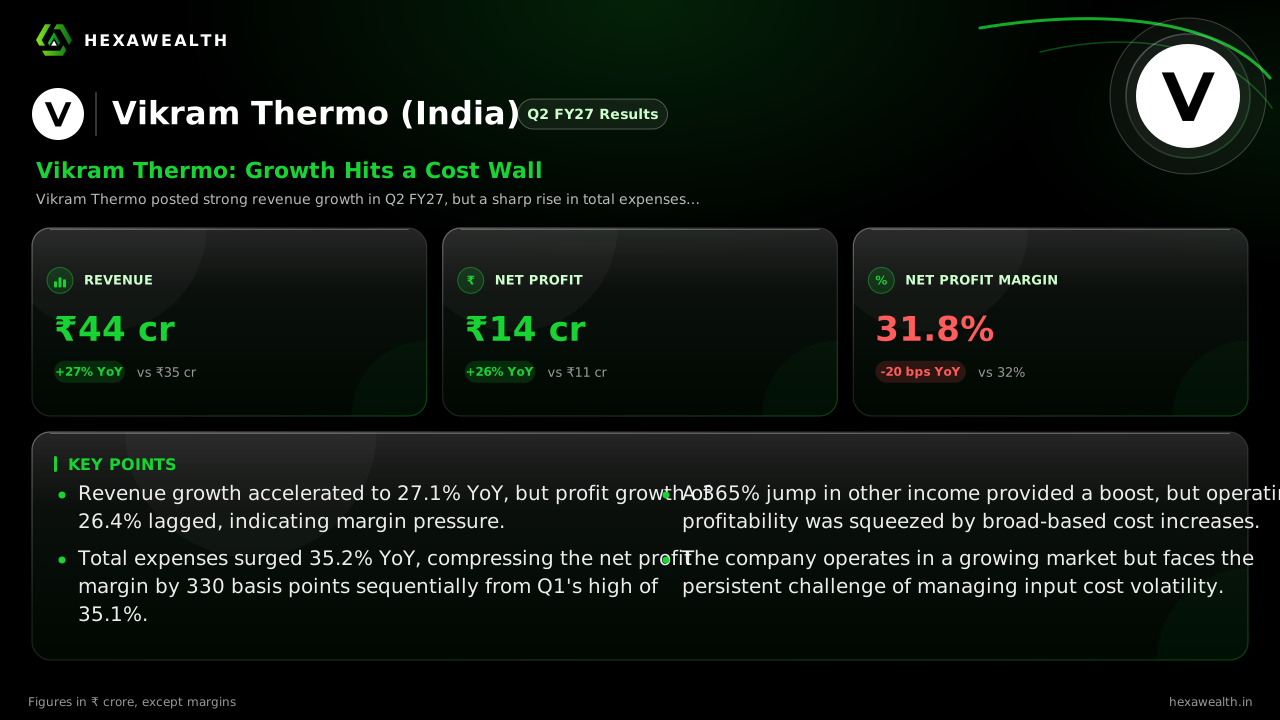
Vikram Thermo's Q2 FY27 revenue jumped 27% year-on-year, but profit growth lagged as total expenses surged 35%, squeezing margins sequentially.
Vikram Thermo posted strong revenue growth in Q2 FY27, but a sharp rise in total expenses outpaced sales, compressing net profit margins. The quarter highlights the challenge of maintaining profitability amid rising costs.
For a niche pharmaceutical excipient maker like Vikram Thermo, growth is often about high-margin, research-based products and sticky customer relationships. The September quarter delivered the top-line momentum, but profitability faced a new pressure point.
Revenue rose 27.1% year-on-year to ₹44.0 crore, accelerating from the June quarter. Net profit grew 26.4% to ₹14.0 crore. However, the sequential story reveals a squeeze: revenue grew 16.2% from Q1, but profit inched up only 5.4%.
Revenue & profit
Revenue (₹ Cr)
Profit (₹ Cr)
Net Profit Margin
| Metric | CurrentQ2 FY27 | PreviousQ1 FY27 | Same quarter LYQ2 FY26 |
|---|---|---|---|
| Revenue (₹ Cr) | 44.0YoY +27% | 37.87 | 34.63 |
| Profit (₹ Cr) | 14.0YoY +26% | 13.28 | 11.08 |
| Net Profit Margin | 31.8%YoY -0.6% | 35.1% | 32.0% |
Why margins compressed
Total expenses surged 35.2% year-on-year and 29.4% sequentially, far outpacing revenue growth. This drove the net profit margin down 330 basis points from the previous quarter. The cost jump appears broad-based, with employee benefits, depreciation, and other expenses all rising significantly.
A key factor was a sharp rise in other income, which soared 365% year-on-year to ₹1.0 crore. MarketsMojo notes this contributed to profit but also signals that operating performance faced headwinds. The margin compression suggests the company's pricing power or product mix was not enough to fully offset the cost inflation.
The growth runway and its constraints
Management has previously guided for a 10% capacity expansion in FY27, as noted in a May 2026 board outcome. The sector outlook is supportive, with India's polymer excipients market projected to grow 9–12% annually through 2035, driven by generic drug production.
Yet, the quarter's cost surge is a reminder of risks. SectorAlpha highlights raw material price volatility as a medium risk, with inputs like methacrylic acid linked to crude oil prices. The company's strong balance sheet, with near-zero debt, provides a cushion, but controlling this cost inflation is critical for the margin story.
Key Points
- Revenue growth accelerated to 27.1% YoY, but profit growth of 26.4% lagged, indicating margin pressure.
- Total expenses surged 35.2% YoY, compressing the net profit margin by 330 basis points sequentially from Q1's high of 35.1%.
- A 365% jump in other income provided a boost, but operating profitability was squeezed by broad-based cost increases.
- The company operates in a growing market but faces the persistent challenge of managing input cost volatility.
Hexa Perspective
Vikram Thermo's quarter is a classic case of growth meeting a cost wall. The revenue acceleration is positive, confirming demand for its specialized excipients. However, the margin compression shows that this growth, for now, is coming at a higher cost.
The path ahead hinges on whether this cost surge is a one-quarter spike or a new norm. With the chemical sector in early recovery and input prices volatile, margins may remain under pressure near-term. Investors are weighing solid top-line momentum against the need for the company to demonstrate it can regain its industry-leading profitability.
Also read
Want this applied to your portfolio?
Talk to a HexaWealth advisor, or sync your mutual fund data for insights tailored to your holdings.