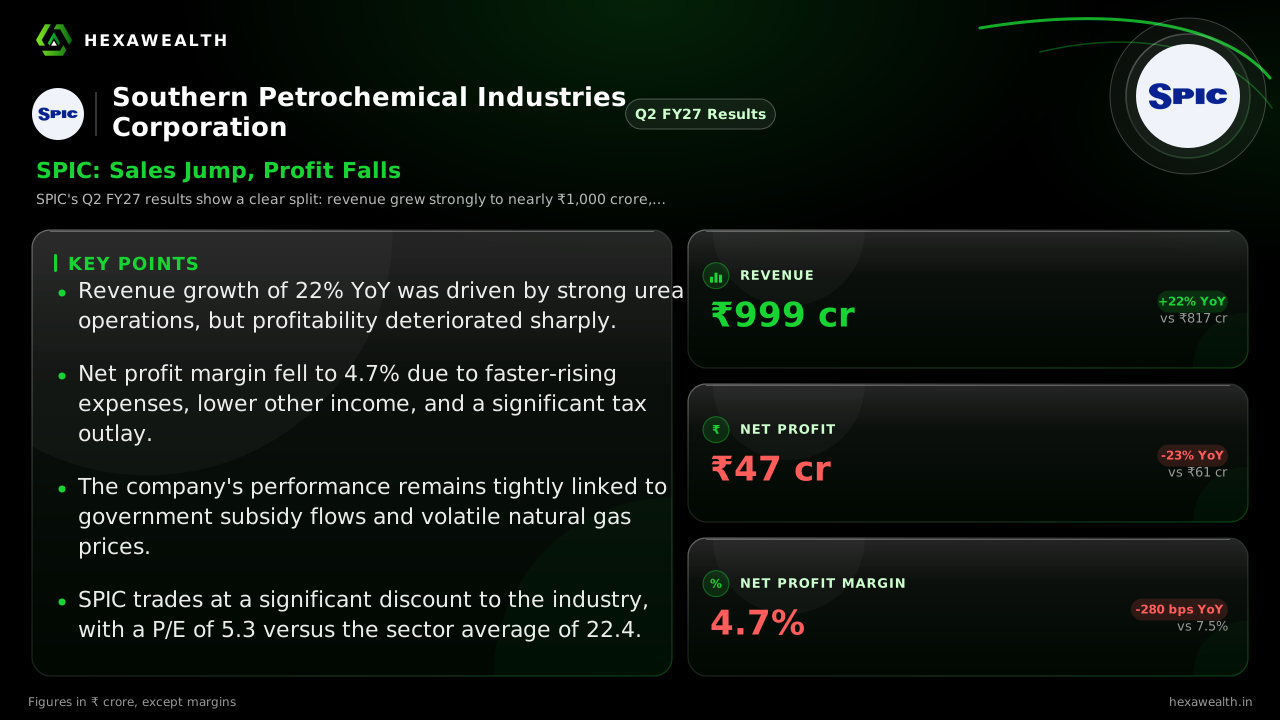
SPIC Q2 FY27 Profit Falls 23% as Surging Costs Outpace Strong Revenue Growth
Southern Petrochemical's Q2 revenue jumped 22% year-on-year, but net profit fell sharply on higher input costs and a steep tax expense.
SPIC's Q2 FY27 results show a clear split: revenue grew strongly to nearly ₹1,000 crore, but net profit fell over 20%. Rising raw material costs and a sharp jump in tax expense squeezed margins, highlighting the pressure in the fertilizer sector.
For a fertilizer maker like SPIC, the quarter is a race between government-supported sales and the volatile cost of making them. In Q2 FY27, sales won the top line but costs won the bottom, leaving profit well behind.
The numbers tell the split story clearly. Revenue rose 22% year-on-year to ₹999 crore, a solid sequential jump of 18%. Yet net profit fell 23% from a year ago and 22% from the prior quarter to ₹47 crore. The net profit margin compressed to 4.7%, down 280 basis points from last year.
Revenue & profit
Revenue (₹ Cr)
Profit (₹ Cr)
Net Profit Margin (%)
| Metric | CurrentQ2 FY27 | PreviousQ1 FY27 | Same quarter LYQ2 FY26 |
|---|---|---|---|
| Revenue (₹ Cr) | 999.17YoY +22% | 848.81 | 817.29 |
| Profit (₹ Cr) | 47.06YoY -23% | 60.18 | 61.22 |
| Net Profit Margin (%) | 4.7YoY -37% | 7.1 | 7.5 |
Why margins shrank despite higher sales
Total expenses grew faster than revenue, rising 26% year-on-year. A sharp 86% drop in other income, from ₹25.5 crore to ₹3.6 crore, removed a cushion. But the main pressure came from operational costs. Chairman Ashwin Muthiah, cited by Tradealone, noted that rising input costs pressured margins despite healthy revenue growth.
Interest expense jumped 37% year-on-year, reflecting higher borrowing costs. Employee costs also rose 14%. A fivefold sequential increase in tax expense to ₹14.9 crore further weighed on the bottom line, as per the verified analysis.
The outlook hinges on input costs and subsidies
The fertilizer sector faces a volatile global environment for key inputs like natural gas. Research from AgroSpectrum India notes gas accounts for 70-80% of urea production cost. While the government has recently increased gas allocation to plants, securing it competitively remains critical for margins.
Government subsidy policy is the other pillar. The Economic Times reports India's fertilizer subsidy bill is set to overshoot its budget this fiscal year due to global cost pressures. Timely subsidy reimbursements are essential for SPIC's working capital, especially with a current ratio below 1.
Key Points
- Revenue growth of 22% YoY was driven by strong urea operations, but profitability deteriorated sharply.
- Net profit margin fell to 4.7% due to faster-rising expenses, lower other income, and a significant tax outlay.
- The company's performance remains tightly linked to government subsidy flows and volatile natural gas prices.
- SPIC trades at a significant discount to the industry, with a P/E of 5.3 versus the sector average of 22.4.
Hexa Perspective
The quarter underscores the inherent tension in SPIC's model. Revenue is buoyant, but profitability is fragile and exposed to costs the company cannot fully control. The margin compression is structural, not a one-off, given the persistent rise in input costs.
Investors are weighing robust volume growth against razor-thin and declining margins. The stock's deep valuation discount reflects this risk. For the squeeze to ease, either global input costs must fall meaningfully or subsidy support must increase to cover them.
Also read
Want this applied to your portfolio?
Talk to a HexaWealth advisor, or sync your mutual fund data for insights tailored to your holdings.