Gujarat Kidney (GKSL) Q2 FY27's Q2 Reveals a Sharp Split Between Standalone and Consolidated Results
The company's reported standalone revenue fell 76% sequentially, while its consolidated figures show a 195% yearly surge, highlighting a story of two different financial pictures.
Gujarat Kidney and Super Speciality's Q2 FY27 presents a dual narrative. While consolidated results show explosive growth, the standalone figures reveal a dramatic sequential crash, driven by a shift in business focus and subsidiary contributions.
For Gujarat Kidney and Super Speciality, the September quarter tells two different financial stories. The standalone numbers show a sharp contraction, while the consolidated view paints a picture of explosive growth, a divergence that defines its current transition phase.
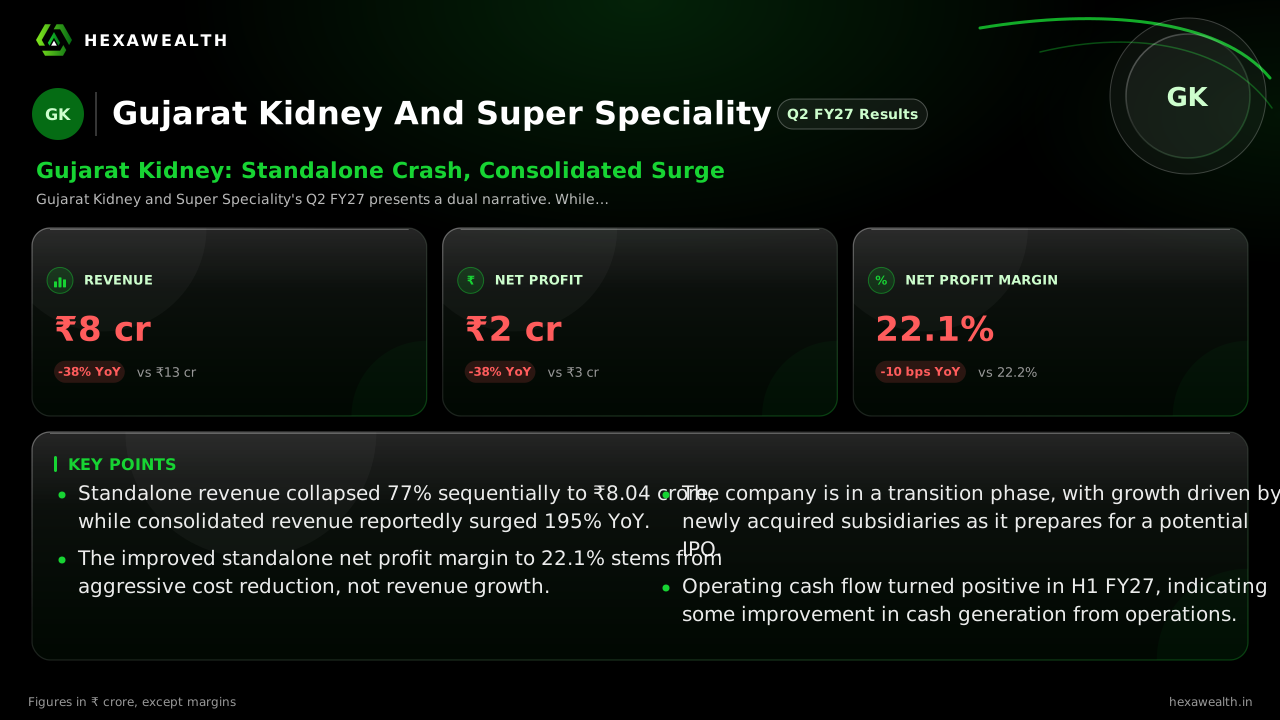
The standalone scorecard shows revenue fell to ₹8.04 crore, down 38% from a year ago and a steep 77% from the previous quarter. Profit followed, dropping 38% YoY to ₹1.78 crore. Yet, the net profit margin improved sharply to 22.1%, up 660 basis points sequentially, as costs fell even faster than revenue.
Revenue & profit
Revenue (₹ Cr)
Profit (₹ Cr)
Net Profit Margin (%)
| Metric | CurrentQ2 FY27 | PreviousQ1 FY27 | Same quarter LYQ2 FY26 |
|---|---|---|---|
| Revenue (₹ Cr) | 8.04YoY -38% | 34.29 | 12.93 |
| Profit (₹ Cr) | 1.78YoY -38% | 5.32 | 2.88 |
| Net Profit Margin (%) | 22.1YoY -0.5% | 15.5 | 22.2 |
The Two Faces of Growth
This standalone slump contrasts with the robust consolidated performance highlighted in investor materials. According to a report from univest.in, consolidated revenue for Q2 FY27 was ₹38.09 crore, a 195% jump year-on-year. Consolidated profit was reported at ₹6.60 crore, up 129%.
The gap points to a strategic shift. Research from scanx.trade notes that while standalone revenue contracted, consolidated revenue nearly tripled, indicating growth is now driven by subsidiary contributions. The parent company's core operations may be facing headwinds as capital is redirected.
Costs Follow the Revenue Trail
On a standalone basis, total expenses fell 77% quarter-on-quarter, mirroring the revenue decline. Employee costs dropped 38% year-on-year, likely reflecting adjustments from recent acquisitions or divestments. Other income surged 492% YoY to ₹0.52 crore, providing a cushion to the bottom line.
The improved margin this quarter is a function of this rapid cost-cutting, not operating leverage. It suggests the company is managing a smaller, perhaps transitioning, standalone operation with greater efficiency for now.
The Road Ahead and Market View
Management's focus appears firmly on the consolidated entity and future expansion. The company has filed a draft red herring prospectus for a potential IPO, as noted by stockfin.ai. Its investor presentation highlights an asset-light expansion model and plans for entry into Dubai healthcare.
Operational cash flow turned positive for the half-year ended September 2026, reports scanx.trade, a sign of improving efficiency. However, with the stock trading at a P/E of 51.5, a discount to the industry, the market seems to be weighing the execution risks of this inorganic growth strategy against the promising top-line numbers.
Key Points
- Standalone revenue collapsed 77% sequentially to ₹8.04 crore, while consolidated revenue reportedly surged 195% YoY.
- The improved standalone net profit margin to 22.1% stems from aggressive cost reduction, not revenue growth.
- The company is in a transition phase, with growth driven by newly acquired subsidiaries as it prepares for a potential IPO.
- Operating cash flow turned positive in H1 FY27, indicating some improvement in cash generation from operations.
Hexa Perspective
The quarter lays bare the tension between the old and the new Gujarat Kidney. The standalone business is shrinking, perhaps intentionally, as capital and focus shift to an acquisition-led model. The high consolidated growth numbers are compelling but come with integration risks and a reliance on continued deal-making.
Investors are presented with a bifurcated reality: a profitable but contracting legacy operation and a rapidly scaling but unproven consolidated entity. The sustainability of margins and the conversion of consolidated revenue into strong, consistent cash flows will be the true test of this strategy's success.
Also read
Want this applied to your portfolio?
Talk to a HexaWealth advisor, or sync your mutual fund data for insights tailored to your holdings.