Steel Exchange India (STEELXIND) Q2 FY27 Profit Surges 735% on Record Production
Record re-bar output and aggressive debt reduction drove a massive profit leap, though margin pressure emerged as costs rose.
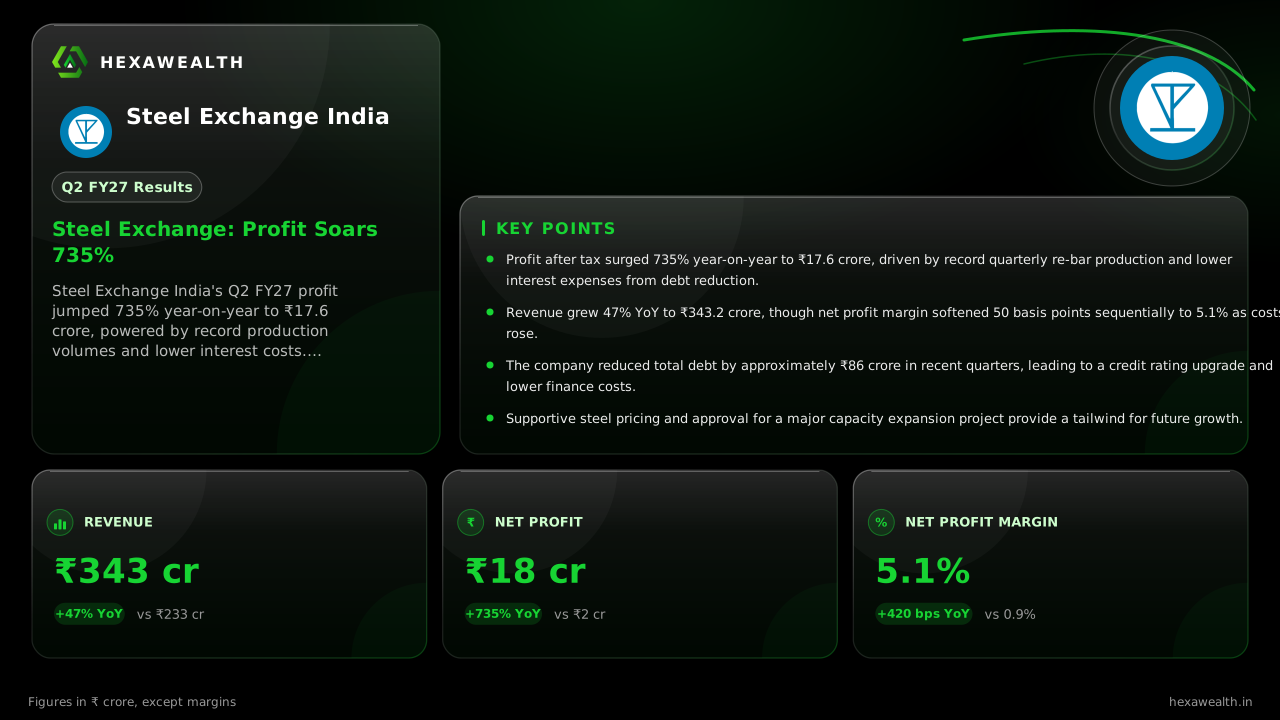
Steel Exchange India's Q2 FY27 profit jumped 735% year-on-year to ₹17.6 crore, powered by record production volumes and lower interest costs. Revenue grew 47% to ₹343 crore, but margins softened sequentially as costs rose.
For Steel Exchange India, the story this quarter is a powerful rebound from a weak base, driven by operational execution. Record-breaking production of its core TMT rebars and a sustained debt reduction effort delivered a staggering 735% leap in profit, even as the cost of that growth began to show.
The numbers tell a story of explosive growth from a low starting point. Revenue reached ₹343.2 crore, up 47% from a year ago and 27% from the previous quarter. Profit soared to ₹17.6 crore, though the net profit margin slipped 50 basis points sequentially to 5.1%.
Revenue & profit
Revenue (₹ Cr)
Profit (₹ Cr)
Net Profit Margin
| Metric | CurrentQ2 FY27 (Sep 2026) | PreviousQ1 FY27 (Jun 2026) |
|---|---|---|
| Revenue (₹ Cr) | 343.16 | 269.71 |
| Profit (₹ Cr) | 17.62 | 15.03 |
| Net Profit Margin | 5.1% | 5.6% |
The Engine: Record Volumes and Lower Interest
The profit surge was powered by two main levers. First, the company achieved its highest-ever quarterly re-bar production of 69,617 metric tonnes, as reported by Scanx.trade. This followed the commissioning of a new reheating furnace that boosted capacity.
Second, a disciplined deleveraging campaign cut finance costs. The company reduced total debt by approximately ₹86 crore in recent quarters, according to Sahi.com. This shrank the interest burden, amplifying the benefit of higher sales.
The Catch: Rising Costs and Margin Pressure
Despite the top-line boom, profitability per rupee of sales dipped from the prior quarter. The EBITDA margin contracted to 10%, down from 11% a year ago, notes Arthneeti.com. This suggests input or operating costs rose in step with, or faster than, the record revenue.
The company’s other income also fell over 80% sequentially, a one-off that contributed to the margin squeeze. The focus now is whether volume-led growth can outpace these cost pressures in a supportive pricing environment.
A Supportive Market and Ambitious Plans
The broader market is helping. Government data shows domestic TMT rebar prices in September 2026 were 26% higher than a year ago, supporting realizations. Steel Exchange is also positioning for the future, with plans to diversify into higher-margin specialty steels under the PLI scheme.
Its balance sheet is strengthening, evidenced by a two-notch credit rating upgrade to BBB+/Stable reported by Scanx.trade. A massive ₹5,194 crore expansion project, recently approved by the Andhra Pradesh government, points to a long-term capacity goal of 1 million tonnes per annum.
Key Points
- Profit after tax surged 735% year-on-year to ₹17.6 crore, driven by record quarterly re-bar production and lower interest expenses from debt reduction.
- Revenue grew 47% YoY to ₹343.2 crore, though net profit margin softened 50 basis points sequentially to 5.1% as costs rose.
- The company reduced total debt by approximately ₹86 crore in recent quarters, leading to a credit rating upgrade and lower finance costs.
- Supportive steel pricing and approval for a major capacity expansion project provide a tailwind for future growth.
Hexa Perspective
The quarter showcases a successful turnaround from operational inefficiency and high leverage. The profit jump is dramatic, but it comes from a very low base in Q2 FY26, a period of industry-wide margin pressure.
The sequential margin dip is a watchpoint. It indicates that the benefits of volume growth and lower interest are being partially offset by rising costs. The sustainability of this profit surge now hinges on the company's ability to manage input cost inflation while executing its ambitious expansion and specialty steel plans.
Also read
Want this applied to your portfolio?
Talk to a HexaWealth advisor, or sync your mutual fund data for insights tailored to your holdings.