TGIF Agribusiness Q2 FY27 Profit Rises on a Surge in Other Income
TGIF Agribusiness posted a 0.9% YoY profit rise in Q2 FY27, but revenue fell 8.7% as a jump in other income lifted margins.
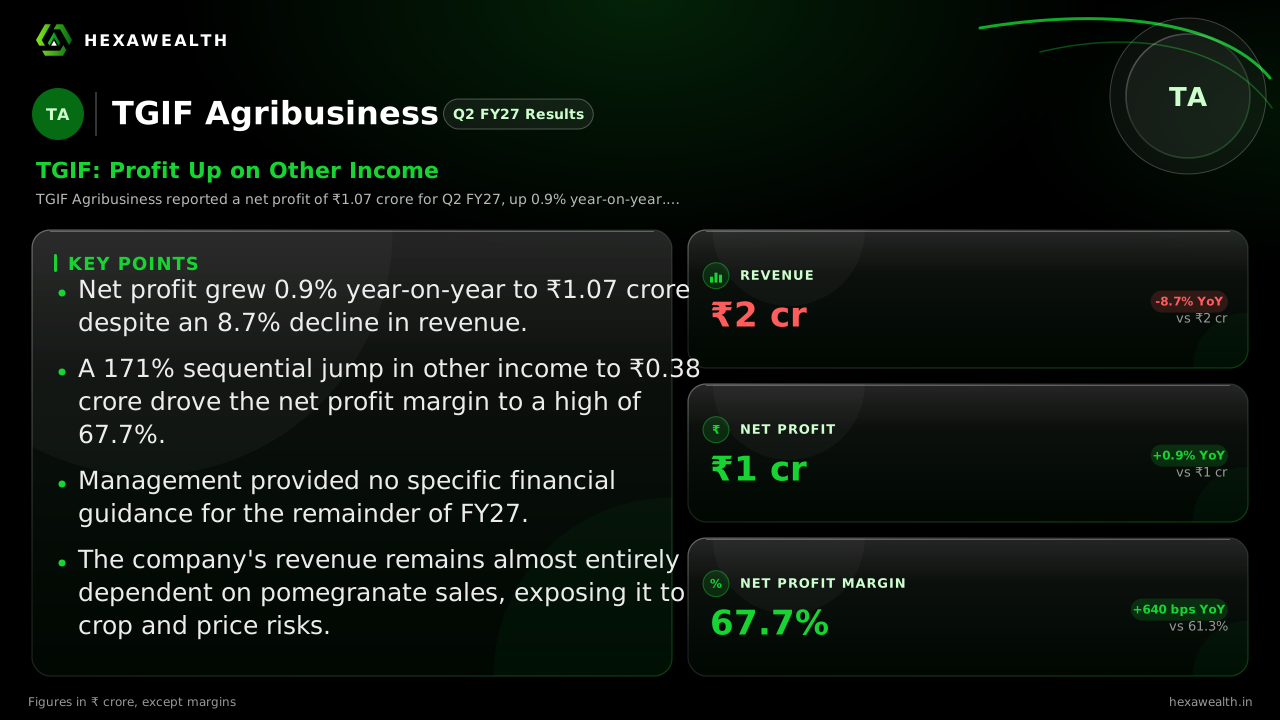
TGIF Agribusiness reported a net profit of ₹1.07 crore for Q2 FY27, up 0.9% year-on-year. Revenue, however, declined 8.7% to ₹1.58 crore, with a sharp rise in other income driving a 730 bps sequential margin expansion.
For a pomegranate grower like TGIF Agribusiness, the quarter's top line is a direct read on crop sales. The September quarter showed a revenue drop, but profit still inched up. The reason lies not in the fields, but in a line item that flattered the bottom line.
Revenue fell 8.7% from a year ago to ₹1.58 crore, while net profit edged up 0.9% to ₹1.07 crore. The net profit margin jumped to 67.7%, a 730 basis point improvement from the March quarter. A look at the last five quarters shows the tension between sales and profitability.
Revenue & profit
Revenue (₹ Cr)
Profit (₹ Cr)
Net Profit Margin
| Metric | CurrentQ2 FY27 | Same quarter LYQ2 FY26 |
|---|---|---|
| Revenue (₹ Cr) | 1.58YoY -8.7% | 1.73 |
| Profit (₹ Cr) | 1.07YoY +0.9% | 1.06 |
| Net Profit Margin | 67.7%YoY +10% | 61.3% |
The other income that lifted profit
The margin expansion was driven by a surge in other income, which ballooned to ₹0.38 crore from ₹0.14 crore in the prior quarter. This more than doubled the company's total income for the period, according to the analysis. With core revenue down, this non-operational boost was the primary driver of the higher profit and record margin.
A muted outlook from the farm
Management did not provide any forward-looking guidance, notes a StockFin.ai analysis. The company's annual report mentions plans to expand domestic presence and direct-to-home services, but concrete capital expenditure plans remain undisclosed. The business remains heavily concentrated, with pomegranates accounting for over 95% of revenue, as per a Newboard.in report.
The weather risk remains
The broader market environment adds a layer of risk. A FreshPlaza report details drought conditions affecting pomegranate quality and exports from key Indian growing regions. While TGIF operates in Rajasthan, such climatic stress highlights the vulnerability of a single-crop model to weather and pricing volatility.
Key Points
- Net profit grew 0.9% year-on-year to ₹1.07 crore despite an 8.7% decline in revenue.
- A 171% sequential jump in other income to ₹0.38 crore drove the net profit margin to a high of 67.7%.
- Management provided no specific financial guidance for the remainder of FY27.
- The company's revenue remains almost entirely dependent on pomegranate sales, exposing it to crop and price risks.
Hexa Perspective
The quarter tells a story of two diverging lines. Operational performance, as seen in falling revenue, was weak. The profit growth was entirely supported by a non-recurring surge in other income, making the elevated margin unsustainable. For the trend to hold, the company needs its core horticulture business to recover. That hinges on overcoming the industry-wide challenges of weather and pricing, for which no near-term catalyst is visible. The lack of a clear growth or capex strategy, as noted in research, leaves investors with a business in a holding pattern, reliant on occasional non-operational boosts.
Also read
Want this applied to your portfolio?
Talk to a HexaWealth advisor, or sync your mutual fund data for insights tailored to your holdings.