Sarla Performance Fibers (SARLAPOLY) Q2 FY27 Profit Dives 37% as Costs Bite into Revenue Gain
Sarla Performance Fibers' Q2 profit fell sharply despite higher sales, as elevated freight, raw material costs and a one-off flood loss squeezed margins.
Sarla Performance Fibers reported a 37% year-on-year drop in Q2 FY27 profit to ₹12 crore, even as revenue grew 5%. The decline was driven by a sharp fall in other income and rising operational costs, including a flood loss at its Silvassa unit.
For a yarn exporter, a quarter of modest sales growth is often enough. The real test is whether that top line can withstand the twin pressures of global logistics and volatile raw material costs. Sarla Performance Fibers' September quarter shows it could not, as profit fell sharply despite higher revenue.
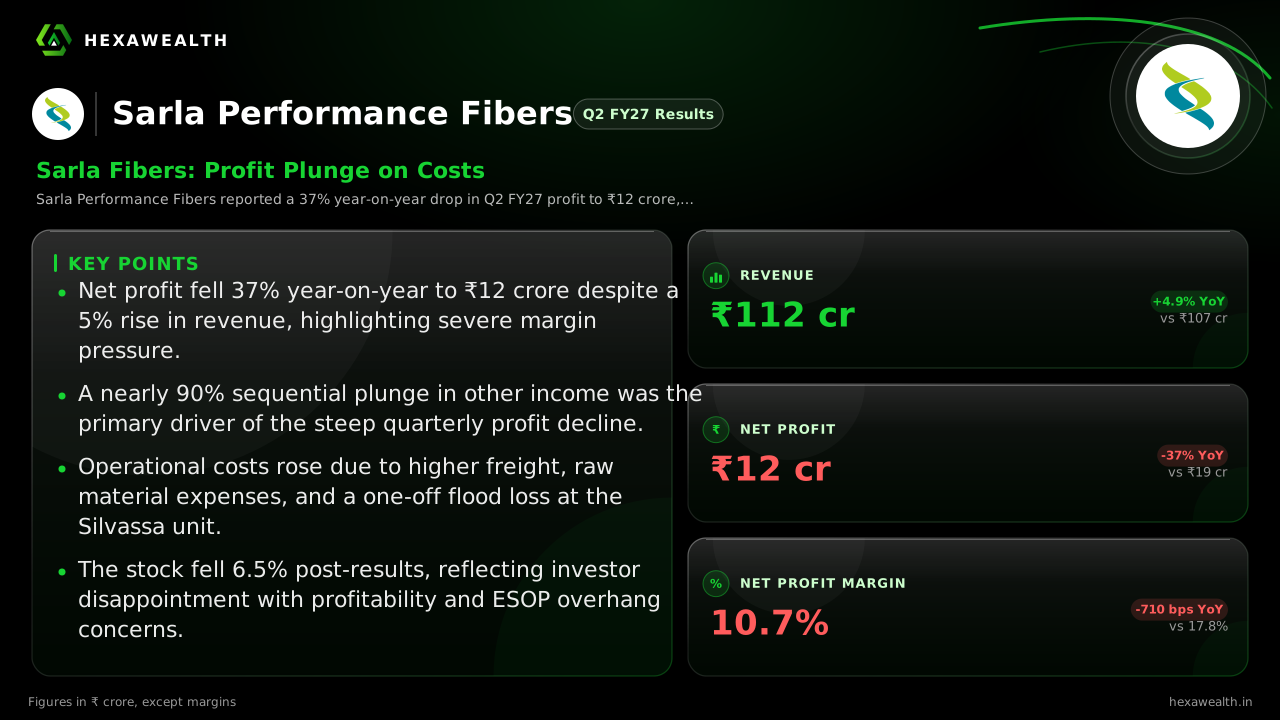
The numbers tell a story of divergence. Revenue from operations grew 4.9% year-on-year to ₹112.33 crore. Yet, net profit plunged 37% to ₹12 crore. The net profit margin contracted by 710 basis points to 10.7%.
Revenue & profit
Revenue (₹ Cr)
Profit (₹ Cr)
Net Profit Margin (%)
Metric
CurrentQ2 FY27 (Sep '26)
PreviousQ1 FY27 (Jun '26)
Revenue (₹ Cr)
112.33
113.26
Profit (₹ Cr)
12.0
37.28
Net Profit Margin (%)
10.7
32.9
The disappearing tailwind
The most dramatic shift was in other income, which collapsed 88% sequentially to ₹3.4 crore. Reports from Scanx.trade and Pokharna Research note this sharp drop from ₹27.84 crore in the June quarter drove the steep quarter-on-quarter profit decline of 68%. The prior quarter's profit was flattered by significant non-operating gains, making this quarter's core weakness more apparent.
At the same time, operating costs rose. Total expenses increased nearly 12% year-on-year. The board cited ongoing Middle East tensions for higher freight and raw material costs, according to Scanx.trade. A report from mCapital.in also mentions a one-off ₹2.31 crore flood loss at the company's Silvassa unit during the quarter.
A tough environment to navigate
The global backdrop offers little near-term relief. Industry reports from September 2026 describe a complex synthetic textile market. Polyester and nylon feedstock prices remain volatile, while peak-season shipping creates logistics pressure and delays.
For Sarla, this translated into a 44% year-on-year jump in interest expense, reflecting higher working capital needs. The company's debt-to-equity ratio stood at a moderate 0.37, but its interest cover is negative, indicating earnings are insufficient to service debt comfortably.
The market reaction was negative. According to Cruxal, Sarla's shares fell 6.5% following the results, weighed down by the softer profit and concerns over the new ESOP plan's potential dilution.
Key Points
Net profit fell 37% year-on-year to ₹12 crore despite a 5% rise in revenue, highlighting severe margin pressure.
A nearly 90% sequential plunge in other income was the primary driver of the steep quarterly profit decline.
Operational costs rose due to higher freight, raw material expenses, and a one-off flood loss at the Silvassa unit.
The stock fell 6.5% post-results, reflecting investor disappointment with profitability and ESOP overhang concerns.
“
Hexa Perspective
The quarter underscores Sarla's earnings sensitivity to non-operational income and external cost shocks. While the first half of FY27 still shows a strong profit rebound from FY26's full-year loss, sustainability is the question.
Profitability now hinges on the core yarn business absorbing persistent input cost inflation. With the global textile chain facing freight and feedstock volatility, margin recovery may be gradual unless the company can pass on costs or see a sustained drop in crude-linked raw material prices.
Talk to a HexaWealth advisor, or sync your mutual fund data for insights tailored to your holdings.
Frequently asked questions
What were Sarla Performance Fibers' Q2 FY27 results?
Sarla Performance Fibers reported a standalone net profit of ₹12 crore for Q2 FY27 (July-September 2026), a 37% drop from the same quarter last year. Revenue from operations grew 4.9% year-on-year to ₹112.33 crore, but margins were squeezed by higher costs.
Why did Sarla Performance Fibers' Q2 FY27 profit fall despite higher sales?
Sarla's Q2 FY27 profit fell 37% year-on-year primarily due to a sharp 88% quarter-on-quarter drop in other income, as reported by Scanx.trade. Simultaneously, operational costs rose due to higher freight, raw material expenses, and a one-off flood loss at its Silvassa unit.
What caused the sharp quarter-on-quarter drop in Sarla's net profit margin in Q2 FY27?
The net profit margin fell 22.2 percentage points sequentially in Q2 FY27 mainly because other income plummeted from ₹27.84 crore in Q1 to ₹3.40 crore. This decline, noted by Scanx.trade, drastically reduced total income and profit, despite relatively stable revenue.
Why did Sarla Performance Fibers' interest expense rise 44% year-on-year in Q2 FY27?
Sarla's interest expense rose 44% year-on-year to ₹3.02 crore in Q2 FY27, reflecting higher working capital requirements. This increase likely stems from the need to fund operations amid rising input costs and a longer cash cycle in a tight cost environment.
Was Sarla's Q2 profit driven by a specific product segment?
The core yarn segment drove revenue, contributing ₹109.84 crore according to Arthneeti.com. However, profit was not segment-specific; the decline was due to company-wide factors like lower other income and higher costs affecting overall profitability.
What is Sarla Performance Fibers' debt and working capital status?
As of the latest data, Sarla had a debt-to-equity ratio of 0.37. However, its interest cover is negative, indicating operating profit is insufficient to cover interest costs. SectorAlpha.in notes the company's cash cycle was 188 days in FY26, tying up significant working capital.
Did Sarla's management provide any guidance for future quarters?
No specific forward guidance was provided in the results statement. Arthneeti.com notes the company did not publish an earnings-call transcript for this quarter, so the reported figures do not include formal management commentary or projections.
What are the key input cost pressures facing Sarla Performance Fibers?
The key pressures are higher costs for crude oil-derived raw materials like PTA and MEG, used in polyester yarn, and elevated freight costs. The board cited ongoing geopolitical tensions in the Middle East as a contributor to these increased costs during the quarter.
How did Sarla's stock price react to the Q2 FY27 results?
According to Cruxal, Sarla Performance Fibers' shares fell 6.5% following the Q2 FY27 results announcement. The decline was attributed to softer-than-expected profit, cost headwinds, and concerns over the new Employee Stock Option Plan.
Sarla Performance Fibers Q2 profit drop
Sarla Performance Fibers' Q2 FY27 (July-September 2026) profit dropped 37% year-on-year to ₹12 crore. The decline was driven by a massive sequential fall in other income and increased operational costs, including freight, raw materials, and a one-off flood loss.
Sarla Performance Fibers September quarter profit
Sarla Performance Fibers reported a standalone net profit of ₹12 crore for the September 2026 quarter (Q2 FY27). This represents a 37% decrease compared to the profit of ₹19.04 crore in the same quarter a year earlier.
Why did Sarla Performance Fibers profits plunge despite higher sales?
Sarla's profits plunged 37% in Q2 FY27 despite a 5% sales increase because other income fell sharply and operational costs rose. Reports attribute this to an 88% drop in other income from the previous quarter and higher freight, raw material costs, and a flood loss.