GP Eco Solutions (GPECO) Q2 FY27 Profit Doubles as Manufacturing Scales, But Costs and Debt Rise
GP Eco's Q2 profit jumped 115% year-on-year as its own manufacturing business grew, but rising interest and employee costs squeezed margins sequentially.
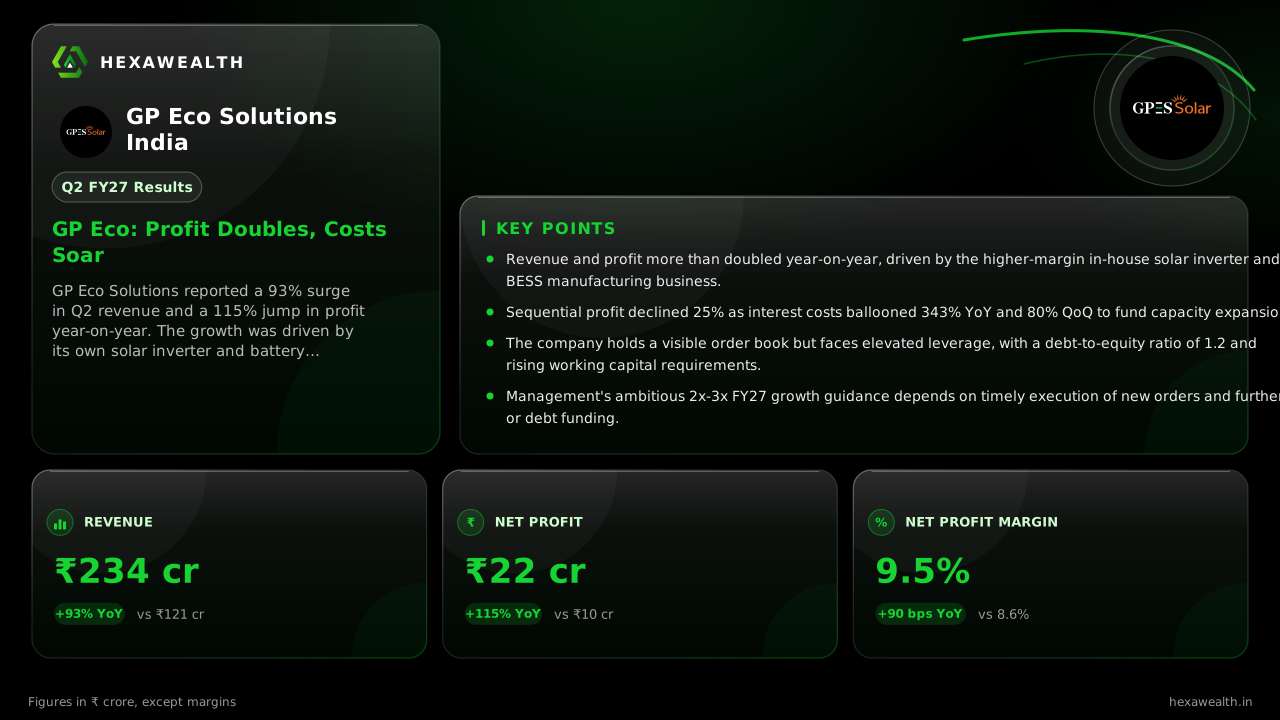
GP Eco Solutions reported a 93% surge in Q2 revenue and a 115% jump in profit year-on-year. The growth was driven by its own solar inverter and battery storage manufacturing, though higher financing and operational costs led to a sequential decline.
For GP Eco Solutions, the September quarter was about proving its shift from a distributor to a manufacturer could deliver. The year-on-year numbers show it did, but the cost of that transition is now hitting the income statement.
The company's revenue nearly doubled to ₹234.4 crore, while net profit more than doubled to ₹22.3 crore compared to last year. Sequentially, however, both top and bottom lines softened from the March quarter peak, with profit down 25%.
Revenue & profit
Revenue (₹ Cr)
Net Profit (₹ Cr)
| Metric | CurrentQ2 FY27 (Sep 2026) | PreviousQ4 FY26 (Mar 2026) |
|---|---|---|
| Revenue (₹ Cr) | 234.4 | 292.9 |
| Net Profit (₹ Cr) | 22.3 | 29.7 |
| PAT Margin | 9.5% | 10.1% |
The shift to higher-margin work
Growth was powered by its own manufacturing segments. According to Arthneeti.com, revenue from the Solar Inverter & Battery Energy Storage System (BESS) segment nearly tripled year-on-year to over ₹91 crore. The company is moving away from low-margin distribution, a shift that SectorAlpha notes is lifting blended profitability.
Where the profit gain was spent
This expansion is capital-intensive. Interest expense surged 343% from a year ago and 80% from the prior quarter, reaching ₹9.1 crore. Arthneeti.com reports this followed a sharp rise in both long and short-term borrowings to fund its new Dasna factory. Employee costs also jumped 43% sequentially as the company scaled operations.
These costs explain the sequential margin dip. The net profit margin, while up 90 basis points year-on-year, fell 60 points from the March quarter.
The heavy lift ahead
Management, in a June call noted by SectorAlpha, guided for FY27 revenue and profit to grow two to three times. Achieving this hinges on converting a strong project pipeline. The company has announced orders worth over ₹130 crore in recent months, including a ₹76.85 crore EPC contract.
Yet, the balance sheet is under strain. The debt-to-equity ratio stands at 1.2, and working capital days remain extended. The company raised equity via warrants in July and September to partly fund its over ₹150 crore FY27 capital expenditure plan.
Key Points
- Revenue and profit more than doubled year-on-year, driven by the higher-margin in-house solar inverter and BESS manufacturing business.
- Sequential profit declined 25% as interest costs ballooned 343% YoY and 80% QoQ to fund capacity expansion.
- The company holds a visible order book but faces elevated leverage, with a debt-to-equity ratio of 1.2 and rising working capital requirements.
- Management's ambitious 2x-3x FY27 growth guidance depends on timely execution of new orders and further equity or debt funding.
Hexa Perspective
The quarter confirms GP Eco's strategic pivot is gaining commercial traction. The problem is that the capital needed to build this business is arriving faster than the profit from it.
Investors are weighing a 115% profit jump against a 74% discount to the industry PE. The valuation gap reflects the execution and funding risks ahead. The next few quarters will test whether operating leverage from the new factory can outrun the rising cost of capital.
Also read
Want this applied to your portfolio?
Talk to a HexaWealth advisor, or sync your mutual fund data for insights tailored to your holdings.