Pearl Global (PGIL) Q2 FY27 Profit Doubles as Global Diversification Pays Off
Pearl Global Industries posted its strongest-ever quarterly performance, with profit surging 75% on a 37% revenue jump, driven by strategic geographic diversification.
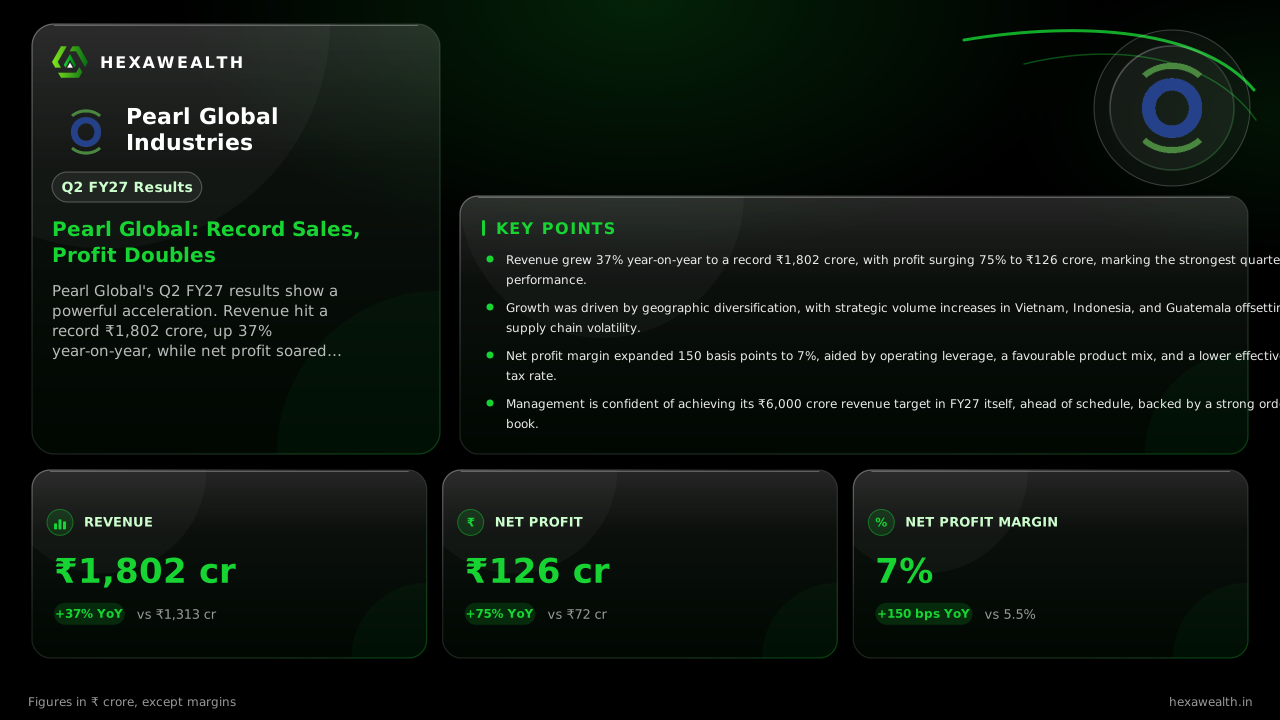
Pearl Global's Q2 FY27 results show a powerful acceleration. Revenue hit a record ₹1,802 crore, up 37% year-on-year, while net profit soared 75% to ₹126 crore as margins expanded to 7%.
For global apparel manufacturers, resilience is built on a map. Pearl Global Industries’ latest quarter shows why, as its multi-country production footprint turned geopolitical and supply chain volatility into a record growth story.
Revenue rose 37% year-on-year to ₹1,802 crore, while profit jumped 75% to ₹126 crore. The net profit margin expanded to 7%, up 150 basis points from a year ago. This marks the third consecutive quarter of accelerating growth.
Revenue & profit
Revenue (₹ Cr)
Profit (₹ Cr)
Net Profit Margin
Metric
CurrentQ2 FY27
PreviousQ1 FY27
Same quarter LYQ2 FY26
Revenue (₹ Cr)
1,801.53YoY +37%
1,528.26
1,312.93
Profit (₹ Cr)
125.76YoY +75%
99.23
71.97
Net Profit Margin
7.0%YoY +27%
6.5%
5.5%
Why the Engine Revved Higher
The surge was powered by strategic volume growth in Southeast Asia and Central America, according to Brands-To-Retail. Higher utilisation in Vietnam, Indonesia, and Guatemala absorbed cost pressures and offset volatility in traditional hubs. Shipments for the first half rose to 43.6 million pieces from 37.1 million a year earlier.
Management, on the earnings call, highlighted a rebound from a conservative sourcing year. The India-UK Free Trade Agreement is also driving elevated interest from UK-based customers. This geographic fungibility is a key advantage, with the company able to serve clients from both India and Bangladesh.
The Margin Lever at Work
Profit growth far outpaced sales, pointing to operating leverage. The adjusted EBITDA margin, excluding ESOP costs, rose 90 basis points year-on-year to 10.2%, reports indiantelevision.com. A shift toward higher-value product categories and optimized factory efficiency contributed.
A lower effective tax rate also helped. The group CFO noted on the call that the blended tax rate is around 15%, as profits are concentrated in favourable geographies. This supported the 75% leap in net profit.
The Cash Trade-Off and the Road Ahead
Strong growth temporarily strained working capital. Receivable days increased to 50 as of September from 30 in March, due to year-end festive shipments and deferred factoring, management explained. They expect normalization in the coming quarters.
The outlook is confident. Management now expects to hit its ₹6,000 crore revenue target—previously set for FY28—within this financial year itself. A planned ₹675-725 crore investment through FY30 will fund capacity expansion and backward integration.
Key Points
Revenue grew 37% year-on-year to a record ₹1,802 crore, with profit surging 75% to ₹126 crore, marking the strongest quarterly performance.
Growth was driven by geographic diversification, with strategic volume increases in Vietnam, Indonesia, and Guatemala offsetting supply chain volatility.
Net profit margin expanded 150 basis points to 7%, aided by operating leverage, a favourable product mix, and a lower effective tax rate.
Management is confident of achieving its ₹6,000 crore revenue target in FY27 itself, ahead of schedule, backed by a strong order book.
“
Hexa Perspective
The quarter demonstrates the payoff from Pearl Global’s multi-year investment in a diversified manufacturing map. The model is delivering both growth and margin expansion as capacity utilisation rises.
The catch is working capital, which absorbed cash as receivables stretched. The promise of normalization in H2 is crucial for free cash flow. The guidance upgrade to ₹6,000 crore for FY27 sets a high bar, implying the current momentum must hold through the second half.
Talk to a HexaWealth advisor, or sync your mutual fund data for insights tailored to your holdings.
Frequently asked questions
What were Pearl Global Industries' Q2 FY27 results?
For Q2 FY27 (quarter ended September 2026), Pearl Global reported consolidated revenue of ₹1,801.53 crore, a 37.2% year-on-year increase. Net profit surged 74.7% to ₹125.76 crore. The net profit margin expanded to 7.0%, up from 5.5% in the same quarter last year.
Why did Pearl Global's profit grow faster than revenue in Q2 FY27?
Pearl Global's 75% profit growth outpaced its 37% revenue rise due to significant margin expansion. According to Brands-To-Retail, this was driven by operational leverage, higher utilisation in low-cost hubs, and a shift toward higher-value product categories. A lower effective tax rate also boosted net profit.
What drove Pearl Global's 37% revenue growth in Q2 FY27?
The revenue jump was driven by strategic geographic diversification and volume growth. Brands-To-Retail reported growth in Southeast Asia and Central America offset volatility in traditional hubs. The company shipped 43.6 million pieces in H1 FY27, up from 37.1 million a year earlier.
What is Pearl Global's revenue guidance for FY27?
Management, on the Q2 earnings call, stated they are confident of reaching their ₹6,000 crore revenue target within FY27 itself. This target was previously set for FY28. The upgrade is based on a strong order book and execution momentum.
How did Pearl Global's margins improve in Q2 FY27?
Pearl Global's net profit margin improved 150 basis points year-on-year to 7.0%. According to indiantelevision.com, the adjusted EBITDA margin rose 90 bps to 10.2%. This expansion was due to operational leverage, better factory efficiency, and a favourable product mix.
What is Pearl Global's capacity expansion plan?
Pearl Global plans to invest ₹675-725 crore between FY27 and FY30, as reported by indiantelevision.com. This will fund capacity expansion and backward integration projects. A new facility in Bangladesh, inaugurated in H1, adds about 7 million pieces of annual capacity.
How did Pearl Global's working capital change in Q2 FY27?
Working capital days increased to 56 days as of September 2026 from 43 days in March, according to the earnings call. This was mainly due to an increase in receivable days to 50 from 30, caused by festive season shipments and deferred factoring. Management expects normalization in Q3 and Q4.
What was Pearl Global's tax rate in Q2 FY27?
The Group CFO stated on the earnings call that the company's blended effective tax rate is around 15%. This favourable rate, due to profit concentration in specific geographies, helped net profit grow faster than pre-tax profit in the quarter.
Did Pearl Global's Q2 FY27 results beat analyst estimates?
While specific consensus estimates are not provided in the research, the company reported record quarterly revenue and profit, with growth rates significantly ahead of its long-term guidance. The results were described as its 'strongest-ever quarterly performance' by indiantelevision.com.
Pearl Global Q2 revenue jumps 37 per cent to record Rs 1,802 crore
Yes, for Q2 FY27, Pearl Global's consolidated revenue jumped 37.2% year-on-year to a record ₹1,802 crore, as reported by indiantelevision.com. Profit after tax surged 74.7% to a record ₹126 crore in the same quarter.
Pearl Global Industries Limited Q2 2027 Earnings Call Transcript
The Q2 FY27 earnings call transcript highlights record revenue of ₹1,802 crore and profit of ₹126 crore. Management discussed growth drivers like geographic diversification, the India-UK FTA benefit, a strong order book, and a capex plan of ₹675-725 crore through FY30.
Pearl Global standalone PAT fell 30% despite H1 revenue gain
This refers to the standalone (India-only) entity performance in H1 FY27, which differs from the strong consolidated results. Consolidated performance, which includes all global subsidiaries, saw PAT jump 63.6% in H1 FY27.
Pearl Global’s operating cash flow falls to Rs 5 crore in H1FY27
In H1 FY27, Pearl Global's net cash from operations fell to ₹5 crore from ₹273 crore a year earlier, as reported by multibagg.ai. This was due to a working capital outflow of ₹360 crore, mainly from an increase in receivable days.