PCS Technology Q2 FY27 Profit Slips 12% as Core Business Remains Muted
The IT infrastructure firm posted a sequential drop in profit despite flat revenue, highlighting its continued reliance on investment income over core operations.
PCS Technology's Q2 FY27 profit fell 12% from the previous quarter, even as revenue was flat. The results underscore a structural dependency on other income, which made up the bulk of its top line.
For PCS Technology, a provider of IT infrastructure management, the September quarter told a familiar story of two distinct businesses. One, the core operations, remained quiet. The other, its investment portfolio, delivered the profit.
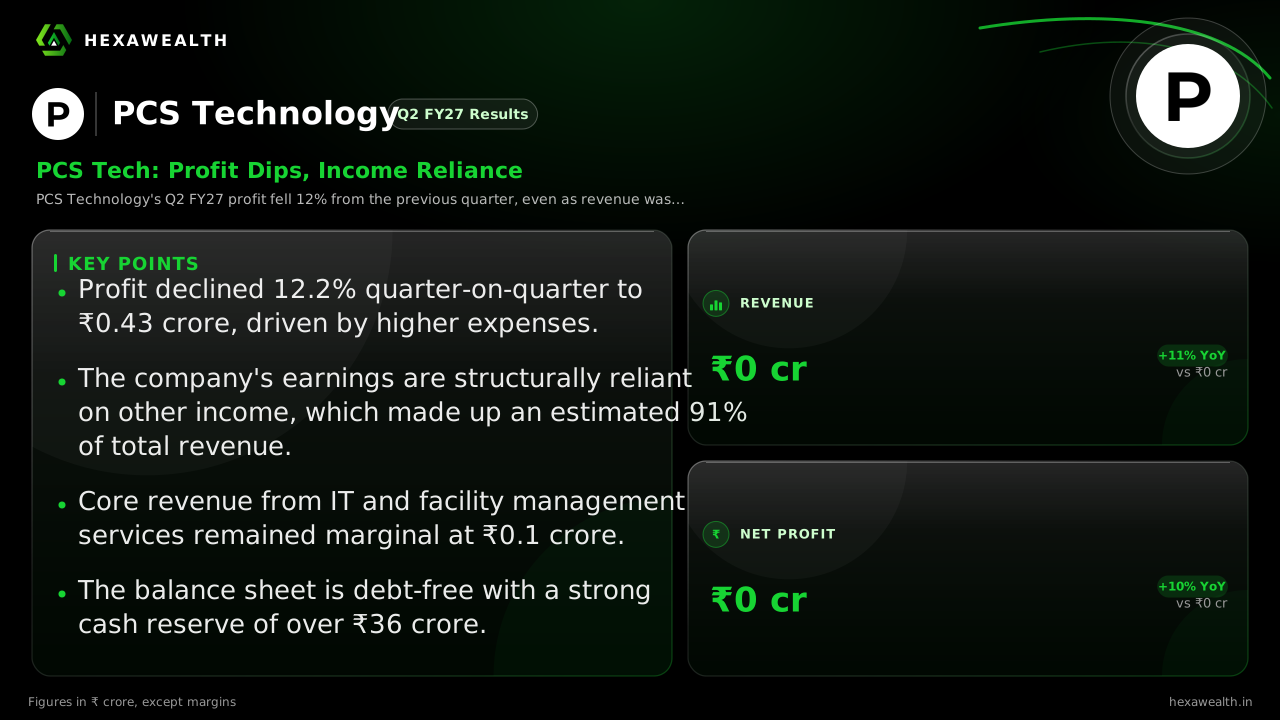
The numbers show a stable top line but a weaker bottom line. Revenue was flat sequentially at ₹0.1 crore, while net profit fell 12.2% to ₹0.43 crore. Year-on-year, profit grew 10.3%.
Revenue & profit
Revenue (₹ Cr)
Profit (₹ Cr)
| Metric | CurrentQ2 FY27 (Sep 2026) | PreviousQ1 FY27 (Jun 2026) |
|---|---|---|
| Revenue (₹ Cr) | 0.1 | 0.1 |
| Profit (₹ Cr) | 0.43 | 0.49 |
The Engine Is Elsewhere
The profit drop stemmed from a 7.4% sequential rise in total expenses. More importantly, the profit itself was largely generated by non-operational sources. According to a scanx.trade report, other income constituted roughly 91% of total revenue for the quarter.
This highlights a structural dependency on investment returns rather than its core facility management services. The report notes that revenue from IT-enabled services was "much lower," causing other income to dominate.
A Quiet Core in a Noisy Market
This reliance comes as India's IT services and managed infrastructure market is projected for strong growth. NASSCOM forecasts the domestic tech sector to reach $315 billion in FY26. For a player like PCS, the gap between market potential and its own operational scale is stark.
Management did not provide specific forward guidance in the results announcement. The company's cash position remains robust at over ₹36 crore, with no long-term debt, as per scanx.trade.
Key Points
- Profit declined 12.2% quarter-on-quarter to ₹0.43 crore, driven by higher expenses.
- The company's earnings are structurally reliant on other income, which made up an estimated 91% of total revenue.
- Core revenue from IT and facility management services remained marginal at ₹0.1 crore.
- The balance sheet is debt-free with a strong cash reserve of over ₹36 crore.
Hexa Perspective
The quarter confirms that PCS Technology operates more as an investment vehicle with a small operating subsidiary. Profitability is secure for as long as its investment income stream holds, but this offers limited visibility on growth.
The 39% premium to the industry P/E ratio seems to price in a business transition that the financials have yet to demonstrate. For the narrative to change, investors need to see a material shift in the revenue mix toward its core IT services.
Also read
Want this applied to your portfolio?
Talk to a HexaWealth advisor, or sync your mutual fund data for insights tailored to your holdings.