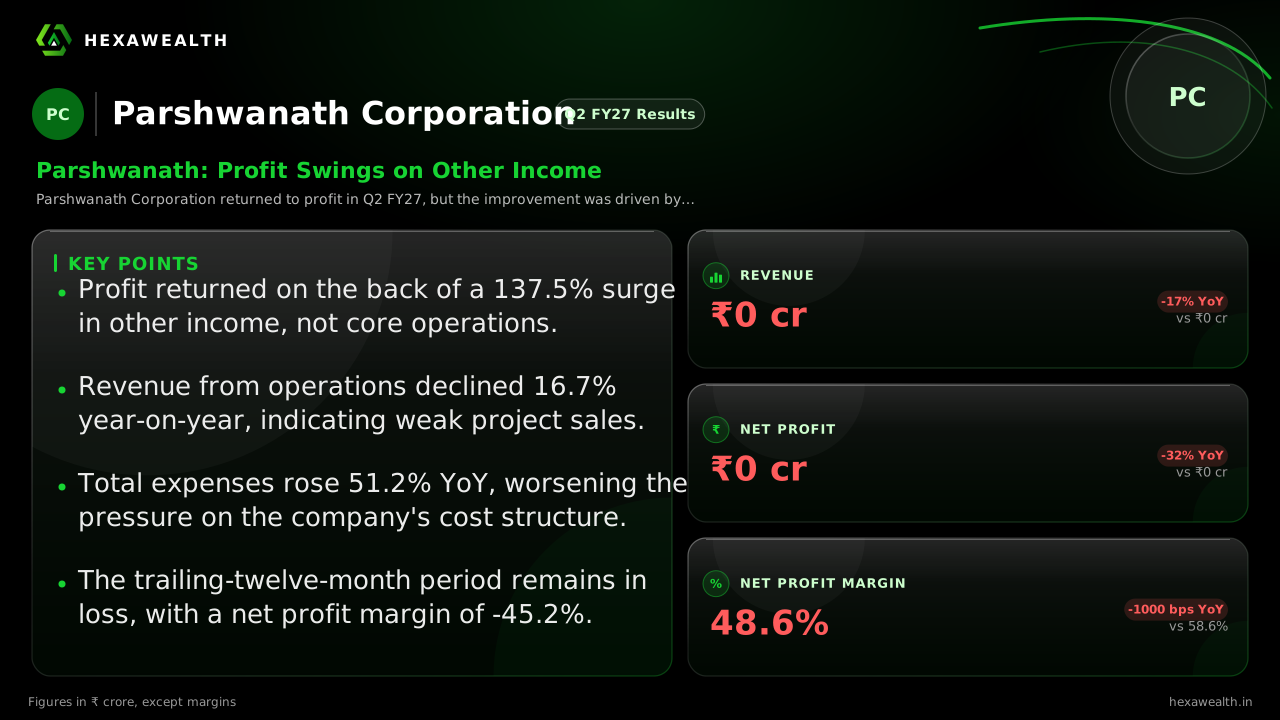
Parshwanath (PARSHWANA) Q2 FY27 Profit Returns on a Surge in Other Income
Parshwanath Corporation swung to a Q2 profit of ₹0.17 crore, but a 16.7% drop in core revenue and a sharp rise in expenses highlight an uneven recovery.
Parshwanath Corporation returned to profit in Q2 FY27, but the improvement was driven by a 137.5% surge in other income. Core revenue from operations fell year-on-year as total expenses climbed over 50%.
For a real estate developer, a return to profit should signal project sales and construction progress. Parshwanath Corporation's September quarter tells a different story, where the bottom line improved on income not from its core business.
The company reported a net profit of ₹0.17 crore for Q2 FY27, a swing from a loss in the prior quarter. Yet revenue from operations fell 16.7% year-on-year to ₹0.35 crore. Total expenses surged 51.2% over the same period, squeezing the core business further.
Revenue & profit
Revenue (₹ Cr)
Profit (₹ Cr)
Net Profit Margin (%)
| Metric | CurrentQ2 FY27 | PreviousQ1 FY27 | Same quarter LYQ2 FY26 |
|---|---|---|---|
| Revenue (₹ Cr) | 0.35YoY -17% | 0.18 | 0.42 |
| Profit (₹ Cr) | 0.17YoY -32% | -0.02 | 0.25 |
| Net Profit Margin (%) | 48.6YoY -17% | -10.4 | 58.6 |
What powered the profit swing?
The profit recovery was almost entirely fueled by other income, which jumped 137.5% year-on-year to ₹0.19 crore. This line item, which can include interest or one-time gains, contributed more than half of the quarter's total income. Without it, the company's operational performance would have remained under severe pressure.
The core business remains under strain
While other income soared, the company's main real estate activity struggled. The 16.7% drop in revenue suggests limited project sales or handovers. At the same time, total expenses grew more than half, a trend that, according to TradingView data, has been building in recent quarters.
This paints a picture of a business generating minimal revenue while its cost base expands, a challenging combination for sustainability. The net profit margin, while high at 48.6%, is a function of the other income boost rather than operational efficiency.
A muted market backdrop
The broader residential market showed mixed signals. A report by The Economic Times citing ANAROCK Research noted home sales across top cities rose 3% year-on-year in Q3 2026, but unsold inventory climbed 12%. This environment of rising supply and selective demand creates headwinds for smaller developers like Parshwanath.
Key Points
- Profit returned on the back of a 137.5% surge in other income, not core operations.
- Revenue from operations declined 16.7% year-on-year, indicating weak project sales.
- Total expenses rose 51.2% YoY, worsening the pressure on the company's cost structure.
- The trailing-twelve-month period remains in loss, with a net profit margin of -45.2%.
Hexa Perspective
The quarter reveals a business surviving on non-operational income while its core engine sputters. The return to profit is a technical improvement, but the underlying trend—falling revenue and rising costs—remains a concern. For the recovery to be meaningful, Parshwanath needs to demonstrate revenue growth from project completions or new sales. Until then, the company's financial health hinges on the sustainability of its other income streams, which are typically volatile and not a reliable foundation for a real estate firm.
Also read
Want this applied to your portfolio?
Talk to a HexaWealth advisor, or sync your mutual fund data for insights tailored to your holdings.