Gujarat Inject (GUJINJEC) Q2 FY27 Profit Soars 942% YoY as Solar Shift Takes Hold
The company's renewable energy pivot drove a massive year-on-year jump, though revenue fell sequentially from a strong Q1.
Gujarat Inject (Kerala) posted a 268% YoY revenue surge to ₹5.82 crore in Q2 FY27, with profit up 942% to ₹0.73 crore. The growth stems from its solar module trading business, though revenue dipped over 53% from the previous quarter.
Gujarat Inject (Kerala) is living its renewable energy transition. The September quarter shows the stark contrast between its new solar-powered reality and its quiet pharmaceutical past, with revenue and profit leaping from a tiny base.
The numbers tell a story of transformation. Revenue hit ₹5.82 crore, up 268% from a year ago. Profit surged 942% to ₹0.73 crore. Yet the quarter also saw a sequential slowdown, with revenue down 53% from a bumper Q1.
Revenue & profit
Revenue (₹ Cr)
Profit (₹ Cr)
Net Profit Margin %
| Metric | CurrentQ2 FY27 | PreviousQ1 FY27 | Same quarter LYQ2 FY26 |
|---|---|---|---|
| Revenue (₹ Cr) | 5.82YoY +268% | 12.46 | 1.58 |
| Profit (₹ Cr) | 0.73YoY +943% | 1.25 | 0.07 |
| Net Profit Margin % | 12.5YoY +191% | 10.1 | 4.3 |
Why the YoY surge is solar-driven
The explosive growth is almost entirely from solar module trading. According to Alfafinder, the company secured multiple orders this year, including a ₹6.25 crore deal from Deon Energy due in October. This pivot has redefined its top line, moving it far beyond its traditional pharmaceutical commissions.
The quarter-on-quarter dip and margin silver lining
Revenue fell sharply from Q1’s ₹12.46 crore. Business Standard noted that Q1 revenue had already moderated from an exceptionally strong Q4. The solar business appears lumpy, dependent on the timing of large order deliveries.
Profitability, however, improved. The net profit margin expanded 240 basis points sequentially to 12.5%, as per Flash Finance data. Better cost control as revenue scaled from a low base helped protect the bottom line despite the top-line drop.
A business built on timing and policy
The outlook hinges on order execution and a complex solar market. The company has orders scheduled for delivery, which should support near-term revenue. However, the broader industry faces headwinds.
Wood Mackenzie research, cited by Business Standard, forecasts a 20% rise in Indian solar system prices by Q4 2026 due to domestic cell supply constraints. New US anti-dumping duties add another layer of uncertainty for exporters. Gujarat Inject’s trading model must navigate these shifting costs and policy risks.
The financial foundation remains thin
Operating at a larger scale tests the balance sheet. The company’s current ratio is 0.47, indicating tight working capital. Multibagg.ai reported cash dwindled to ₹4.80 lakh by September end from ₹67.82 lakh in March.
To fund growth, the board approved a ₹3 crore preferential warrant issue, as noted by Stockwatch. The company is also leasing new premises in Ahmedabad for factory and R&D, signaling a commitment to its renewable energy focus.
Key Points
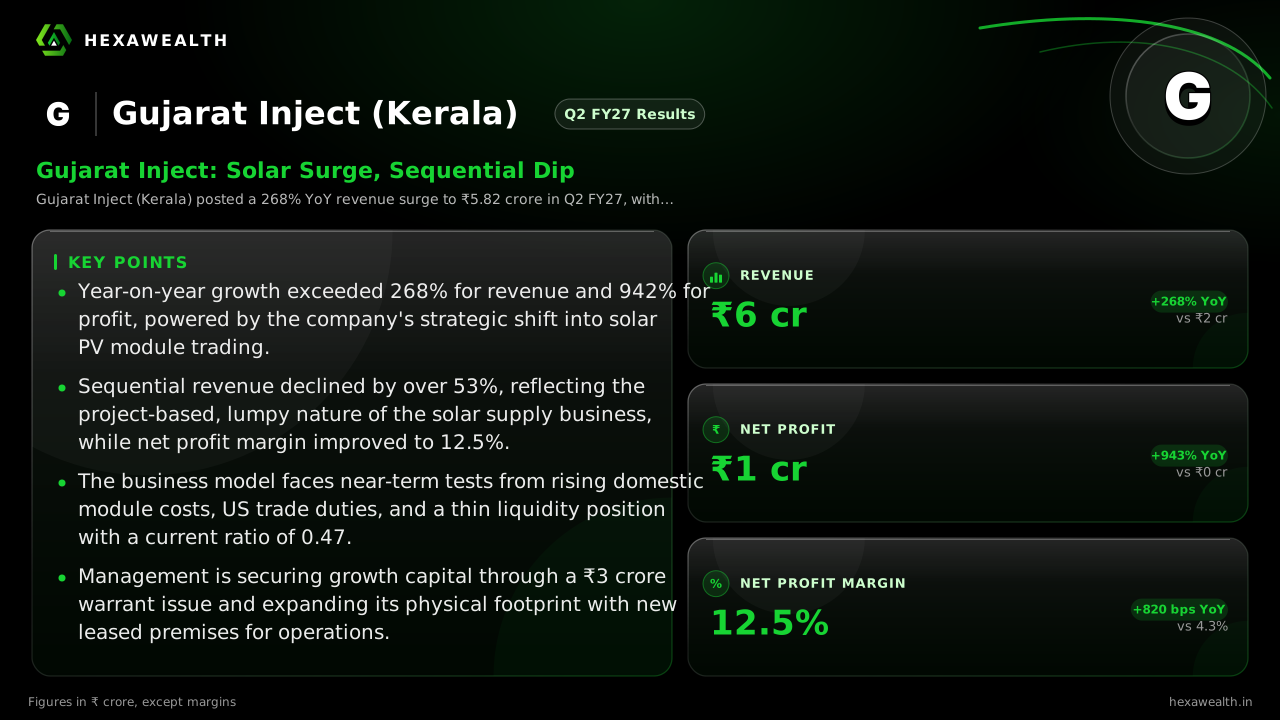
- Year-on-year growth exceeded 268% for revenue and 942% for profit, powered by the company's strategic shift into solar PV module trading.
- Sequential revenue declined by over 53%, reflecting the project-based, lumpy nature of the solar supply business, while net profit margin improved to 12.5%.
- The business model faces near-term tests from rising domestic module costs, US trade duties, and a thin liquidity position with a current ratio of 0.47.
- Management is securing growth capital through a ₹3 crore warrant issue and expanding its physical footprint with new leased premises for operations.
Hexa Perspective
The quarter confirms the solar transition is real and can be profitable at this scale. The 12.5% net margin shows the trading model can work when orders are executed efficiently. Yet, the volatility from Q1 to Q2 underscores a fundamental dependency on the timing of a few large contracts.
Investors are weighing a high-growth narrative against real execution risks. The stock's 60% decline over the past year, alongside zero institutional ownership per Anand Rathi data, reflects deep skepticism. The next few quarters will show if order flow can become consistent enough to build a sustainable business, or if this remains a story of sporadic spikes.
Also read
Want this applied to your portfolio?
Talk to a HexaWealth advisor, or sync your mutual fund data for insights tailored to your holdings.