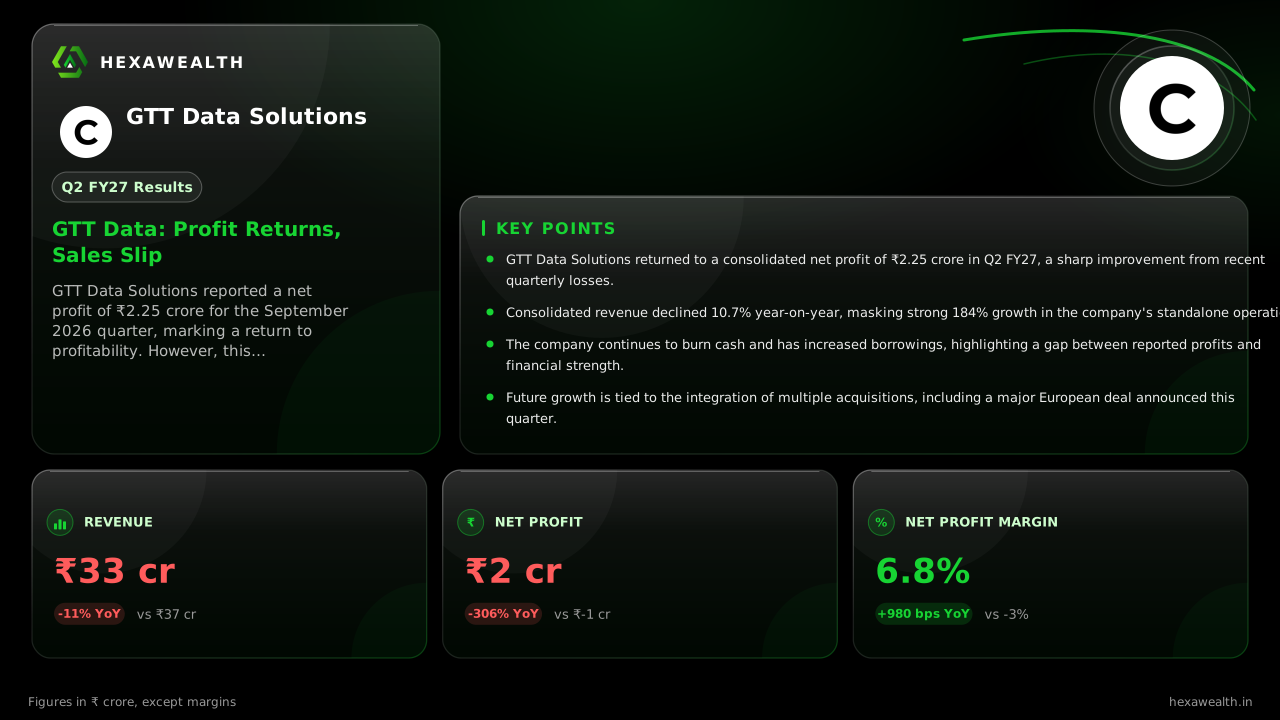
GTT Data Solutions reported a net profit of ₹2.25 crore for the September 2026 quarter, marking a return to profitability. However, this improvement came alongside an 11% year-on-year decline in consolidated revenue, highlighting a complex quarter.
For GTT Data Solutions, a company built through acquisitions in the fast-growing data analytics space, the September quarter delivered a bottom-line win but a top-line puzzle. The firm swung to a net profit of ₹2.25 crore, yet its consolidated revenue fell 11% from a year ago.
The numbers show a business in transition. Revenue dipped slightly from the June quarter to ₹32.85 crore. The profit swing from a ₹3.05 crore loss last quarter was dramatic, pushing the net profit margin to 6.8%.
Revenue & profit
Revenue (₹ Cr)
Profit (₹ Cr)
Net Profit Margin
Metric
CurrentQ2 FY27 (Sep 2026)
PreviousQ1 FY27 (Jun 2026)
Revenue (₹ Cr)
32.85
33.04
Profit (₹ Cr)
2.25
-3.05
Net Profit Margin
6.8%
-9.2%
A Turnaround Built on Two Tracks
The profit recovery stems from two diverging stories. According to a report from ScanX, the company's standalone operations saw revenue surge 184% year-on-year. This growth in the core data analytics and training business helped narrow losses at that level.
On the consolidated statement, however, this standalone strength was offset by weaker performance in other subsidiaries. The result was the overall revenue decline, making the profit jump a function of margin improvement on a smaller sales base.
The Cash Flow Conundrum
Profitability has not yet translated into financial stability. A MarketsMojo analysis points to a persistent cash burn, with an operating cash flow of negative ₹17 crore for FY26. The firm relied on external financing, with short-term borrowings rising to ₹30.18 crore as of September 2026.
This reliance on debt to fund operations and its ambitious acquisition strategy raises questions about sustainability. The quality of earnings is under scrutiny until the business generates cash consistently.
An Acquisition-Led Future
Management's focus remains squarely on growth through deals. The board approved the acquisition of a 90% stake in Hungary-based STRATIS for up to €9 million, as noted by ScanX. This follows a series of acquisitions aimed at building a 'Dual Intelligence' platform of AI services and human skills training.
The strategy is to bolt on niche firms with partner badges from giants like IBM and Salesforce. Success now hinges on integrating these purchases and converting the promised revenue run-rate of ₹150-180 crore into sustained, cash-generating operations.
Key Points
GTT Data Solutions returned to a consolidated net profit of ₹2.25 crore in Q2 FY27, a sharp improvement from recent quarterly losses.
Consolidated revenue declined 10.7% year-on-year, masking strong 184% growth in the company's standalone operations.
The company continues to burn cash and has increased borrowings, highlighting a gap between reported profits and financial strength.
Future growth is tied to the integration of multiple acquisitions, including a major European deal announced this quarter.
“
Hexa Perspective
The quarter presents a classic turnaround tension: profitability arrived, but from a shrinking revenue base and without operational cash flow. The standalone business shows promise, yet the consolidated picture is muddied by legacy or underperforming units.
Investors are essentially betting on the acquisition engine. The recent Hungarian deal and stated revenue targets suggest aggressive scaling. The risk is that integrating these buys and funding them stretches the balance sheet further before the model proves it can generate organic, cash-backed profits. The next few quarters must show revenue consolidation and a path to positive cash flow to validate the strategy.
Talk to a HexaWealth advisor, or sync your mutual fund data for insights tailored to your holdings.
Frequently asked questions
What were GTT Data Solutions' Q2 FY27 results?
GTT Data Solutions reported a net profit of ₹2.25 crore on revenue of ₹32.85 crore for the quarter ended September 2026. This marks a return to profitability from a net loss of ₹1.09 crore in the same quarter last year, though revenue declined by 10.7% year-on-year.
Why did GTT Data Solutions' Q2 FY27 profit increase despite lower revenue?
GTT Data Solutions' profit turned positive due to significant margin improvement. The net profit margin expanded to 6.8% from -3.0% a year ago. This was driven by strong growth in its standalone data analytics operations, as reported by ScanX, which helped offset the weaker performance of other consolidated subsidiaries.
What caused the 10.7% year-on-year decline in revenue for GTT Data Solutions?
The consolidated revenue decline of 10.7% in Q2 FY27 occurred despite standalone revenue growing 184% year-on-year, according to ScanX. The drop suggests that growth in the parent company's core operations was offset by a contraction or restructuring within its existing subsidiary businesses.
What is GTT Data Solutions' cash flow situation?
GTT Data Solutions' cash flow remains a concern. A MarketsMojo analysis noted an operating cash flow of negative ₹17 crore for FY26. The company has increased its reliance on borrowings, with short-term debt rising to ₹30.18 crore as of September 2026 to fund operations and acquisitions.
What guidance did GTT Data Solutions management provide?
While specific quarterly guidance wasn't detailed, management has set ambitious long-term targets. As reported by Construction Technology, the company aims to reach an annual revenue run rate of ₹150–180 crores. Its strategy is heavily focused on growth through acquisitions, like the recently approved deal for a Hungarian IT firm.
What is the status of GTT Data Solutions' transition to data analytics?
GTT Data Solutions is actively transitioning via acquisitions. Its standalone operations, which represent the new data analytics and training business, saw revenue jump 184% year-on-year. However, legacy or other subsidiary segments are still impacting the consolidated revenue figure, indicating the transition is ongoing.
What are GTT Data Solutions' planned expansion projects?
GTT Data Solutions plans to expand primarily through acquisitions. The board recently approved buying a 90% stake in STRATIS, a Hungarian IT consulting firm, for up to €9 million. The company's strategy, as outlined by Flash Finance, involves acquiring firms in India, the UK, and Europe to build its 'Dual Intelligence' service platform.
What are the key risks facing GTT Data Solutions?
Key risks include persistent negative cash flow, rising debt to fund acquisitions, and the challenge of integrating multiple new businesses. The company also faces competitive pressures in the data analytics market and execution risk on its aggressive growth targets, as highlighted by various analyst reports.
How did GTT Data Solutions' stock price react to the Q2 FY27 results?
Specific price reaction data for the results date is not detailed in the research. However, broader analysis from sources like MarketsMojo points to significant concerns over cash flow and sustainability, which have contributed to a cautious market view of the stock.
Did GTT Data Solutions' Q2 FY27 results beat analyst estimates?
The research does not provide specific analyst estimates for comparison. Therefore, it cannot be determined if the results constituted a beat or a miss against consensus forecasts. The focus of commentary has been on the mixed nature of the profit turnaround and revenue decline.
GTT Data Solutions Q2FY27 Results
GTT Data Solutions' Q2 FY27 results, announced in November 2026, showed a consolidated net profit of ₹2.25 crore on revenue of ₹32.85 crore. This represented a significant improvement in profitability from a loss of ₹1.09 crore in Q2 FY26, even as revenue fell by 10.7% over the same period.
GTT Data Solutions Q2 results order book
The available research on GTT Data Solutions' Q2 FY27 results does not mention a specific order book for its data analytics consulting services. The company's growth narrative is currently centered on acquisition-led expansion rather than disclosing a traditional project pipeline.