Ganesh Holdings (GANHOLD) Q2 FY27 Posts Another Zero-Revenue Quarter as Losses Continue
The NBFC reported a net loss of ₹0.04 crore for Q2 FY27 with no operating revenue, highlighting a continued reliance on volatile investment gains.
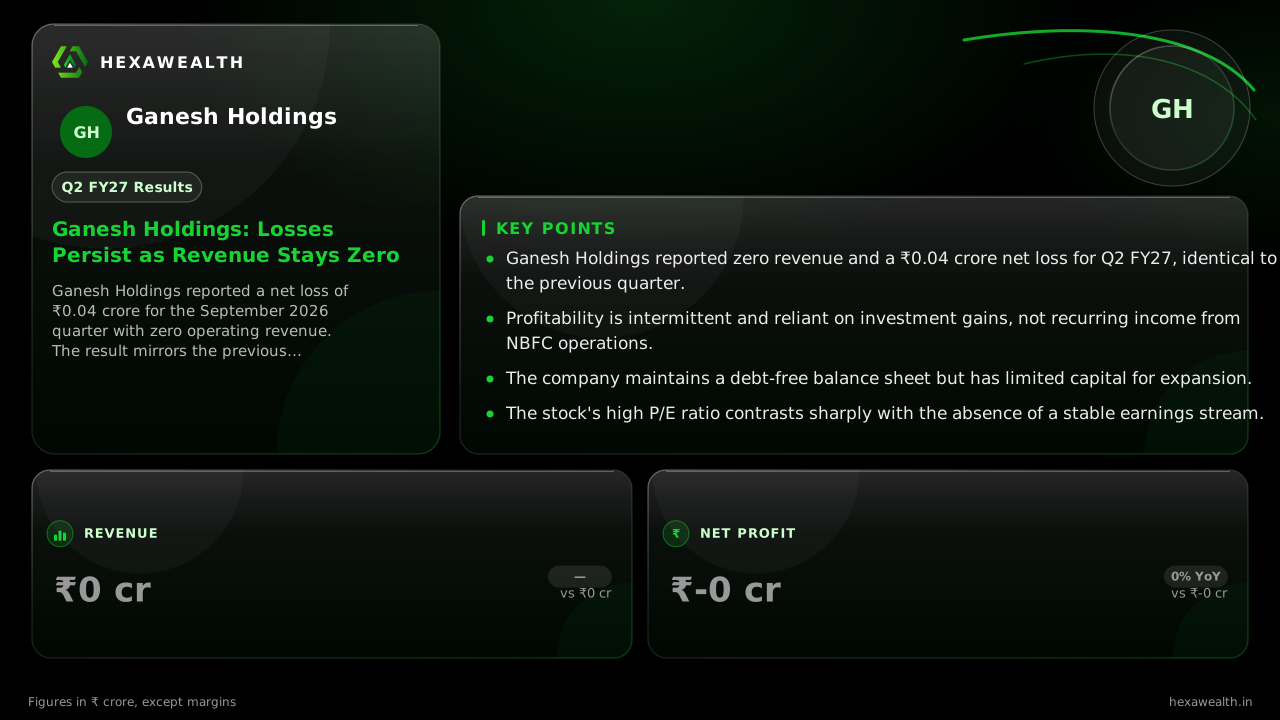
Ganesh Holdings reported a net loss of ₹0.04 crore for the September 2026 quarter with zero operating revenue. The result mirrors the previous quarter, underscoring the company's lack of recurring income from its core NBFC activities.
For Ganesh Holdings, an NBFC classified as a non-deposit taking investment company, the core challenge remains generating recurring income. The September quarter results show that hurdle is still unmet, with the company posting another period of zero revenue and a small loss.
The numbers tell a story of inactivity. Revenue was flat at zero for the second consecutive quarter, while net profit stayed at a loss of ₹0.04 crore. This matches the loss from the same period last year, showing no year-on-year improvement in the underlying business.
Revenue & profit
Revenue (₹ Cr)
Profit (₹ Cr)
| Metric | CurrentQ2 FY27 | PreviousQ1 FY27 | Same quarter LYQ2 FY26 |
|---|---|---|---|
| Period Ended | Sep 2026 | Jun 2026 | Sep 2025 |
| Revenue (₹ Cr) | 0.00 | 0.00 | 0.00 |
| Profit (₹ Cr) | -0.04YoY 0% | -0.04 | -0.04 |
The table reveals a pattern of sporadic profitability driven by one-off events. The profitable March 2026 quarter, which contributed to a trailing twelve-month net profit margin of 56.4%, was an outlier. According to analysis from StockFin.ai, that return to profitability was driven by investment gains rather than core business earnings.
A Business Built on Investments
With no operating revenue, the company's financials are entirely shaped by its investment portfolio and associated costs. The balance sheet is conservative, with total assets of ₹7 crore funded solely by equity and no debt, as per a March 2026 snapshot from StockFin.ai. This structure limits risk but also capacity for growth without external capital.
Management's focus appears to be on compliance and governance rather than business expansion. The annual report indicated expectations for improved performance from mutual fund investments, but provided no specific operational targets. The lack of a recurring revenue stream poses a clear structural challenge to long-term viability.
The Market's Read on Stagnation
The stock has risen 46.8% over the past year, but from a very low base. It now trades at a price-to-earnings ratio of 56.7, a 175% premium to the industry average, as per the payload data. This high valuation seems to reflect the company's tiny market cap and thin float rather than earnings prospects, with analysts flagging concerns over sustainable profitability.
Key Points
- Ganesh Holdings reported zero revenue and a ₹0.04 crore net loss for Q2 FY27, identical to the previous quarter.
- Profitability is intermittent and reliant on investment gains, not recurring income from NBFC operations.
- The company maintains a debt-free balance sheet but has limited capital for expansion.
- The stock's high P/E ratio contrasts sharply with the absence of a stable earnings stream.
Hexa Perspective
The quarter confirms Ganesh Holdings is in a holding pattern. Its financials are a function of its investment book, with operating expenses periodically exceeding investment income. For the story to change, the company would need to activate its NBFC license to generate lending income or significantly grow its investment portfolio.
The current regulatory environment offers a potential off-ramp. Recent RBI amendments allow certain low-risk NBFCs without public funds or customer interface to deregister. Given Ganesh Holdings' profile, exploring this path could be a logical step, unless a strategic shift towards active lending is planned.
Also read
Want this applied to your portfolio?
Talk to a HexaWealth advisor, or sync your mutual fund data for insights tailored to your holdings.