Frontline Corporation (FRONTCORP) Q2 FY27 Profit Turns Negative Despite 18% Revenue Growth
A one-time tax expense of ₹80 lakh related to earlier periods erased an otherwise profitable quarter, pushing the company into a net loss.
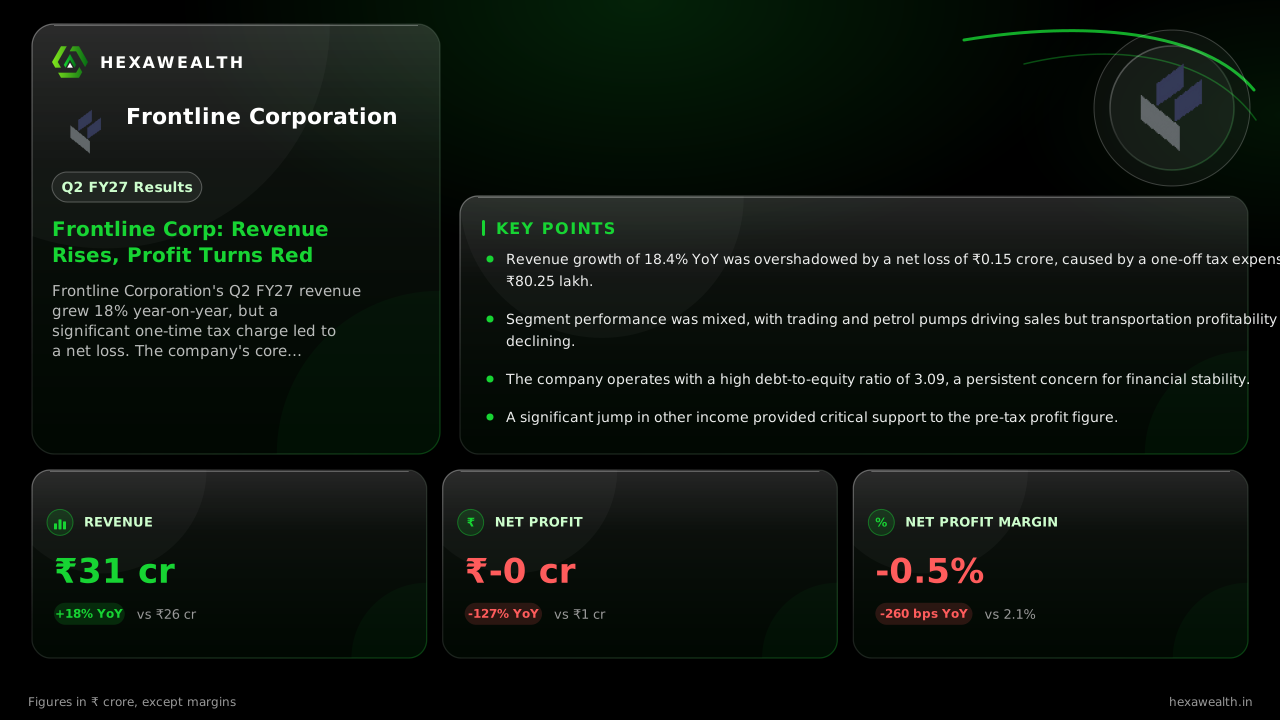
Frontline Corporation's Q2 FY27 revenue grew 18% year-on-year, but a significant one-time tax charge led to a net loss. The company's core operations remained profitable before this exceptional item.
For a diversified company like Frontline Corporation, growth across its trading and petrol pump segments should translate to a stronger bottom line. The September quarter delivered the top-line expansion but ended with a net loss, as a large, non-operating tax charge consumed nearly all the profit.
Revenue rose to ₹30.63 crore, an 18.4% increase from the same quarter last year and 8.1% higher than the June quarter. However, total expenses grew faster at 22.9% year-on-year, squeezing operating margins. The headline result was a net loss of ₹0.15 crore, a sharp reversal from the ₹0.79 crore profit in Q1.
Revenue & profit
Revenue (₹ Cr)
Profit (₹ Cr)
| Metric | CurrentQ2 FY27 (Sep 2026) | PreviousQ1 FY27 (Jun 2026) |
|---|---|---|
| Revenue (₹ Cr) | 30.63 | 28.34 |
| Profit (₹ Cr) | -0.15 | 0.79 |
| PAT Margin (%) | -0.5 | 2.8 |
Why the bottom line turned red
The loss was driven by a one-time tax expense of ₹80.25 lakh relating to earlier periods, as reported by scanx.trade. This single charge consumed nearly 95% of the quarter's pre-tax profit of ₹84.49 lakh. Without it, the company would have reported a modest profit, continuing the positive trend from the previous quarter.
A mixed operational picture
Segment performance was uneven. According to scanx.trade, the trading and petrol pump businesses drove revenue growth. The Ahmedabad segment remained the primary profit contributor, while the Kolkata segment swung to a deeper loss. The transportation segment saw revenue rise to ₹7.10 crore, but its segment profit fell sharply year-on-year, notes multibagg.ai.
A surge in other income, which jumped 169% quarter-on-quarter to ₹2.09 crore, helped support pre-tax profit. This was crucial as the core business, excluding other income, reported an operating loss for the quarter, per Flash Finance.
The structural weight of debt
A high debt load remains a structural concern. The company's debt-to-equity ratio stands at 3.09, indicating significant leverage. While interest costs dipped slightly this quarter, MarketsMojo highlights that such leverage reduces financial flexibility and elevates risk, especially when core profitability is under pressure.
The stock closed at ₹35.48 on November 6, down 9.9% over the past year. It trades at a P/E of 6.5, a steep discount to the industry average of 57.9, reflecting the market's caution given its leveraged balance sheet and inconsistent earnings.
Key Points
- Revenue growth of 18.4% YoY was overshadowed by a net loss of ₹0.15 crore, caused by a one-off tax expense of ₹80.25 lakh.
- Segment performance was mixed, with trading and petrol pumps driving sales but transportation profitability declining.
- The company operates with a high debt-to-equity ratio of 3.09, a persistent concern for financial stability.
- A significant jump in other income provided critical support to the pre-tax profit figure.
Hexa Perspective
The quarter presents a clear divergence between operating performance and the reported bottom line. The one-time tax hit is a past liability cleared, not an indicator of future earnings pressure. The real story is the underlying operational squeeze, where expense growth outpaced sales.
Investors are weighing a cheap valuation against high financial leverage and margin pressure in key segments. For the stock to re-rate, the company needs to demonstrate it can convert top-line momentum into sustained, pre-tax profit from its core businesses while managing its debt burden.
Also read
Want this applied to your portfolio?
Talk to a HexaWealth advisor, or sync your mutual fund data for insights tailored to your holdings.