Apollo Tyres (APOLLOTYRE) Q2 FY27 Profit Drops 16% Sequentially Despite Strong Revenue Growth
Apollo Tyres posted a 16.6% revenue jump in Q2 FY27, but profit fell sequentially as raw material inflation and restructuring charges squeezed margins.
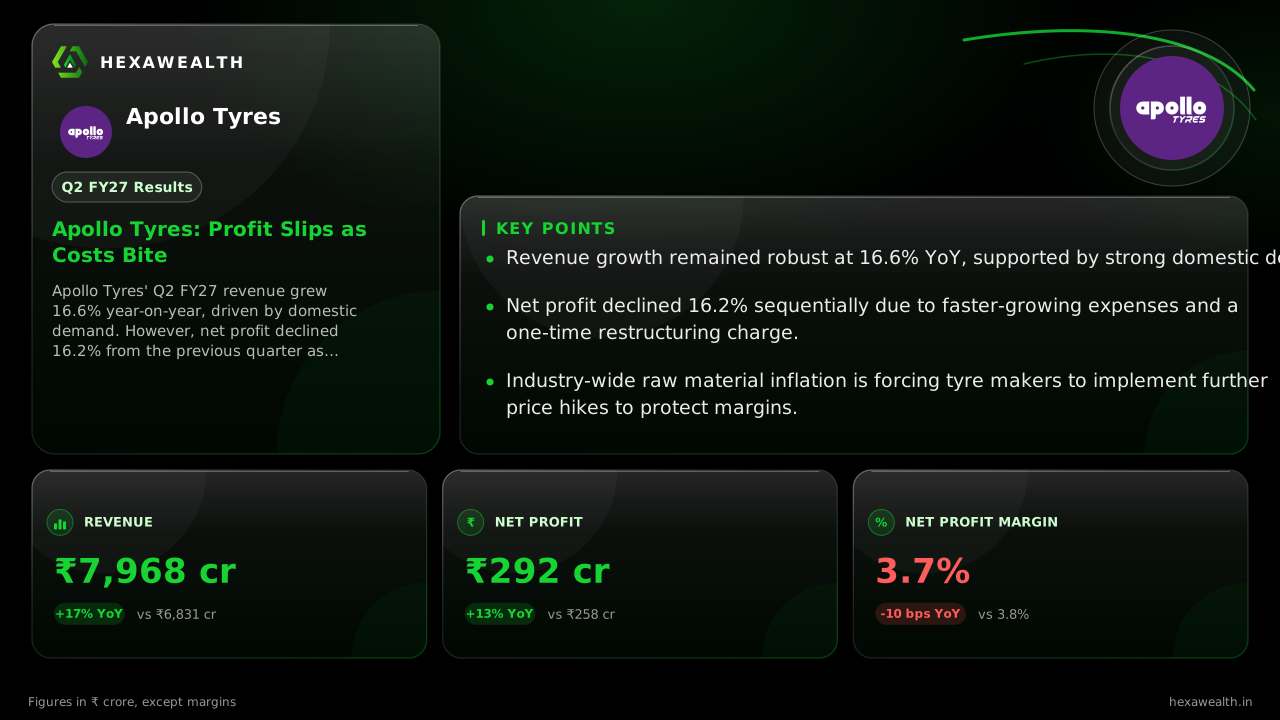
Apollo Tyres' Q2 FY27 revenue grew 16.6% year-on-year, driven by domestic demand. However, net profit declined 16.2% from the previous quarter as elevated raw material costs and European restructuring charges pressured profitability.
For Apollo Tyres, the September quarter brought a clear split between top-line momentum and bottom-line strain. Strong domestic sales drove revenue higher, but the gains were largely absorbed by rising input costs and ongoing European restructuring, leaving profit weaker than the quarter before.
Consolidated revenue rose 16.6% year-on-year to ₹7,968 crore, also marking a 7.7% sequential increase. Net profit, however, declined 16.2% from the June quarter to ₹292 crore. The net profit margin contracted by 100 basis points sequentially to 3.7%.
Revenue & profit
Revenue (₹ Cr)
Net Profit (₹ Cr)
Net Profit Margin (%)
| Metric | CurrentQ2 FY27 (Sep 2026) | PreviousQ1 FY27 (Jun 2026) |
|---|---|---|
| Revenue (₹ Cr) | 7,968.15 | 7,397.79 |
| Net Profit (₹ Cr) | 292.29 | 348.87 |
| Net Profit Margin (%) | 3.7 | 4.7 |
Why the profit fell despite higher sales
Total expenses grew faster than revenue, rising 20.5% year-on-year. According to Autocar Professional, this was primarily driven by a sharp increase in the cost of materials consumed. Chairman Onkar Kanwar cited geopolitical tensions in West Asia as a headwind, leading to elevated input costs and supply chain disruptions.
The quarter also carried a one-time charge. The company booked an exceptional pre-tax restructuring cost of ₹25.85 crore, related to the shutdown of tyre production at its Enschede plant in the Netherlands. This charge, reported by Autocar Professional, directly weighed on the bottom line.
The pricing challenge ahead
The margin pressure is not unique to Apollo Tyres. Reports from peers like JK Tyre and CEAT indicate the industry is grappling with persistent raw material inflation, leading to planned price hikes of 4-5% in the coming quarter. Passing these costs through to customers fully and quickly remains a challenge in a competitive market.
This environment suggests the margin squeeze may persist. Apollo Tyres' ability to recover profitability hinges on the success of these price increases and its ongoing restructuring in Europe, which showed some operational improvement this quarter.
Key Points
- Revenue growth remained robust at 16.6% YoY, supported by strong domestic demand.
- Net profit declined 16.2% sequentially due to faster-growing expenses and a one-time restructuring charge.
- Industry-wide raw material inflation is forcing tyre makers to implement further price hikes to protect margins.
Hexa Perspective
The quarter underscores a period of transition where sales growth is not translating into earnings momentum. While the demand environment is healthy, the cost structure has shifted. The path to margin recovery now depends on two factors: the company's pricing power in a competitive replacement market, and the full benefit of its European restructuring flowing through. Investors are weighing strong volume traction against a profitability reset that may last another quarter or two.
Also read
Want this applied to your portfolio?
Talk to a HexaWealth advisor, or sync your mutual fund data for insights tailored to your holdings.