Tolins Tyres (TOLINS) Q2 FY27 Profit Falls 6.5% Despite 43% Revenue Jump
Strong volume growth in India was offset by soaring raw material costs and a sharp decline in its UAE business, squeezing profitability.
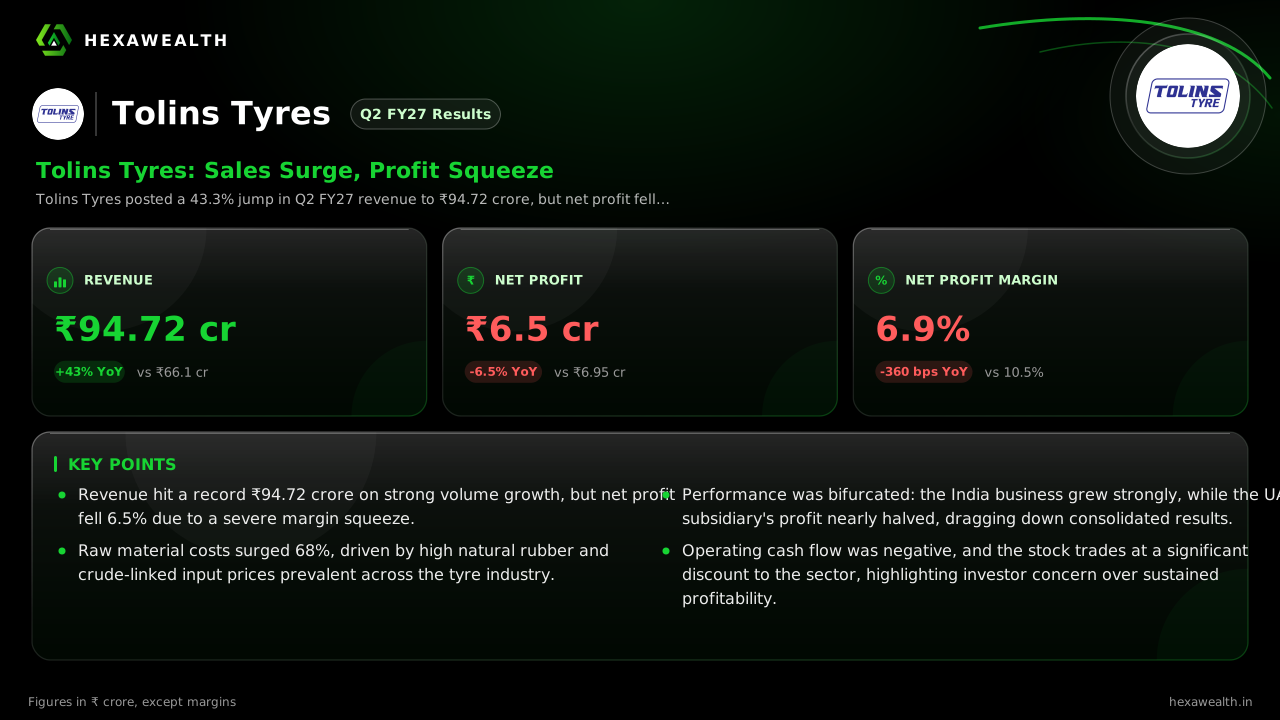
Tolins Tyres posted a 43.3% jump in Q2 FY27 revenue to ₹94.72 crore, but net profit fell 6.5% to ₹6.5 crore. The margin squeeze was driven by a 68% surge in material costs and a sharp downturn in its UAE subsidiary.
For a tyre maker, a sharp rise in sales should translate into stronger earnings. Tolins Tyres' September quarter shows that link is broken when costs rise faster than the top line. Revenue jumped 43% year-on-year, but profit fell 6.5% as margins were squeezed.
The numbers tell a story of growth without reward. Revenue reached ₹94.72 crore, a new quarterly high. Yet net profit slipped to ₹6.5 crore, and the net profit margin contracted by 360 basis points to 6.9%. Profit before tax grew a modest 5.6%.
Revenue & profit
Revenue (₹ Cr)
Profit (₹ Cr)
- Revenue (₹ Cr), Q2 FY26: 66.10
- Revenue (₹ Cr), Q3 FY26: 93.29
- Revenue (₹ Cr), Q4 FY26: 77.99
- Revenue (₹ Cr), Q1 FY27: 79.27
- Revenue (₹ Cr), Q2 FY27: 94.72
- Profit (₹ Cr), Q2 FY26: 6.95
- Profit (₹ Cr), Q3 FY26: 10.49
- Profit (₹ Cr), Q4 FY26: 8.94
- Profit (₹ Cr), Q1 FY27: 6.19
- Profit (₹ Cr), Q2 FY27: 6.50
Revenue (₹ Cr)
- Revenue (₹ Cr), Q2 FY26: 66.10
- Revenue (₹ Cr), Q3 FY26: 93.29
- Revenue (₹ Cr), Q4 FY26: 77.99
- Revenue (₹ Cr), Q1 FY27: 79.27
- Revenue (₹ Cr), Q2 FY27: 94.72
Profit (₹ Cr)
- Profit (₹ Cr), Q2 FY26: 6.95
- Profit (₹ Cr), Q3 FY26: 10.49
- Profit (₹ Cr), Q4 FY26: 8.94
- Profit (₹ Cr), Q1 FY27: 6.19
- Profit (₹ Cr), Q2 FY27: 6.50
Net Profit Margin (%)
- Net Profit Margin (%), Q2 FY26: 10.5
- Net Profit Margin (%), Q3 FY26: 11.2
- Net Profit Margin (%), Q4 FY26: 11.5
- Net Profit Margin (%), Q1 FY27: 7.8
- Net Profit Margin (%), Q2 FY27: 6.9
| Metric | CurrentQ2 FY27 | PreviousQ1 FY27 | Same quarter LYQ2 FY26 |
|---|---|---|---|
| Revenue (₹ Cr) | 94.72YoY +43% | 79.27 | 66.10 |
| Profit (₹ Cr) | 6.50YoY -6.5% | 6.19 | 6.95 |
| Net Profit Margin (%) | 6.9YoY -34% | 7.8 | 10.5 |
Why the growth never reached the bottom line
Management, cited by MarketPing, said the revenue jump was driven by strong volume growth: tyre sales rose 48.8% and precured tread rubber volumes grew 20%. However, the cost of materials consumed surged 68.1% to ₹81.58 crore. This pushed the raw material cost ratio to 86% of revenue, up from 73% a year ago, according to Stockwatch.
The pressure is industry-wide. Reports from Business Standard and Finshots note natural rubber prices climbed to around ₹300 per kg, while crude-linked inputs also rose sharply. Tolins' total expenses grew 47.5%, outpacing its 43.3% revenue gain.
A tale of two geographies
A deeper split reveals the real tension. The India business, as per Autocar Professional, saw revenue soar 62.3% and segment profit grow 35.1%. This was entirely offset by the UAE subsidiary, where revenue fell 27.4% and segment profit nearly halved. The consolidated result was dragged down by this international weakness.
Live Chart
· TOLINS
(BSE)
ISIN: INE0RWQ01014
Management had deferred a clear annual outlook after Q1, citing geopolitical issues in West Asia. The Q2 performance from the UAE unit validates that caution. Stockwatch notes that against an implied goal of maintaining FY26 profit levels, first-half profit is running about 29% behind the required pace.
The cash and capacity story
Financing the growth also shows strain. According to MarketPing, operating cash flow for the first half was negative ₹2.15 crore. Cash reserves fell to ₹1.85 crore from ₹4.42 crore in March, while borrowings rose. The company is investing, with capital expenditure of ₹5.44 crore in H1, partly for a new reclaim-rubber facility.
Management aims to raise overall capacity utilisation to 75% over the next few years from current levels near 40-54%. This suggests the current sales growth is coming from existing, under-utilised lines, not new capacity. The stock, trading at a 57% discount to the industry PE, reflects the market's focus on this profitability gap.
Key Points
- Revenue hit a record ₹94.72 crore on strong volume growth, but net profit fell 6.5% due to a severe margin squeeze.
- Raw material costs surged 68%, driven by high natural rubber and crude-linked input prices prevalent across the tyre industry.
- Performance was bifurcated: the India business grew strongly, while the UAE subsidiary's profit nearly halved, dragging down consolidated results.
- Operating cash flow was negative, and the stock trades at a significant discount to the sector, highlighting investor concern over sustained profitability.
Hexa Perspective
The quarter frames Tolins Tyres' central challenge: it can grow sales, but cannot currently grow profits. The margin contraction is structural, tied to global commodity cycles that show no sign of immediate relief. The company's path to better earnings now depends on two uncertain factors.
First, it must successfully pass on cost increases through price hikes in a competitive replacement market. Second, it needs a recovery in its UAE operations, which are suffering from regional headwinds. Until raw material costs stabilise or pricing power improves, strong revenue growth may continue to deliver weak profit quality.
Also read
Want this applied to your portfolio?
Talk to a HexaWealth advisor, or sync your mutual fund data for insights tailored to your holdings.