STEL Holdings Q2 FY27 Profit Triples on a One-Off Dividend Windfall
A massive dividend receipt from its portfolio powered a 196% profit jump, but the core challenge of capital efficiency remains unchanged.
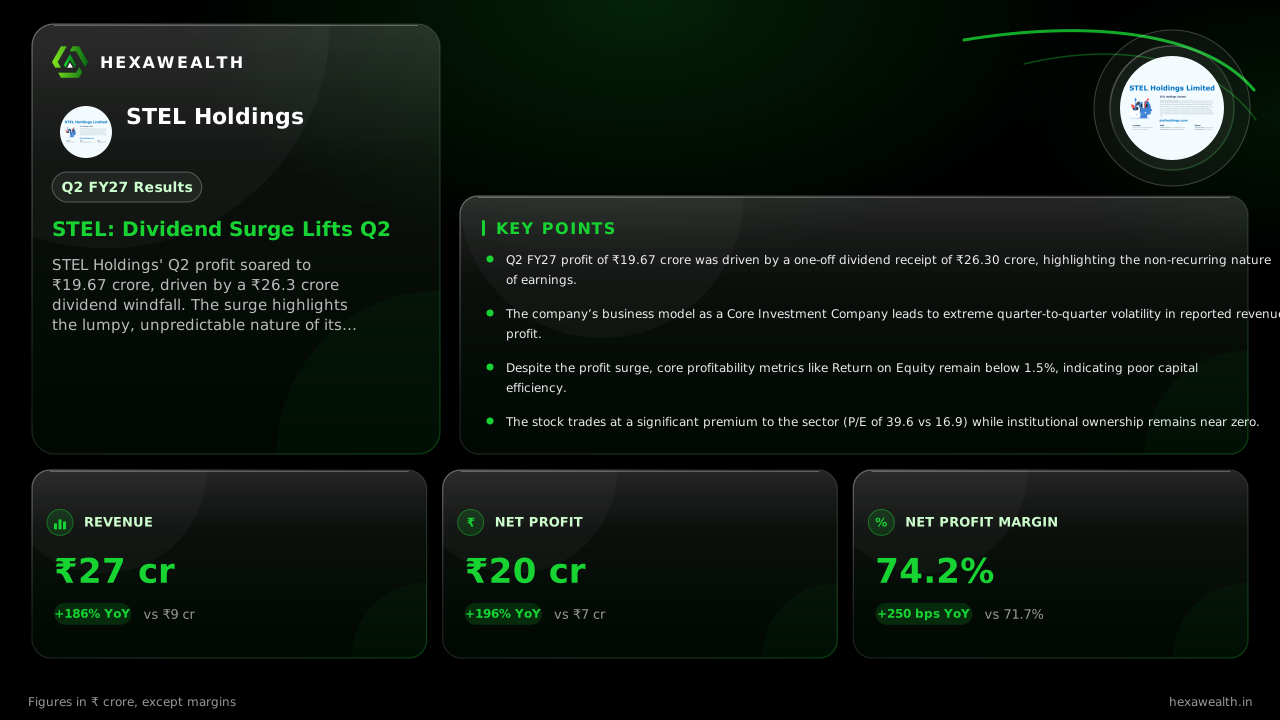
STEL Holdings' Q2 profit soared to ₹19.67 crore, driven by a ₹26.3 crore dividend windfall. The surge highlights the lumpy, unpredictable nature of its income as a pure investment holding company.
For STEL Holdings, a pure investment vehicle for the RPG Group, a quarter’s story is written by its portfolio companies’ dividend cheques. The September quarter brought a very large one, turning a whisper of revenue into a roar and delivering a profit that tripled year-on-year.
The numbers tell a story of extreme concentration. Revenue surged 186% year-on-year to ₹26.51 crore, while profit after tax jumped 196% to ₹19.67 crore. The net profit margin expanded to 74.2%. This followed a June quarter where revenue was a mere ₹0.10 crore.
Revenue & profit
Revenue (₹ Cr)
Profit (₹ Cr)
Net Profit Margin
| Metric | CurrentQ2 FY27 | PreviousQ1 FY27 | Same quarter LYQ2 FY26 |
|---|---|---|---|
| Revenue (₹ Cr) | 26.51YoY +186% | 0.10 | 9.27 |
| Profit (₹ Cr) | 19.67YoY +196% | -0.13 | 6.64 |
| Net Profit Margin | 74.2%YoY +3.5% | – | 71.7% |
The dividend that changed everything
Research from Arthneeti.com shows the quarter’s revenue was almost entirely a ₹26.30 crore dividend receipt, with minimal interest income. This explains the near-100% operating margin reported by MarketsMojo. The company’s lean structure, with just three employees and no debt, lets such income flow straight to the bottom line after tax.
This windfall reverses the previous quarter’s loss, which Front Wave Research had attributed to timing differences in investment income. The pattern is the business model: income arrives in unpredictable, lumpy tranches rather than a steady stream.
A valuation built on patience, not performance
The market values this patience at a steep premium. At a P/E of 39.6, STEL trades 135% above its industry, according to the payload. Yet its return on equity is a meagre 1.18%, a fundamental disconnect noted by MarketsMojo.
Institutional investors seem wary of this volatility. Their combined stake is a negligible 0.08%, while promoter holding has steadily risen to 72.4%, reports SectorAlpha. This suggests strong insider confidence but little external validation from professional money managers.
Key Points
- Q2 FY27 profit of ₹19.67 crore was driven by a one-off dividend receipt of ₹26.30 crore, highlighting the non-recurring nature of earnings.
- The company’s business model as a Core Investment Company leads to extreme quarter-to-quarter volatility in reported revenue and profit.
- Despite the profit surge, core profitability metrics like Return on Equity remain below 1.5%, indicating poor capital efficiency.
- The stock trades at a significant premium to the sector (P/E of 39.6 vs 16.9) while institutional ownership remains near zero.
Hexa Perspective
The quarter is a perfect snapshot of STEL’s identity: a dormant portfolio that occasionally awakens with a large payout. The dividend surge is real cash but does not signal improved operational performance or a change in the underlying return profile.
Investors are left weighing the security of a zero-debt balance sheet and promoter accumulation against persistently weak capital efficiency and earnings unpredictability. The next quarter could just as easily return to silence, making any extrapolation from this result hazardous.
Also read
Want this applied to your portfolio?
Talk to a HexaWealth advisor, or sync your mutual fund data for insights tailored to your holdings.