Solarium Green Energy (SOLARIUM) Profit Stalls as Revenue Doubles in Q4 FY26
The solar EPC player's revenue surged 115% quarter-on-quarter, but net profit grew only 22% as new manufacturing costs and a shift to large projects squeezed margins.
Solarium Green Energy's Q4 FY26 revenue more than doubled from the previous quarter, yet profit growth lagged sharply. The margin squeeze reflects a strategic pivot to large-scale EPC projects and costs from its new module manufacturing plant.
For Solarium Green Energy, the March quarter was about trading margin for scale. The solar EPC and module maker chose to chase large ground-mounted projects, a move that delivered explosive revenue growth but left profitability straining under the weight of a new factory and its borrowed capital.
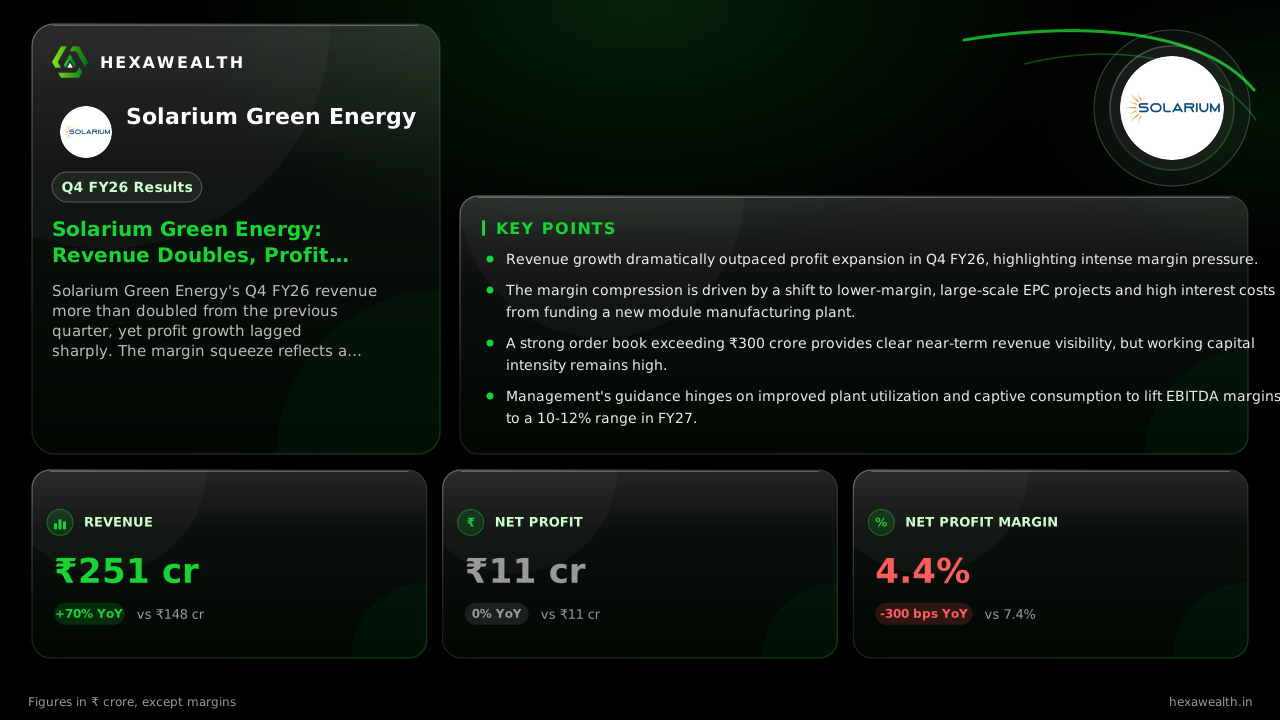
Revenue for Q4 FY26 soared to ₹251 crore, more than doubling from the previous quarter and up 70% from a year ago. Yet net profit grew just 22% sequentially to ₹11 crore, flat against the prior year. The net profit margin collapsed to 4.4%, down 330 basis points from Q2 FY26.
Revenue & profit
Revenue (₹ Cr)
Profit (₹ Cr)
- Revenue (₹ Cr), Q2 FY25: 82.0
- Revenue (₹ Cr), Q4 FY25: 148.0
- Revenue (₹ Cr), Q2 FY26: 117.0
- Revenue (₹ Cr), Q4 FY26: 251.0
- Profit (₹ Cr), Q2 FY25: 8.0
- Profit (₹ Cr), Q4 FY25: 11.0
- Profit (₹ Cr), Q2 FY26: 9.0
- Profit (₹ Cr), Q4 FY26: 11.0
Revenue (₹ Cr)
- Revenue (₹ Cr), Q2 FY25: 82.0
- Revenue (₹ Cr), Q4 FY25: 148.0
- Revenue (₹ Cr), Q2 FY26: 117.0
- Revenue (₹ Cr), Q4 FY26: 251.0
Profit (₹ Cr)
- Profit (₹ Cr), Q2 FY25: 8.0
- Profit (₹ Cr), Q4 FY25: 11.0
- Profit (₹ Cr), Q2 FY26: 9.0
- Profit (₹ Cr), Q4 FY26: 11.0
Net Profit Margin
- Net Profit Margin, Q2 FY25: 9.8%
- Net Profit Margin, Q4 FY25: 7.4%
- Net Profit Margin, Q2 FY26: 7.7%
- Net Profit Margin, Q4 FY26: 4.4%
| Metric | CurrentQ4 FY26 | Same quarter LYQ4 FY25 |
|---|---|---|
| Revenue (₹ Cr) | 251.0YoY +70% | 148.0 |
| Profit (₹ Cr) | 11.0YoY 0% | 11.0 |
| Net Profit Margin | 4.4%YoY -41% | 7.4% |
The cost of a strategic pivot
The margin compression stems from a deliberate business mix change. According to a report by Newboard, the company pivoted to large ground-mounted EPC contracts, which carry lower margins than residential work but offer faster, milestone-linked payments. This shift pulled the gross margin down to about 30% from 34.5% a year earlier.
Compounding this, the company commissioned its 1.2 GW module plant in March. Borrowings for this ₹90 crore capex and related working capital tripled annual finance costs to ₹10.5 crore. In Q4 alone, interest expense jumped 50% sequentially to ₹6 crore, directly pressuring the bottom line.
A balance sheet built for execution
The investment is now aimed at a robust order book. Management cited an order book of over ₹300 crore as of FY26-end in an earnings call summarized by Arthneeti, with a pipeline of over 300 MW under discussion. A CARE rating note later reported the order book had swelled to ₹852.3 crore by June 2026, providing clear revenue visibility.
Live Chart
· SOLARIUM
(BSE)
ISIN: INE0W0H01017
However, this growth is consuming cash. Operating cash flow turned positive at ₹18.33 crore for FY26 but was overshadowed by a ₹86.84 crore outflow for investing activities, primarily the new plant. Receivables and inventory more than doubled year-on-year, tying up capital.
The path to better returns
Management expects the margin squeeze to be temporary. On the Q4 call, they targeted an exit EBITDA margin of 10-12% in FY27, up from about 9.6% in FY26. The thesis is that as plant utilization rises—it was around 45% at the time—fixed costs will be absorbed and captive consumption for EPC projects will improve profitability.
The key is execution at scale without further financial strain. With borrowings mostly in place and no major capex planned for FY27, the next few quarters will test if revenue growth can finally translate into proportionately higher earnings.
Key Points
- Revenue growth dramatically outpaced profit expansion in Q4 FY26, highlighting intense margin pressure.
- The margin compression is driven by a shift to lower-margin, large-scale EPC projects and high interest costs from funding a new module manufacturing plant.
- A strong order book exceeding ₹300 crore provides clear near-term revenue visibility, but working capital intensity remains high.
- Management's guidance hinges on improved plant utilization and captive consumption to lift EBITDA margins back to a 10-12% range in FY27.
Hexa Perspective
Solarium Green Energy is in a classic investment phase, sacrificing current profitability for future scale and integration. The Q4 numbers show the cost of that bet clearly: spectacular top-line growth funded by debt, with profits yet to follow.
The coming year will reveal if this calculus works. Success depends on executing the large order book efficiently, ramping up the new factory to lower unit costs, and managing receivables that have ballooned with growth. If those align, the margin recovery management projects is plausible. If not, the company's thin earnings will continue to be vulnerable to any execution hiccups or rising input costs in its fixed-price contracts.
Also read
Want this applied to your portfolio?
Talk to a HexaWealth advisor, or sync your mutual fund data for insights tailored to your holdings.