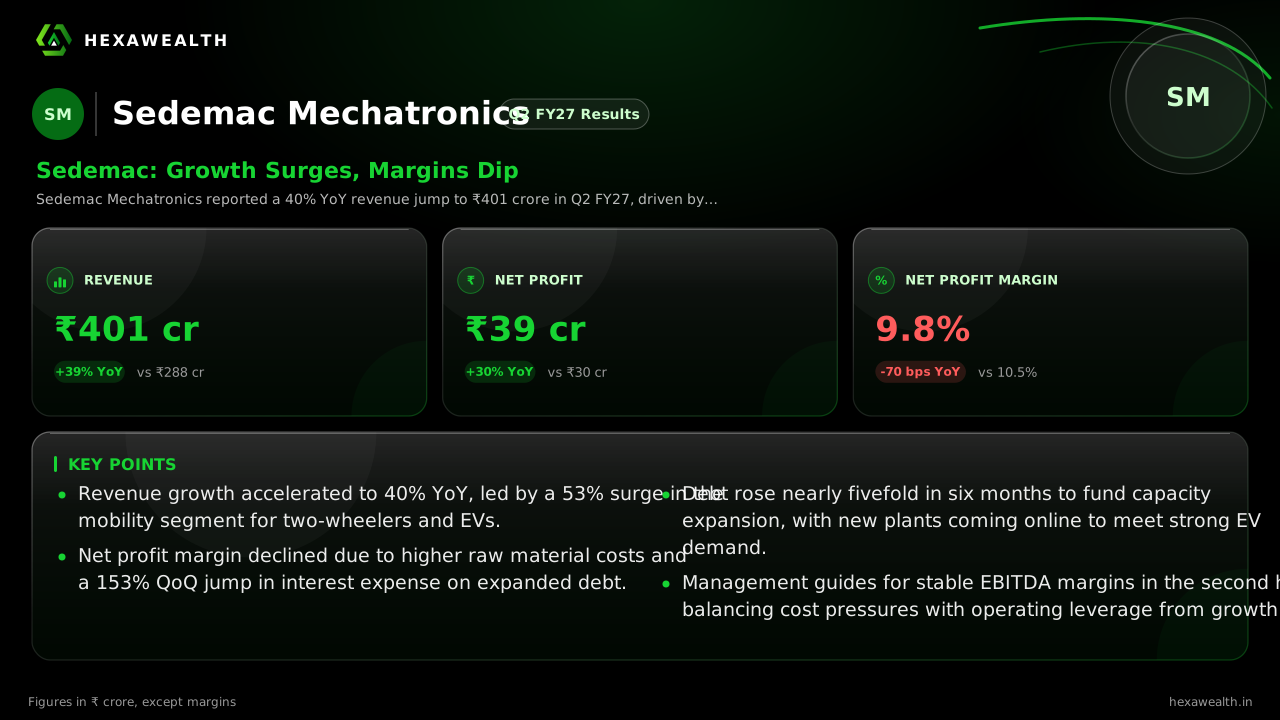
Sedemac Mechatronics reported a 40% YoY revenue jump to ₹401 crore in Q2 FY27, driven by its mobility segment. However, net profit margin fell due to higher raw material costs and a 153% surge in interest expense linked to expansion funding.
Sedemac Mechatronics is riding the wave of India's auto electrification and premiumisation, but the cost of funding that growth is now showing on the income statement. The company's September quarter delivered a 40% revenue surge, yet profitability softened as input inflation and rising debt costs bit into margins.
The numbers show the tension clearly. Revenue hit a record ₹400.64 crore, up 39.3% from a year ago and 29.3% from the June quarter. Net profit grew 30% year-on-year to ₹39.18 crore, but the pace lagged the top line. The net profit margin slipped to 9.8%, down 70 basis points from last year and 100 points from last quarter.
Revenue & profit
Revenue (₹ Cr)
Profit (₹ Cr)
Net Profit Margin (%)
Metric
CurrentQ2 FY27 (Sep 2026)
PreviousQ1 FY27 (Jun 2026)
Revenue (₹ Cr)
400.64
309.77
Profit (₹ Cr)
39.18
33.31
Net Profit Margin (%)
9.8
10.8
Why the margin squeeze outran the growth
The revenue engine was its mobility segment, which grew 53% year-on-year to ₹366.35 crore, according to Autocar Professional. This was driven by the full ramp-up of electric two-wheeler motor control units and ISG ECUs for export three-wheelers. Yet, this growth came at a higher cost.
Total expenses rose 45% year-on-year. CNBC TV18 reported that tightening semiconductor supplies and commodity price inflation increased raw material costs, pressuring EBITDA margins. Interest expense surged 153% sequentially to ₹5.87 crore, a direct result of higher borrowings.
Funding a steep capacity expansion
The jump in debt is funding what the company calls a "steep increase" in capital expenditure. According to its investor presentation, this is for new plants—MF3 in Pune and the recently acquired land for MF5 in Tamil Nadu—and increased working capital needs. Total borrowings stood at ₹245.64 crore as of September 30, up sharply from ₹50.63 crore at the end of March.
This investment is chasing demand. Management told CNBC TV18 that electric two-wheeler demand is outpacing supply at major OEMs. Sedemac's own order book includes a new ISG ECU order from a European OEM, with production set for early next fiscal year.
The outlook: stable margins, watched costs
For the rest of the year, the company expects EBITDA margins to remain around first-half levels. It hopes price corrections and a newer-generation product will partly offset cost pressures. However, it flagged external risks like a potential El Niño affecting monsoon-dependent two-wheeler demand.
The market reaction was mutedly positive, with the stock closing up 2% post-results. Analysts note the growth but watch the margin trajectory and high valuation—the stock trades at a P/E of 118, a 78% premium to the industry.
Key Points
Revenue growth accelerated to 40% YoY, led by a 53% surge in the mobility segment for two-wheelers and EVs.
Net profit margin declined due to higher raw material costs and a 153% QoQ jump in interest expense on expanded debt.
Debt rose nearly fivefold in six months to fund capacity expansion, with new plants coming online to meet strong EV demand.
Management guides for stable EBITDA margins in the second half, balancing cost pressures with operating leverage from growth.
“
Hexa Perspective
Sedemac’s quarter confirms it is a primary beneficiary of content growth in vehicles, especially electrification. The margin compression, however, shifts the debate from pure growth to the quality of that growth—specifically, the return on newly deployed capital.
The coming quarters will test whether revenue can continue to outrun the twin pressures of input costs and a heavier interest burden. Success hinges on flawless execution of the capacity ramp-up and the company's ability to pass through costs in a competitive auto ancillary market.
Talk to a HexaWealth advisor, or sync your mutual fund data for insights tailored to your holdings.
Frequently asked questions
What were Sedemac Mechatronics's Q2 FY27 results?
Sedemac Mechatronics reported revenue of ₹400.64 crore and a net profit of ₹39.18 crore for Q2 FY27 (September 2026 quarter). This represents a 40% year-on-year growth in revenue and a 30% increase in profit compared to the same quarter last year.
Why did Sedemac's profit margin decline in Q2 FY27?
Sedemac's net profit margin fell due to higher input costs and a sharp rise in interest expense. CNBC TV18 reported that semiconductor supply tightening and commodity inflation raised raw material costs, while interest expense surged 153% quarter-on-quarter to ₹5.87 crore due to increased borrowings for expansion.
What drove Sedemac's 29.3% QoQ revenue growth in Q2 FY27?
The 29.3% sequential revenue growth was driven by the mobility segment, specifically the ramp-up of electric two-wheeler motor control units and ISG ECUs for export three-wheelers. According to Autocar Professional, the mobility segment revenue grew 53% year-on-year to ₹366.35 crore.
Was the 153% QoQ surge in Sedemac's interest expense a one-off?
No, the surge in interest expense to ₹5.87 crore reflects a structural increase in debt. Total borrowings rose to ₹245.64 crore as of September 2026 from ₹50.63 crore in March, primarily to fund a steep increase in capital expenditure for new manufacturing plants and working capital.
What is Sedemac's growth outlook for its EV components business?
The outlook is strong, with key products fully ramped up. Sedemac reported a full ramp-up of electric two-wheeler MCUs and ISG ECUs for export three-wheelers. It has also secured a new ISG ECU order from a European OEM, with production expected to begin in the first half of FY28.
How is Sedemac's industrial segment performing?
The industrial segment revenue declined 26% year-on-year to ₹34.3 crore in Q2 FY27. The company noted some negative impact from a weaker hurricane season on its US home-standby generator market business, though it has seen some demand recovery.
What are Sedemac's key capacity expansion plans?
Sedemac is expanding via multiple new plants. MF3 in Chakan has started pilot production, MF4 is expected to start shipping electric machines in Q3 FY27, and the company has acquired ~13 acres for MF5 in Tamil Nadu to serve customers in South India.
What was management's guidance for margins after the Q2 results?
Management expects EBITDA margins for the second half of FY27 to remain around the levels seen in the first half. It anticipates price corrections and a newer-generation ISG controller to partly offset ongoing raw material and PCB cost increases.
Did Sedemac Q2 FY27 results beat analyst estimates?
The available research snippets do not provide specific consensus estimates to determine a beat or miss. The company reported revenue and profit growth of 40% and 30% year-on-year, respectively, with the market focusing on the margin trajectory amid the growth.
What are analysts' main concerns about Sedemac's high valuation?
Analysts express concern over the stock's premium valuation—trading at a P/E of 118, a 78% premium to the industry—leaving little room for execution missteps. The key watchpoints are the company's ability to sustain high growth rates while managing margin pressure and justifying the elevated multiples.
Are institutional investors increasing their stake in Sedemac?
Shareholding data shows mixed trends. As of September 2026, Domestic Institutional Investor (DII) holding was 38.34%, while Foreign Institutional Investor (FII) holding was reported at -10.26% in one source, indicating a complex picture with some funds reducing stakes.
Sedemac Mechatronics Q2 profit drop
Sedemac Mechatronics did not report a profit drop in Q2 FY27. Net profit increased by 30% year-on-year to ₹39.18 crore. However, profit growth lagged revenue growth, and the net profit margin declined due to higher costs and interest expenses.
Sedemac Mechatronics Q2 net profit
Sedemac Mechatronics reported a net profit of ₹39.18 crore for the second quarter (Q2) of FY27, ended September 2026. This marks a 30% increase from the ₹30.14 crore net profit reported in the same quarter of the previous fiscal year.
Why did Sedemac profits plunge despite higher sales?
Sedemac's profits did not plunge; they grew 30% year-on-year. However, profit growth of 30% was slower than the 40% revenue growth because margins were squeezed. Higher raw material costs and a 153% quarter-on-quarter surge in interest expense reduced profitability relative to sales.