Shipping Corporation of India (SCI) Q2 FY27 Profit Triples, But a Provision and Rising Costs Dent Margins
The state-owned shipper's Q2 revenue surged 71% on strong tanker performance, but a one-off provision and higher expenses caused a sequential profit dip.
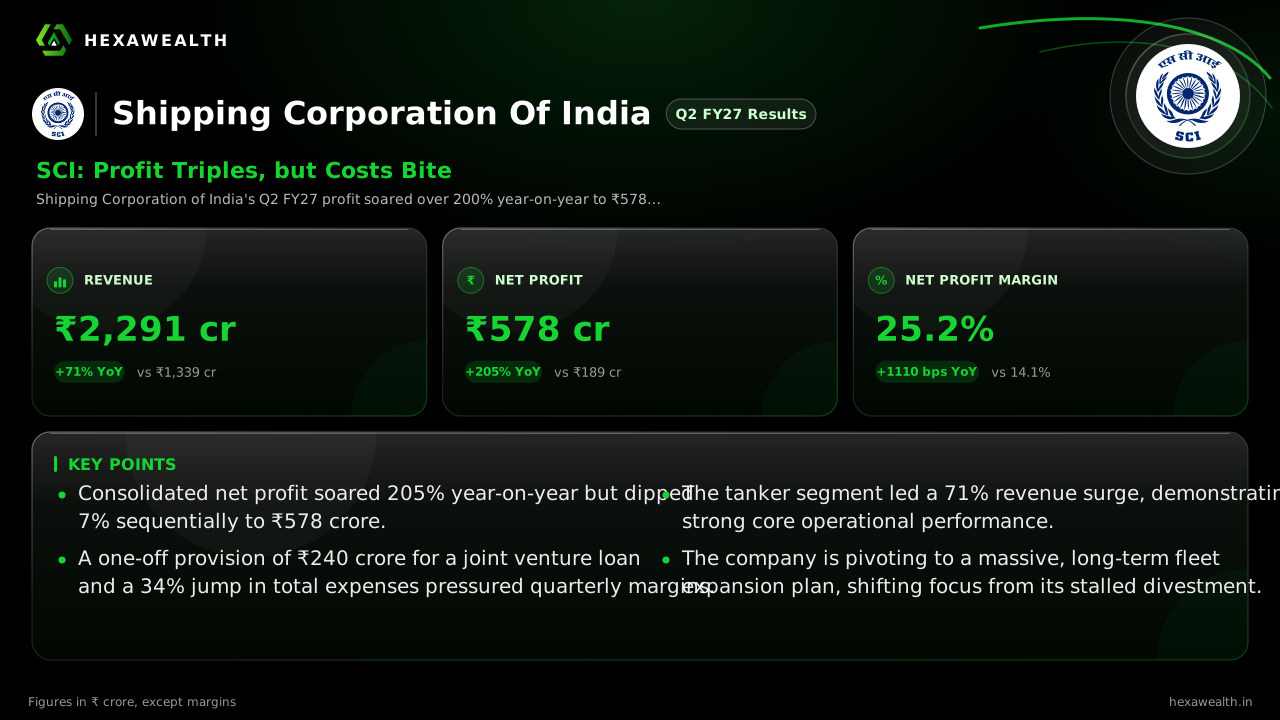
Shipping Corporation of India's Q2 FY27 profit soared over 200% year-on-year to ₹578 crore. Revenue jumped 71%, led by its tanker segment. However, profit fell 7% sequentially as a large provision and rising costs squeezed margins.
For Shipping Corporation of India, the September quarter was a story of two powerful currents. A surging tide of tanker revenue lifted earnings far above last year's subdued levels. Yet beneath that headline growth, a significant one-off provision and rising operational costs pulled profitability down from the exceptional high of the prior quarter.
The numbers show the split clearly. Consolidated revenue climbed 71% year-on-year to ₹2,291 crore, while profit after tax more than tripled to ₹578 crore. Sequentially, however, profit slipped 6.7% even as revenue grew 24%, dragging the net profit margin down by 830 basis points to 25.2%.
Revenue & profit
Revenue (₹ Cr)
Profit (₹ Cr)
Net Profit Margin (%)
| Metric | CurrentQ2 FY27 | PreviousQ1 FY27 | Same quarter LYQ2 FY26 |
|---|---|---|---|
| Revenue (₹ Cr) | 2,290.73YoY +71% | 1,846.56 | 1,338.87 |
| Profit (₹ Cr) | 577.76YoY +205% | 619.34 | 189.16 |
| Net Profit Margin (%) | 25.2YoY +79% | 33.5 | 14.1 |
The Tanker Engine and the Provision Anchor
The year-on-year boom was powered by its core shipping operations. According to CNBC-TV18, the tanker segment was the largest contributor, with revenue nearly doubling to ₹1,582 crore. The liner division also reported a sharp increase. This operational strength is the bedrock of the company's current performance.
The sequential profit decline had two main causes. First, the company recognized a ₹240.19 crore provision related to a loan extended to joint venture ILT-3, as noted in a Perivis blog report. This non-recurring charge directly weighed on consolidated profit. Second, total expenses surged 34% quarter-on-quarter, outpacing revenue growth.
Costs Rise as the Fleet Grows
That expense jump reflects the cost of doing more business. Employee costs were stable, but interest expense rose 29% sequentially. This likely ties to funding the company's ambitious long-term plans. Management has outlined a massive ₹1.5 trillion 'Vision 2047' fleet expansion targeting over 200 new vessels.
The focus has shifted firmly to this growth agenda after the stalled privatisation process. Union Minister Sarbananda Sonowal recently underscored SCI's central role in national maritime ambitions. The capital intensity of this path means cost management will remain a key watchpoint alongside freight rates.
Key Points
- Consolidated net profit soared 205% year-on-year but dipped 7% sequentially to ₹578 crore.
- A one-off provision of ₹240 crore for a joint venture loan and a 34% jump in total expenses pressured quarterly margins.
- The tanker segment led a 71% revenue surge, demonstrating strong core operational performance.
- The company is pivoting to a massive, long-term fleet expansion plan, shifting focus from its stalled divestment.
Hexa Perspective
The quarter underscores SCI's leverage to favourable tanker markets, which can deliver spectacular year-on-year gains. However, the sequential margin squeeze reveals the impact of non-operational items and the rising cost base of a capital-intensive expansion.
Investors are left weighing robust operational cash generation against the demands of a multi-decade capex cycle. The stock's valuation, at a slight discount to the industry PE, may reflect this balance between near-term cyclical strength and the long-term execution risk of the fleet plan. The sustainability of current freight rates will be the immediate swing factor for earnings.
Also read
Want this applied to your portfolio?
Talk to a HexaWealth advisor, or sync your mutual fund data for insights tailored to your holdings.