Sangam (SANGAMIND) Q2 FY27 India's Profit More Than Doubles as Margins Expand Sharply
The textile manufacturer delivered a 129% surge in net profit, driven by higher volumes, better realizations, and robust capacity utilization across its core segments.
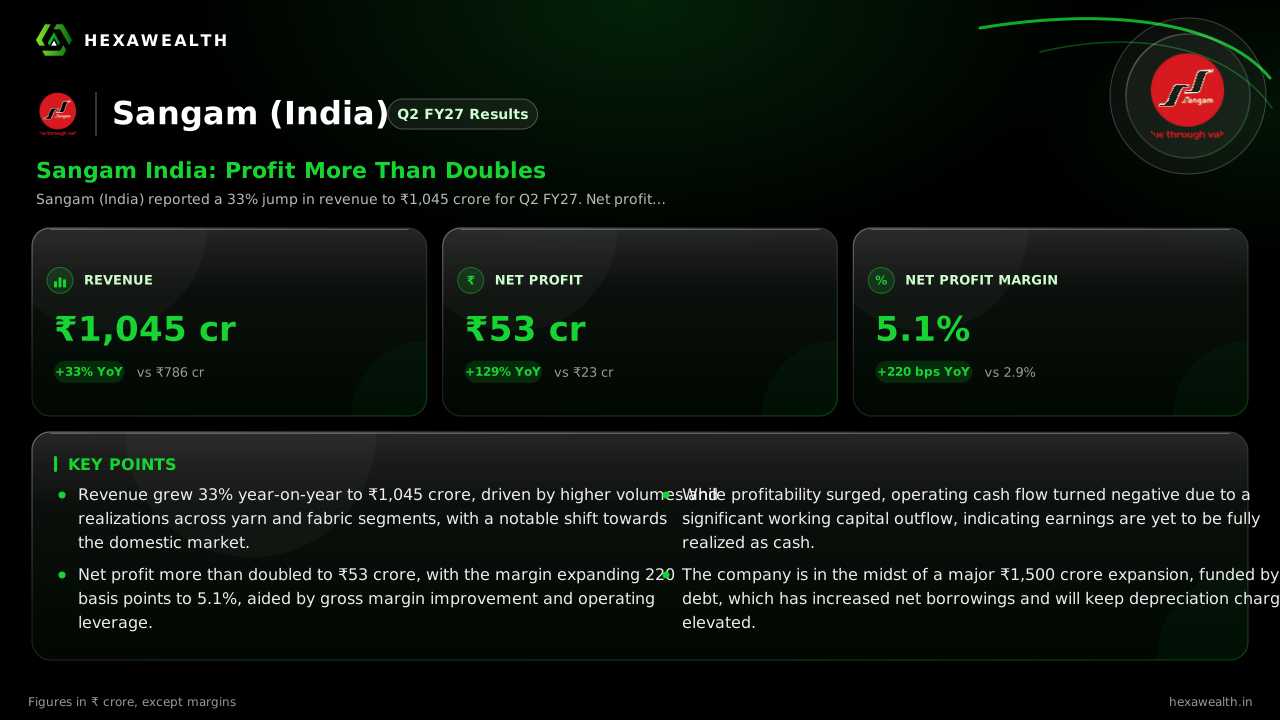
Sangam (India) reported a 33% jump in revenue to ₹1,045 crore for Q2 FY27. Net profit more than doubled to ₹53 crore, with the margin expanding by 220 basis points year-on-year on improved operational efficiency.
For Sangam India, the textile cycle has turned decisively favourable. The company’s second quarter shows what happens when strong demand meets high efficiency, delivering a profit surge that far outpaced sales growth.
Revenue rose 33% year-on-year to ₹1,045 crore, while net profit more than doubled to ₹53 crore. The net profit margin expanded to 5.1%, a 220-basis-point improvement from a year ago. Sequentially, both top and bottom lines grew strongly, with revenue up 22% and profit up 29% from the June quarter.
Revenue & profit
Revenue (₹ Cr)
Profit (₹ Cr)
Net Profit Margin (%)
| Metric | CurrentQ2 FY27 (Sep 2026) | PreviousQ1 FY27 (Jun 2026) |
|---|---|---|
| Revenue (₹ Cr) | 1,045.0 | 860.4 |
| Profit (₹ Cr) | 53.0 | 41.0 |
| Net Profit Margin (%) | 5.1 | 4.8 |
The twin engines of growth
Growth was driven by higher volumes and improved realizations across both yarn and fabric segments, according to a scanx.trade report. Capacity utilization was robust, with yarn at 93%, green fibre at 97%, and denim fabric at 97%. The revenue mix also shifted, with domestic sales rising to 71% of total revenue from 63% a year earlier.
Why margins expanded despite rising costs
Total expenses rose 31% year-on-year, yet profitability improved sharply. The key was a 134-basis-point expansion in gross margin to 41.5%, as reported by scanx.trade. This points to better pricing power and a richer product mix. The company also commissioned an 18 MW solar plant in the quarter, part of a renewable energy push expected to deliver significant cost savings.
A sharp 149% year-on-year jump in depreciation, to ₹26 crore, reflects this aggressive capital expenditure. It signals higher future capacity but also a structural increase in the cost base.
The cash flow catch
Despite the stellar profit growth, cash flow from operations turned negative in the first half, according to scanx.trade. This was due to a significant ₹263 crore outflow in working capital, as receivable days increased. It highlights that a portion of the reported earnings is yet to be converted into cash, a key monitorable as the company funds its growth plans.
Sangam is executing a ₹1,500 crore capex plan to be completed by March 2029, as noted by arthneeti.com. This will expand capacity and complete integration from fibre to garmenting. Net debt has risen to ₹1,373 crore to fund these investments, pushing the debt-to-equity ratio to 1.19.
Key Points
- Revenue grew 33% year-on-year to ₹1,045 crore, driven by higher volumes and realizations across yarn and fabric segments, with a notable shift towards the domestic market.
- Net profit more than doubled to ₹53 crore, with the margin expanding 220 basis points to 5.1%, aided by gross margin improvement and operating leverage.
- While profitability surged, operating cash flow turned negative due to a significant working capital outflow, indicating earnings are yet to be fully realized as cash.
- The company is in the midst of a major ₹1,500 crore expansion, funded by debt, which has increased net borrowings and will keep depreciation charges elevated.
Hexa Perspective
The quarter confirms a powerful earnings recovery for Sangam India, driven by a favourable textile cycle and its own operational improvements. The margin expansion, while impressive, comes with two caveats.
The rising depreciation from new assets and the increased debt load mean the company must sustain high utilization and pricing to service its larger fixed-cost base. Furthermore, the negative operating cash flow underscores that the quality of earnings needs to improve alongside their quantity.
The sustainability of this performance hinges on the company's ability to convert its robust order book into cash while navigating the input cost volatility common to the textile sector. The planned capex offers a clear path for growth, but it also raises the stakes for execution.
Also read
Want this applied to your portfolio?
Talk to a HexaWealth advisor, or sync your mutual fund data for insights tailored to your holdings.