All posts

Follow Us

LinkedInInstagramX
Quarterly ResultsArchiveLast updated 16 November 20263 min read

Paradeep Parivahan (PPARIVAH) Q2 FY27 Profit Climbs 12.5% Despite a Revenue Dip

The logistics firm posted a sequential profit gain, but a sharp rise in interest and depreciation expenses points to a heavy investment cycle.

By Abhinav Singhvi, Founder & CEO Hexawealth · Created 12 November 2026

Paradeep Parivahan's Q2 FY27 profit rose 12.5% sequentially to ₹18 crore, even as revenue slipped 7.7%. The quarter highlights a margin recovery funded by a major fleet expansion, which has significantly increased debt and fixed costs.

For a capital-heavy logistics operator, growth is a race between new contract wins and the costs of the fleet needed to serve them. Paradeep Parivahan’s September quarter shows that tension clearly: profit improved sequentially even as revenue softened, but the balance sheet is now carrying the weight of its ambitious expansion.

The numbers tell a story of mixed momentum. Revenue for Q2 FY27 stood at ₹217 crore, up 17.9% from a year ago but down 7.7% from the March 2026 quarter. Profit after tax reached ₹18 crore, a 5.9% yearly gain and a more robust 12.5% sequential improvement. This pushed the net profit margin to 8.3%, recovering 150 basis points from the previous quarter.

Revenue & profit

Revenue (₹ Cr)

Profit (₹ Cr)

Revenue & profitQ2 FY26 (Sep 2025) 184.0, Q4 FY26 (Mar 2026) 235.0, Q2 FY27 (Sep 2026) 217.0. Q2 FY26 (Sep 2025) 17.0, Q4 FY26 (Mar 2026) 16.0, Q2 FY27 (Sep 2026) 18.00100200300400Q2 FY26 (Sep 2025)Q4 FY26 (Mar 2026)Q2 FY27 (Sep 2026)
  • Revenue (₹ Cr), Q2 FY26 (Sep 2025): 184.0
  • Revenue (₹ Cr), Q4 FY26 (Mar 2026): 235.0
  • Revenue (₹ Cr), Q2 FY27 (Sep 2026): 217.0
  • Profit (₹ Cr), Q2 FY26 (Sep 2025): 17.0
  • Profit (₹ Cr), Q4 FY26 (Mar 2026): 16.0
  • Profit (₹ Cr), Q2 FY27 (Sep 2026): 18.0

Revenue (₹ Cr)

Revenue (₹ Cr)Q2 FY26 (Sep 2025) 184.0, Q4 FY26 (Mar 2026) 235.0, Q2 FY27 (Sep 2026) 217.00100200300400Q2 FY26 (Sep 2025)Q4 FY26 (Mar 2026)Q2 FY27 (Sep 2026)
  • Revenue (₹ Cr), Q2 FY26 (Sep 2025): 184.0
  • Revenue (₹ Cr), Q4 FY26 (Mar 2026): 235.0
  • Revenue (₹ Cr), Q2 FY27 (Sep 2026): 217.0

Profit (₹ Cr)

Profit (₹ Cr)Q2 FY26 (Sep 2025) 17.0, Q4 FY26 (Mar 2026) 16.0, Q2 FY27 (Sep 2026) 18.005101520Q2 FY26 (Sep 2025)Q4 FY26 (Mar 2026)Q2 FY27 (Sep 2026)
  • Profit (₹ Cr), Q2 FY26 (Sep 2025): 17.0
  • Profit (₹ Cr), Q4 FY26 (Mar 2026): 16.0
  • Profit (₹ Cr), Q2 FY27 (Sep 2026): 18.0

Net Profit Margin (%)

Net Profit Margin (%)Q2 FY26 (Sep 2025) 9.2, Q4 FY26 (Mar 2026) 6.8, Q2 FY27 (Sep 2026) 8.30%5%10%15%20%Q2 '26Q4 '26Q2 '27
  • Net Profit Margin (%), Q2 FY26 (Sep 2025): 9.2
  • Net Profit Margin (%), Q4 FY26 (Mar 2026): 6.8
  • Net Profit Margin (%), Q2 FY27 (Sep 2026): 8.3
MetricCurrentQ2 FY27 (Sep 2026)PreviousQ4 FY26 (Mar 2026)
Revenue (₹ Cr)
217.0
235.0
Profit (₹ Cr)
18.0
16.0
Net Profit Margin (%)
8.3
6.8

The Cost of Building a Fleet

The profit gain came from a tighter grip on operating expenses, which fell 9.4% from the prior quarter. However, two other costs surged. Interest expense jumped 33% year-on-year and quarter-on-quarter to ₹4 crore. More strikingly, depreciation doubled to ₹6 crore from ₹3 crore in both comparable periods.

This spike is directly tied to a major capital expenditure program. According to a Market News & Analysis report, the company spent ₹43.21 crore on property, plant and equipment in the first half of FY27 to build out its fleet. This was funded by debt, with total borrowings rising to ₹123.17 crore in September from ₹69.75 crore in March.

A Full Order Book Meets a Tough Market

The investment is aimed at a secured future. Management cites a ₹1,050 crore order book, as noted by Business Standard, anchored by long-term contracts like a recent 10-year deal with JSW Group for 100 electric trucks. The goal is to triple the transportation fleet from March 2026 levels.

Live Chart

· PPARIVAH

(BSE)

ISIN: INE0SMW01011

Yet the broader logistics environment presents headwinds. A Jefferies report highlighted by Businessworld notes global container freight rates have surged 130% since February, though India's container trade continues to grow. For a company heavily exposed to port and bulk cargo, such volatility in shipping costs can pressure client budgets and timing.

Key Points

  • Sequential profit growth of 12.5% was achieved despite a 7.7% drop in quarterly revenue, driven by lower operating expenses.
  • Interest and depreciation costs rose sharply due to a ₹43+ crore fleet expansion funded largely by increased debt.
  • The company holds a ₹1,050 crore order book and plans to triple its fleet, but faces a volatile freight cost environment.
  • Net profit margin recovered to 8.3% but remains below the 9.2% level of the same quarter last year.

Hexa Perspective

This quarter underscores a transition phase. Paradeep Parivahan is investing heavily today for contracted revenue tomorrow, a model that makes near-term profitability sensitive to financing costs. The margin recovery is encouraging, but it is being delivered from a higher cost base.

The coming quarters will test whether operating leverage from the new fleet can outrun the rising interest and depreciation charges. Execution on its large order book and management of working capital, which saw operating cash flow turn negative in H1, will be the key metrics to watch.

Share or follow HexaWealth

Also read

Want this applied to your portfolio?

Talk to a HexaWealth advisor, or sync your mutual fund data for insights tailored to your holdings.
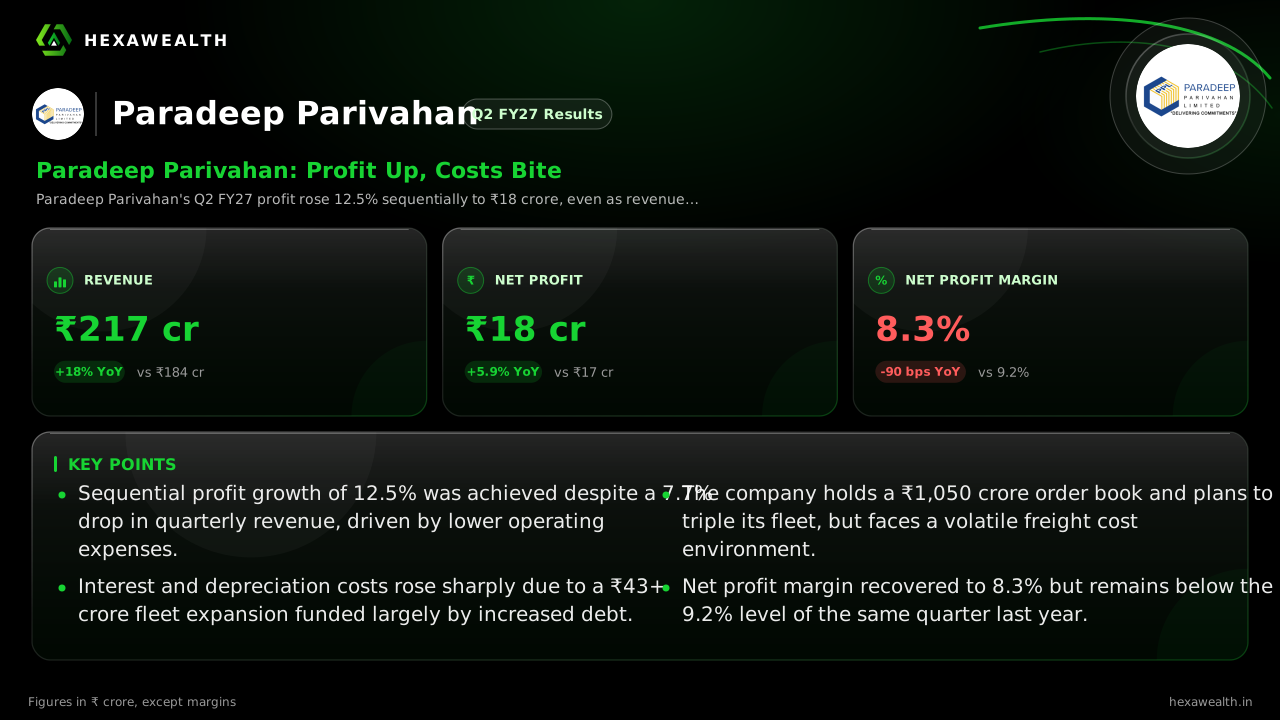
Paradeep Parivahan (PPARIVAH) Q2 FY27 results, revenue and profits.

Frequently asked questions

What were Paradeep Parivahan's Q2 FY27 results?
For the quarter ended September 2026, Paradeep Parivahan reported revenue of ₹217 crore and a net profit of ₹18 crore. This represents a year-on-year growth of 17.9% in revenue and 5.9% in profit, though revenue declined 7.7% from the previous quarter.
Why did Paradeep Parivahan's Q2 FY27 revenue decline sequentially by 7.7% despite a strong YoY growth?
Paradeep Parivahan's Q2 FY27 revenue of ₹217 crore was down 7.7% from the previous quarter's ₹235 crore. The company's business can be seasonal or project-based, and this sequential dip occurred even as the company secured major new contracts, suggesting a timing mismatch in revenue recognition from different projects.
What drove the 12.5% sequential profit growth for Paradeep Parivahan in Q2 FY27 despite lower revenue?
Paradeep Parivahan's Q2 profit grew 12.5% sequentially to ₹18 crore due to a 9.4% reduction in total operating expenses. This cost control allowed profitability to improve even on a lower revenue base of ₹217 crore, lifting the net profit margin to 8.3%.
Why did Paradeep Parivahan's depreciation expense double in Q2 FY27?
Paradeep Parivahan's depreciation expense doubled year-on-year and quarter-on-quarter to ₹6 crore in Q2 FY27. This was due to a significant fleet expansion, with the company spending ₹43.21 crore on property, plant and equipment in the first half of the fiscal year, as reported by Market News & Analysis.
What caused the 33% increase in interest expense for Paradeep Parivahan in Q2 FY27?
Paradeep Parivahan's interest expense rose 33% year-on-year and quarter-on-quarter to ₹4 crore in Q2 FY27. This increase was driven by higher borrowings, which reached ₹123.17 crore in September 2026 to fund the company's ₹43.21 crore fleet capital expenditure program.
What is the status of Paradeep Parivahan's working capital and cash flow?
Paradeep Parivahan's operating cash flow turned negative in H1 FY27, according to a Market News & Analysis report. This was due to working capital absorption, including a rise in trade receivables and loans, even as the business reported an EBITDA of ₹34.40 crore for the half-year.
Did Paradeep Parivahan secure any major long-term contracts in Q2 FY27?
Yes, Paradeep Parivahan secured a landmark 10-year contract with the JSW Group to deploy 100 electric trucks, as announced in October 2026. This is part of a broader ₹1,050 crore order book the company has reported, comprising signed long-term contracts.
What are Paradeep Parivahan's fleet expansion plans?
Paradeep Parivahan plans to scale its transportation fleet by approximately three times over its March 2026 levels. The company has ordered 150 electric vehicles and invested ₹43.21 crore in capital expenditure during H1 FY27 to support this expansion and contract execution.
How did Paradeep Parivahan's stock price react to the Q2 FY27 results?
Following its results announcement, Paradeep Parivahan's stock fell 10.64% on November 12, 2026, according to a Multibagg.ai report. The market reaction suggested investor concern over the company's increased debt and costs despite reporting revenue growth and a large order book.
What are the key customer concentration risks for Paradeep Parivahan?
Paradeep Parivahan faces significant customer concentration risk. A Multibagg.ai report notes that IFFCO contributed 60% to 70% of its business in the first half of FY26. While new contracts like the one with JSW Group help diversify, reliance on a few large clients remains a key business risk.
Paradeep Parivahan H1 FY27 results
For the first half of FY27 (April-September 2026), Paradeep Parivahan reported consolidated revenue of ₹216.64 crore, up 17.6% year-on-year. EBITDA grew 27.6% to ₹34.40 crore, while net profit increased 8.0% to ₹18.47 crore, according to a Business Standard report.
Paradeep Parivahan order book
Paradeep Parivahan reports a secured order book of ₹1,050 crore, as stated in a Business Standard article. This pipeline mainly comprises signed long-term contracts, supporting the company's plan to triple its transportation fleet over the coming periods.