KV Toys India (KVTOYS) Q4 FY26 Profits Rise as Revenue Hits ₹94 Crore, But Cash Flow Tells a Different Story
The toy maker's Q4 FY26 saw sales climb to ₹94 crore, but a surge in receivables and capex turned operating cash flow negative, highlighting the cost of rapid expansion.
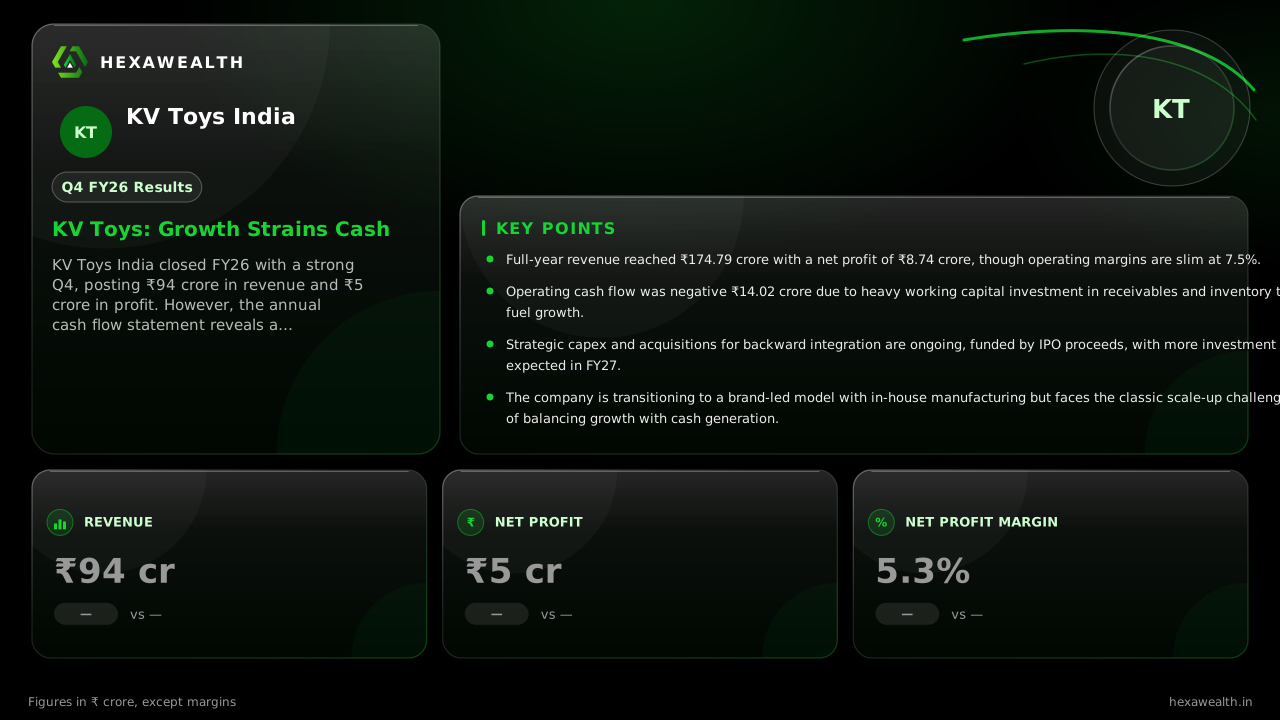
KV Toys India closed FY26 with a strong Q4, posting ₹94 crore in revenue and ₹5 crore in profit. However, the annual cash flow statement reveals a significant cash burn from working capital and new investments, despite a profitable year.
For KV Toys India, the final quarter of FY26 capped a year of rapid growth, but the financial statements reveal the strain that expansion places on cash. The company reported ₹94 crore in revenue and ₹5 crore in net profit for Q4, bringing the full-year figures to ₹174.79 crore and ₹8.74 crore, respectively.
A thin operating margin of 7.5% for the year, as per the annual analysis, underscores the competitive nature of toy manufacturing. The cost of purchased goods consumes a large portion of sales, leaving little room for error.
| Metric | CurrentQ4 FY26 |
|---|---|
| Revenue (₹ Cr) | 94.0 |
| Profit (₹ Cr) | 5.0 |
| Net Profit Margin | 5.3% |
The Cash Conundrum
Despite reporting a profit, KV Toys India's operating cash flow for FY26 was a negative ₹14.02 crore. According to analysis from mcapital.in, this was primarily due to a sharp increase in trade receivables and inventory to support sales growth. Money is tied up in the supply chain faster than it is collected from customers.
This working capital drain was partly funded by IPO proceeds, with ₹26.41 crore already deployed. The cash flow statement shows financing activities brought in ₹25.15 crore, largely from the share issue, which offset the operational outflow.
Building for the Future
Management is investing heavily to shift from a pure distributor to a 'House of Play' with in-house manufacturing. The company commenced operations at its 55%-owned subsidiary, Indo Manufacturers LLP, in May 2026. It also acquired stakes in Play Panda for educational toys and Crayonix for stationery.
Live Chart
· KVTOYS
(BSE)
ISIN: INE1IE301018
These moves aim for backward integration and margin improvement but require capital. mcapital.in estimates suggest further capex of ₹8-12 crore is likely in FY27, which will continue to pressure free cash flow in the near term.
A Market in Transition
The company is navigating a favorable 'Make in India' policy environment and began its first exports to Germany in FY26. However, the industry remains fragmented with thin margins, and KV Toys trades at a significant discount to the industry average P/E.
Foreign institutional investors reduced their stake slightly to 0.80% by September 2026, as per Cruxal.in, while promoter holding remained steady at 58.54%. The board has chosen to conserve cash for expansion, recommending no dividend for FY26.
Key Points
- Full-year revenue reached ₹174.79 crore with a net profit of ₹8.74 crore, though operating margins are slim at 7.5%.
- Operating cash flow was negative ₹14.02 crore due to heavy working capital investment in receivables and inventory to fuel growth.
- Strategic capex and acquisitions for backward integration are ongoing, funded by IPO proceeds, with more investment expected in FY27.
- The company is transitioning to a brand-led model with in-house manufacturing but faces the classic scale-up challenge of balancing growth with cash generation.
Hexa Perspective
KV Toys India is in a classic growth phase where the income statement and the cash flow statement tell opposing stories. Profitability is evident, but cash is being consumed to build the infrastructure for future scale. The success of its backward integration into manufacturing will be key to improving margins over the medium term.
The next few quarters will test whether revenue growth can accelerate enough to outpace the working capital cycle and whether the new manufacturing ventures can deliver the promised operational leverage. Investors are essentially funding this build-out, betting that the company can eventually convert its top-line momentum into sustained cash earnings.
Also read
Want this applied to your portfolio?
Talk to a HexaWealth advisor, or sync your mutual fund data for insights tailored to your holdings.