Insilco (INSILCO) Q2 FY27 Reports Zero Revenue as Liquidation Process Nears Finale
Insilco's Q2 FY27 results show no operational income, with the company's voluntary liquidation process moving towards a final distribution to shareholders.
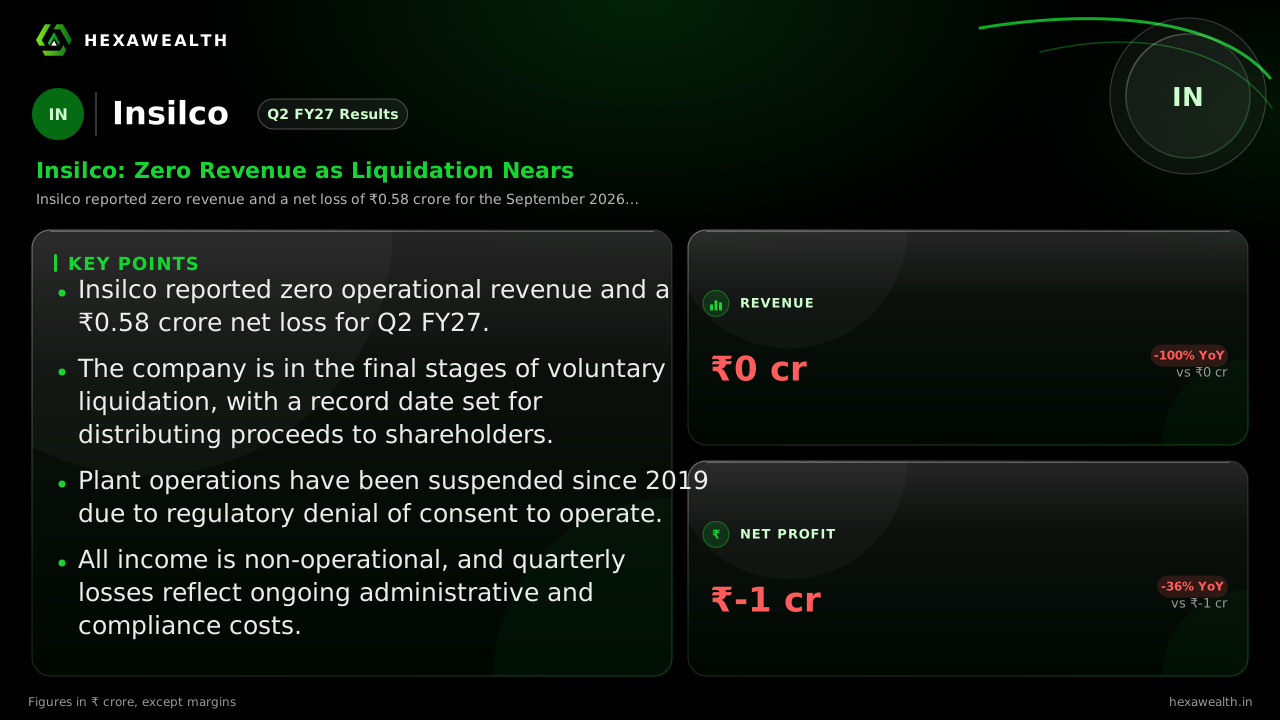
Insilco reported zero revenue and a net loss of ₹0.58 crore for the September 2026 quarter. The company remains under voluntary liquidation, with its plant shut since 2019 and a record date set for distributing remaining proceeds to shareholders.
For Insilco, the September quarter was not about business performance but the final administrative steps of its dissolution. The chemical manufacturer, under voluntary liquidation since 2021, reported zero operational revenue and a net loss of ₹0.58 crore, as the process of winding up nears its legal conclusion.
Revenue & profit
Revenue (₹ Cr)
Profit (₹ Cr)
| Metric | CurrentQ2 FY27 | PreviousQ1 FY27 | Same quarter LYQ2 FY26 |
|---|---|---|---|
| Period | Sep 2026 | Jun 2026 | Sep 2025 |
| Revenue (₹ Cr) | 0.00YoY -100% | 0.08 | 0.10 |
| Profit (₹ Cr) | -0.58YoY +36% | -0.79 | -0.91 |
The reported 'revenue' of ₹0.08 crore in the prior quarter came entirely from other income, primarily interest on financial assets, as noted by Multibagg AI. With that source now absent, the top line has fallen to zero. The quarterly loss stems from administrative costs to maintain corporate compliance during liquidation.
The Final Chapter
The company's plant in Gajraula has been suspended since October 2019 after the Uttar Pradesh Pollution Control Board refused its 'Consent to Operate', as reported by ScanX Trade. This triggered the voluntary liquidation process, which was completed in July 2025. The board has now set November 20, 2026, as the record date for the distribution of the remaining liquidation proceeds to shareholders.
Management's focus is solely on closing the corporate entity. The board approved a related-party transaction with promoter Evonik India for payments towards liquidation costs, according to StockWatch. No revival plans or new business ventures are on the table.
Key Points
- Insilco reported zero operational revenue and a ₹0.58 crore net loss for Q2 FY27.
- The company is in the final stages of voluntary liquidation, with a record date set for distributing proceeds to shareholders.
- Plant operations have been suspended since 2019 due to regulatory denial of consent to operate.
- All income is non-operational, and quarterly losses reflect ongoing administrative and compliance costs.
Hexa Perspective
This quarter confirms Insilco's status as a corporate entity in run-off, with its financials reflecting only the costs of dissolution. The investment story has concluded, shifting from earnings analysis to the mechanics of final shareholder distribution. The remaining value for investors is tied to the net realizable value of any residual assets, not future business prospects.
Also read
Want this applied to your portfolio?
Talk to a HexaWealth advisor, or sync your mutual fund data for insights tailored to your holdings.