Go Digit (GODIGIT) Q2 FY27 Profit Falls 31% as Flood Claims and Soft Premiums Pressure Margins
The digital insurer's net profit dropped sharply year-on-year as a high claims ratio and disciplined underwriting offset a modest rise in revenue.
Go Digit's Q2 FY27 profit fell 31% to ₹142 crore despite a 3.7% revenue gain. The drop was driven by a surge in flood-related claims and a strategic pullback from unattractive business, pushing the combined ratio to 99.8%.
For a digital insurer, growth is often measured by premium collection and underwriting discipline. Go Digit's September quarter shows the tension between the two, as profit fell sharply even as revenue inched up.
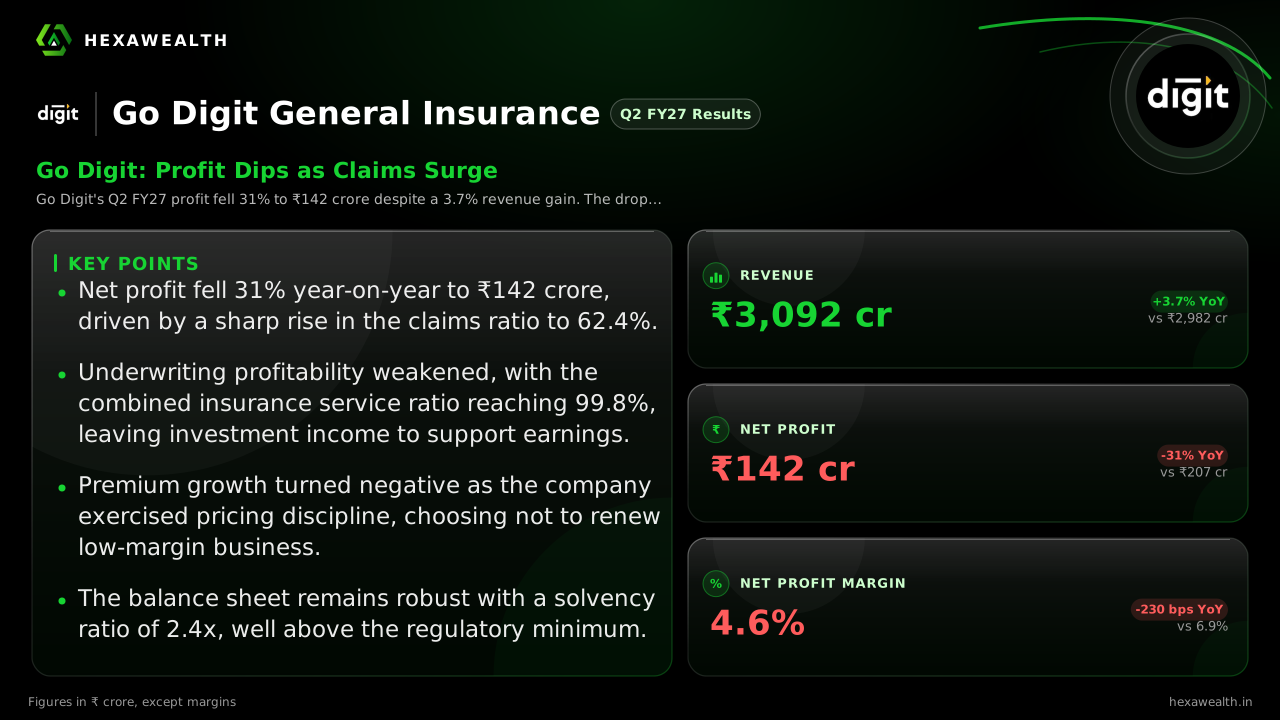
The numbers tell a story of pressure. Revenue grew 3.7% year-on-year to ₹3,092 crore, but net profit dropped 31.1% to ₹142 crore. The net profit margin compressed by 230 basis points to 4.6%. Sequentially, profit rebounded 64.8% from a weak Q1, but that recovery was from a low base.
Revenue & profit
Revenue (₹ Cr)
Profit (₹ Cr)
Net Profit Margin (%)
| Metric | CurrentQ2 FY27 | PreviousQ1 FY27 | Same quarter LYQ2 FY26 |
|---|---|---|---|
| Revenue (₹ Cr) | 3,091.99YoY +3.7% | 2,427.98 | 2,982.01 |
| Profit (₹ Cr) | 142.39YoY -31% | 86.39 | 206.79 |
| Net Profit Margin (%) | 4.6YoY -33% | 3.6 | 6.9 |
The Underwriting Squeeze
The profit drop stems from the core insurance business. The combined insurance service ratio, a key measure of underwriting profitability, deteriorated to 99.8% from 94.9% a year ago, as reported by Ventura Securities. A ratio near 100% means underwriting contributed almost nothing to earnings.
Heavy monsoon floods were a primary culprit, with losses of ₹63 crore this quarter against ₹10 crore last year. The claims ratio jumped to 62.4% from 48.2%. Management, cited in reports, framed this as a temporary weather shock.
Growth Takes a Back Seat
Simultaneously, the company held back on top-line growth. Gross written premium fell 3.6%, while the industry grew 7%. Go Digit chose not to renew unattractively priced health reinsurance and government business.
This discipline is a strategic choice flagged since last quarter. The focus is on protecting margins in a soft market, even if it means ceding market share temporarily. The motor own-damage segment, a persistent trouble spot, saw its loss ratio improve sequentially but remains elevated.
The Investment Buffer and Outlook
Investment income of ₹368 crore, as per reports, provided crucial support to the bottom line. Excluding mark-to-market impacts and flood losses, Ventura Securities notes profit after tax would have been closer to ₹255 crore.
The road ahead hinges on claims normalisation. If the flood impact recedes as expected, the combined ratio should improve. However, the competitive motor pricing environment remains a structural challenge. The company's strong solvency ratio of 2.4x provides capital flexibility to navigate this period.
Key Points
- Net profit fell 31% year-on-year to ₹142 crore, driven by a sharp rise in the claims ratio to 62.4%.
- Underwriting profitability weakened, with the combined insurance service ratio reaching 99.8%, leaving investment income to support earnings.
- Premium growth turned negative as the company exercised pricing discipline, choosing not to renew low-margin business.
- The balance sheet remains robust with a solvency ratio of 2.4x, well above the regulatory minimum.
Hexa Perspective
The quarter underscores the classic insurance trade-off: growth versus profitability. Go Digit is clearly choosing the latter for now, accepting a slower premium trajectory to defend its book's quality. The flood losses appear transient, but the underlying pressure in motor lines is a sector-wide issue that won't vanish quickly.
The investment portfolio is a reliable earnings cushion, but for the stock's premium valuation to hold, the market needs to see the combined ratio sustainably retreat below 100 and premium growth re-accelerate. The strategic optionality of a potential combination with IDBI Bank via promoter Fairfax remains a long-term narrative, but the near-term story is one of margin repair.
Also read
Want this applied to your portfolio?
Talk to a HexaWealth advisor, or sync your mutual fund data for insights tailored to your holdings.