Goa Carbon (GOACARBON) Q2 FY27’s Revenue Triples, But Debt Costs Keep It in the Red
The calcined petroleum coke maker saw a 149% revenue jump, but a record interest bill of over ₹10 crore prevented a return to profitability.
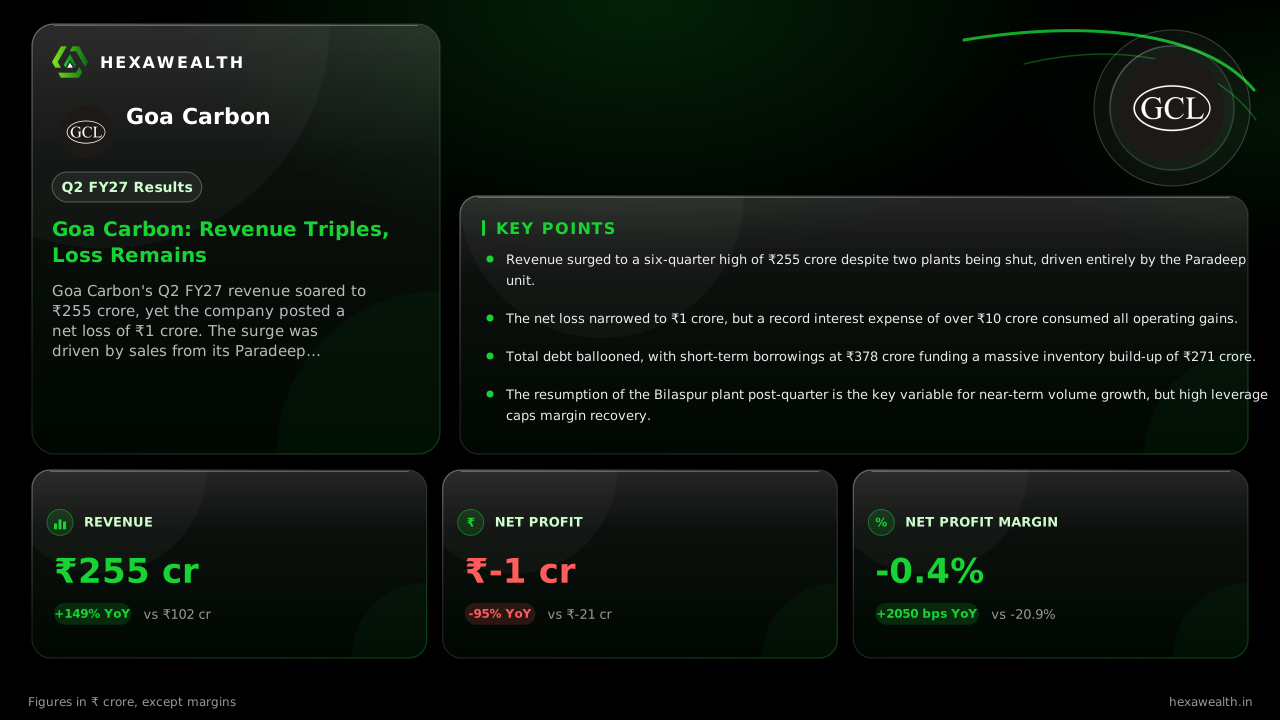
Goa Carbon's Q2 FY27 revenue soared to ₹255 crore, yet the company posted a net loss of ₹1 crore. The surge was driven by sales from its Paradeep plant, but high debt and interest costs eroded operating gains.
For a calcined petroleum coke maker, a quarter where two of three plants are shut is usually a disaster. Goa Carbon’s Q2 FY27 turned that logic on its head, posting its highest revenue in six quarters even as its Goa and Bilaspur units were idled for maintenance. The top-line surge, however, failed to reach the bottom line.
Revenue hit ₹255 crore, up 149% from a year ago and nearly quadruple the dismal ₹66 crore in Q1. The net loss narrowed sharply to ₹1 crore from ₹21 crore last year, but the company remains unprofitable. The operating margin turned positive for the first time in five quarters, reaching 2.3%.
Revenue & profit
Revenue (₹ Cr)
Profit (₹ Cr)
| Metric | CurrentQ2 FY27 | PreviousQ1 FY27 | Same quarter LYQ2 FY26 |
|---|---|---|---|
| Revenue (₹ Cr) | 255.01YoY +149% | 65.70 | 102.47 |
| Profit (₹ Cr) | -1.00YoY +95% | -6.58 | -21.41 |
| Net Margin (%) | -0.4YoY +98% | -10.0 | -20.9 |
The debt that ate the profit
The revenue jump, as reported by Stockwatch, came solely from the Paradeep plant running at full tilt while the other two were shut. This operational efficiency turned EBITDA positive. Yet, total expenses rose 118% year-on-year to ₹260 crore, nearly matching revenue.
The primary culprit was a record quarterly interest cost of ₹10.26 crore, up 70% from last year. MarketsMojo notes this interest bill alone was nearly double the quarter’s operating profit of ₹5.79 crore. This stems from a massive working capital build-up, with inventory soaring to ₹271 crore from ₹90 crore in March and short-term borrowings jumping to ₹378 crore.
A fragile path forward
The immediate catalyst for Q3 is the Bilaspur plant, which resumed operations on October 3. Its contribution should boost volumes, but the underlying debt burden remains a structural drag. The company’s debt-to-equity ratio stands at 1.97, and with 93% of promoter shares pledged, financial flexibility is severely constrained.
Demand from the aluminium sector, a key consumer, appears stable. Hindalco recently flagged that calcined petroleum coke contributed to a sequential cost increase for aluminium production. However, for Goa Carbon, translating stable demand into profit requires taming its finance costs first.
Key Points
- Revenue surged to a six-quarter high of ₹255 crore despite two plants being shut, driven entirely by the Paradeep unit.
- The net loss narrowed to ₹1 crore, but a record interest expense of over ₹10 crore consumed all operating gains.
- Total debt ballooned, with short-term borrowings at ₹378 crore funding a massive inventory build-up of ₹271 crore.
- The resumption of the Bilaspur plant post-quarter is the key variable for near-term volume growth, but high leverage caps margin recovery.
Hexa Perspective
This quarter is a story of operational grit overshadowed by financial strain. Running one plant to generate ₹255 crore in sales is a feat, but it was funded by debt that now demands a ₹10 crore quarterly tribute. The improvement in operating margin is real, yet it exists in a narrow band above zero, leaving no buffer against interest shocks.
For the loss to vanish, either operating profit must grow enough to cover the interest, or debt must fall. The Bilaspur restart helps the first, but the second requires a reversal of the inventory build-up that may not come quickly. Investors are left weighing a promising volume recovery against a balance sheet that shows little sign of easing.
Also read
Want this applied to your portfolio?
Talk to a HexaWealth advisor, or sync your mutual fund data for insights tailored to your holdings.