Finkurve (FINKURVE) Q2 FY27's Gold Loan Bet Pays Off, But Profitability Takes a Hit
Finkurve Financial Services saw assets under management nearly double year-on-year, driving a 204% profit surge, but rising costs and a drop in asset quality squeezed margins.
Finkurve Financial Services posted explosive growth in its September quarter, with revenue up 244% and profit jumping 204%. The gold loan-focused NBFC's rapid branch expansion fueled this surge, but higher funding and operating costs eroded its net profit margin.
For Finkurve Financial Services, the September quarter was a story of aggressive growth meeting rising costs. The gold loan NBFC, now rebranding to Augmont, saw its asset base nearly double from a year ago, translating into a massive profit jump. Yet, the cost of funding that expansion has started to bite, compressing margins and raising questions about asset quality as the book scales.
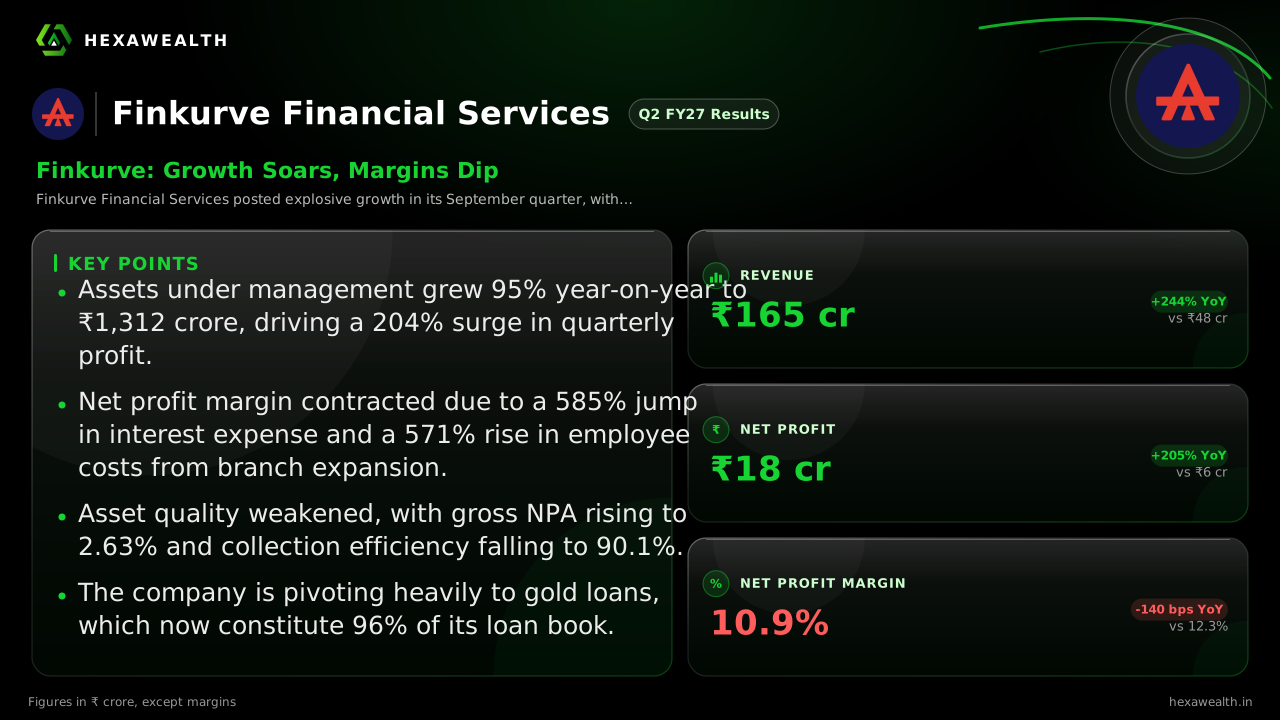
The numbers tell a powerful growth story. Revenue soared 244% year-on-year to ₹165 crore, while profit after tax more than tripled to ₹18 crore. Sequentially, revenue and profit both more than doubled from the June quarter. The engine was a 95% surge in assets under management (AUM) to ₹1,312 crore, as reported by Outlook Business.
Revenue & profit
Revenue (₹ Cr)
Profit (₹ Cr)
Net Profit Margin (%)
| Metric | CurrentQ2 FY27 | PreviousQ1 FY27 | Same quarter LYQ2 FY26 |
|---|---|---|---|
| Revenue (₹ Cr) | 165.04YoY +243% | 75.10 | 48.05 |
| Profit (₹ Cr) | 18.03YoY +205% | 8.44 | 5.92 |
| Net Profit Margin (%) | 10.9YoY -11% | 11.2 | 12.3 |
The Cost of Scaling
The growth came at a price. Interest expense rocketed 585% year-on-year as the company borrowed more to fund its loan book. Employee costs also surged 571%, driven by a branch network that expanded from 92 to 122 locations and the hiring of senior leadership.
This spending spree pressured profitability. The net interest margin, a key measure of lending efficiency, fell to 18.0% from 25.6% a year ago, according to a Multibagg.ai analysis. Consequently, the net profit margin shrank 140 basis points year-on-year to 10.9%.
A Quality Question Mark
Alongside margin pressure, signs of stress emerged in the loan portfolio. Gross NPA rose to 2.63% from 1.13% a year ago, while net NPA reached 2.37%, as per the company's investor presentation. Collection efficiency also dipped to 90.1%.
The company's loan-to-value ratio on gold loans climbed to 80.4%, up from 64.4% a year earlier. This suggests higher risk exposure per loan, even as the core gold loan business now makes up 96% of the book.
The Road Ahead
Management, cited by Outlook Business, aims to deepen its gold loan presence and strengthen branch productivity in the second half. The company is targeting a co-lending contribution of up to 30% of AUM over the next few years to improve capital efficiency.
However, the recent RBI move to increase risk weights on unsecured retail credit, highlighted by The Economic Times, could raise funding costs for NBFCs. This adds a regulatory headwind just as Finkurve plans to increase leverage to 4-4.5x by FY27-end, as noted by StockFin.ai.
Key Points
- Assets under management grew 95% year-on-year to ₹1,312 crore, driving a 204% surge in quarterly profit.
- Net profit margin contracted due to a 585% jump in interest expense and a 571% rise in employee costs from branch expansion.
- Asset quality weakened, with gross NPA rising to 2.63% and collection efficiency falling to 90.1%.
- The company is pivoting heavily to gold loans, which now constitute 96% of its loan book.
Hexa Perspective
Finkurve is executing a high-velocity growth playbook, successfully scaling its gold loan franchise. The trade-off is clear: top-line momentum for near-term margin compression and emerging asset quality concerns.
The next few quarters will test whether operational leverage from its expanded branch network can offset rising funding costs. Investors are weighing robust AUM growth against a valuation that trades at an 89% premium to the industry PE, all while watching for stability in collections and credit costs.
Also read
Want this applied to your portfolio?
Talk to a HexaWealth advisor, or sync your mutual fund data for insights tailored to your holdings.