Chandni Machines (CHANDNIMACH) Q1 FY27' Trading Engine Stalls as Q1 Revenue Plunges 98%
The equipment trader's core business evaporated, leading to a near-total revenue wipeout and a deeper net loss, even as it pivots to new ventures.
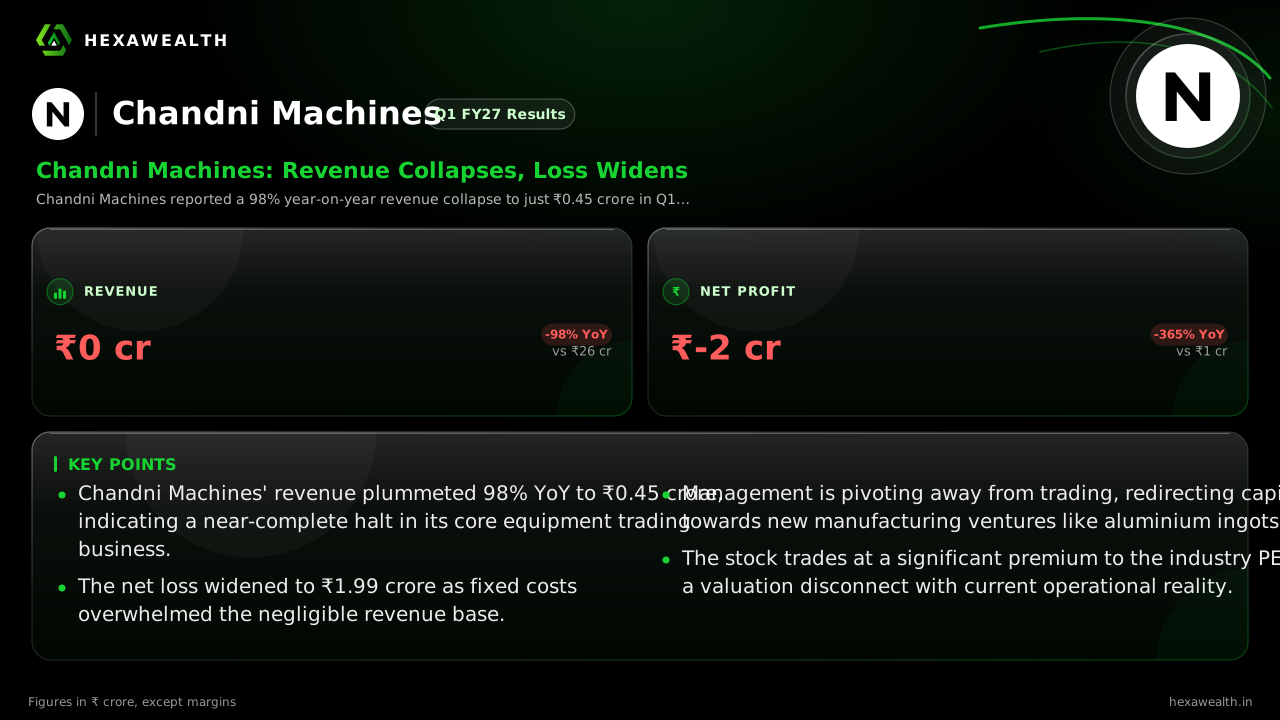
Chandni Machines reported a 98% year-on-year revenue collapse to just ₹0.45 crore in Q1 FY27. The net loss widened to ₹1.99 crore, highlighting a severe breakdown in its core trading operations.
For a company that acts as a bridge between global machine builders and Indian factories, a quarter with almost no sales signals a broken link. Chandni Machines' Q1 FY27 reveals a near-total evaporation of its core trading business, with revenue collapsing 98% from the year-ago period and losses deepening.
The numbers paint a stark picture of operational paralysis. Revenue fell to a mere ₹0.45 crore from ₹25.9 crore a year ago. The net loss widened to ₹1.99 crore, compared to a profit of ₹0.75 crore in Q1 FY26. Sequentially, a 542% jump in revenue from an abysmal ₹0.07 crore base offers no comfort, as total expenses surged over 1400%.
Revenue & profit
Revenue (₹ Cr)
Profit (₹ Cr)
| Metric | CurrentQ1 FY27 | PreviousQ4 FY26 | Same quarter LYQ1 FY26 |
|---|---|---|---|
| Revenue (₹ Cr) | 0.45YoY -98% | 0.07 | 25.9 |
| Profit (₹ Cr) | -1.99YoY -365% | -1.15 | 0.75 |
Why the Trading Floor Went Silent
The collapse is not a market-wide phenomenon. Reports from Tradebrains and MarketsMojo note that India's injection moulding sector is actually growing, driven by automotive and packaging demand. The problem appears specific to Chandni Machines' ability to execute trades. A MarketsMojo analysis of Q4 FY26 flagged a "virtual collapse" of trading operations, a trend that clearly continued into this quarter.
With minimal revenue, fixed costs like employee expenses and depreciation became a crushing burden. This led to an operating loss of ₹2.59 crore. The situation was exacerbated by a tax credit of ₹0.61 crore, which, while providing accounting relief, underscores the depth of the pre-tax loss.
A Pivot Amid the Ruins
Facing a non-functional core, management is executing a sharp strategic turn. Shareholders recently approved a major expansion of the company's Memorandum of Association, as reported by ScanX. The new mandate includes manufacturing metal ingots, marine engineering, and chemical trading.
An aluminium ingot manufacturing project in Rajkot is already underway, with trial production targeted for September 2026. This diversification is funded by reallocating ₹29.09 crore from a recent preferential issue. The old business of trading machines is being sidelined for a new, unproven one in manufacturing.
Key Points
- Chandni Machines' revenue plummeted 98% YoY to ₹0.45 crore, indicating a near-complete halt in its core equipment trading business.
- The net loss widened to ₹1.99 crore as fixed costs overwhelmed the negligible revenue base.
- Management is pivoting away from trading, redirecting capital towards new manufacturing ventures like aluminium ingots.
- The stock trades at a significant premium to the industry PE, a valuation disconnect with current operational reality.
Hexa Perspective
This quarter is less an earnings report and more a diagnosis of a failed business model. The trading engine has seized, and the promised pivot into manufacturing is a high-risk, capital-intensive reinvention. The ₹150 lakh aluminium project is a small bet against a history of volatility. Investors are left weighing the credibility of this strategic shift against a track record of extreme quarterly swings. The 66% premium to the industry PE seems to price in a successful transformation that is, as yet, only a plan on paper. The next few quarters will reveal if this is a rebirth or a retreat.
Also read
Want this applied to your portfolio?
Talk to a HexaWealth advisor, or sync your mutual fund data for insights tailored to your holdings.