DSJ Keep Learning (KEEPLEARN) Q2 FY27 Swings to Loss as Costs Soar Amid Revenue Decline
The education services provider posted a quarterly loss of ₹0.93 crore as a sharp drop in revenue collided with a 35% surge in employee costs.
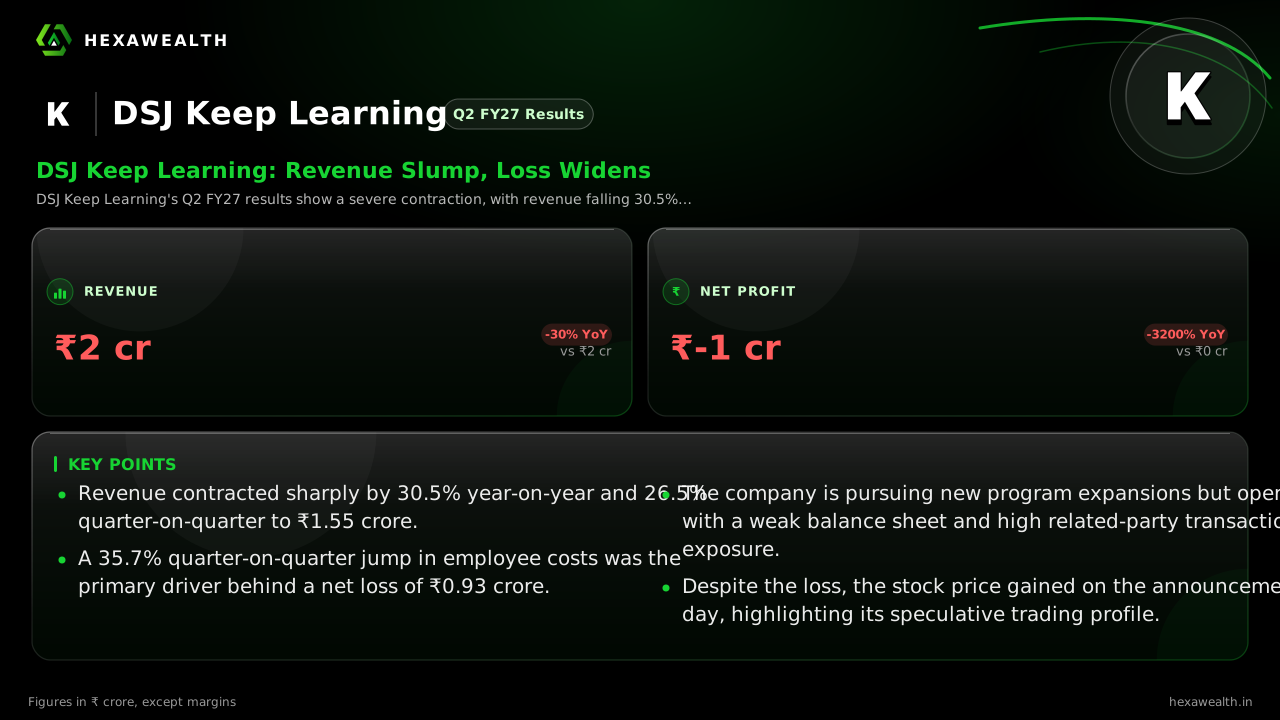
DSJ Keep Learning's Q2 FY27 results show a severe contraction, with revenue falling 30.5% year-on-year to ₹1.55 crore. The company swung to a net loss of ₹0.93 crore, driven by sharply higher employee expenses and interest costs.
For DSJ Keep Learning, a quarter that began with a return to profit has ended in a deeper loss. The education enabler's revenue fell sharply while its cost base expanded, wiping out the fragile gains from the prior quarter and raising questions about its operating stability.
The September quarter saw revenue drop to ₹1.55 crore, down 30.5% from a year ago and 26.5% sequentially. This decline pushed the company into a net loss of ₹0.93 crore, a stark reversal from the ₹0.10 crore profit in Q1. The story is told in the widening gap between shrinking income and rising expenses.
Revenue & profit
Revenue (₹ Cr)
Net Profit (₹ Cr)
| Metric | CurrentQ2 FY27 | PreviousQ1 FY27 | Same quarter LYQ2 FY26 |
|---|---|---|---|
| Revenue (₹ Cr) | 1.55YoY -30% | 2.11 | 2.23 |
| Net Profit (₹ Cr) | -0.93YoY -3200% | 0.10 | 0.03 |
The Cost Squeeze That Erased Profit
Total expenses jumped 24.1% quarter-on-quarter to ₹2.55 crore even as revenue fell. The main driver was a 35.7% sequential surge in employee costs, which reached ₹1.38 crore. Interest expense also rose sharply by 72.9% to ₹0.10 crore. This fixed-cost inflation against a declining revenue base created an unsustainable drag on profitability.
Research from StockFin.ai notes the company's financial ratios show significant deterioration, requiring close monitoring of profitability and liquidity risks. The market had no formal estimates to beat or miss, as a Univest.in preview noted no verified analyst consensus exists for this small-cap name.
A Strategic Pivot Amidst Weakness
Management is not standing still. The company's annual report, cited by InvestorFeed, indicates it is eyeing expansion into new MSc programs and SaaS offerings. However, this comes after a full-year net loss of ₹0.97 crore in FY26. Furthermore, shareholders recently approved substantial related-party transactions, which a StockFin.ai report flags as totaling 312.5% of consolidated turnover.
The stock defied the weak print, rising 8.65% on results day according to The Economic Times. This reaction may reflect its micro-cap nature and low liquidity, rather than fundamental approval. The one-year share price return remains deeply negative at -33.3%.
Key Points
- Revenue contracted sharply by 30.5% year-on-year and 26.5% quarter-on-quarter to ₹1.55 crore.
- A 35.7% quarter-on-quarter jump in employee costs was the primary driver behind a net loss of ₹0.93 crore.
- The company is pursuing new program expansions but operates with a weak balance sheet and high related-party transaction exposure.
- Despite the loss, the stock price gained on the announcement day, highlighting its speculative trading profile.
Hexa Perspective
The quarter underscores the operational fragility of a business at this scale. Revenue is volatile and the cost structure is not aligned with the current income level, leading to deep losses when sales dip.
The path forward hinges on whether new initiatives can generate stable, higher-margin revenue before the cost burden becomes overwhelming. Investors are effectively betting on a strategic turnaround in a sector with long gestation periods, making this a high-risk proposition.
Also read
Want this applied to your portfolio?
Talk to a HexaWealth advisor, or sync your mutual fund data for insights tailored to your holdings.