Capital Infra Trust (CAPINVIT) Q1 FY27 Profit Slips on Accounting Timing, Holds FY27 Payout Target
The InvIT's Q1 profit fell 36% sequentially due to accounting timing and maintenance, but annuity cash flows were stable and management held its distribution guidance.
Capital Infra Trust's Q1 profit fell 36% from the previous quarter, but the decline was driven by accounting recognition and planned maintenance. Management reaffirmed its FY27 distribution per unit guidance, supported by a pipeline of six new asset acquisitions.
For an infrastructure trust, the story is not in a single quarter's reported profit but in the annuity cash flows that fund its distributions. Capital Infra Trust's first quarter showed that split clearly, with profit down sharply from the previous period while the payout to unitholders held its course.
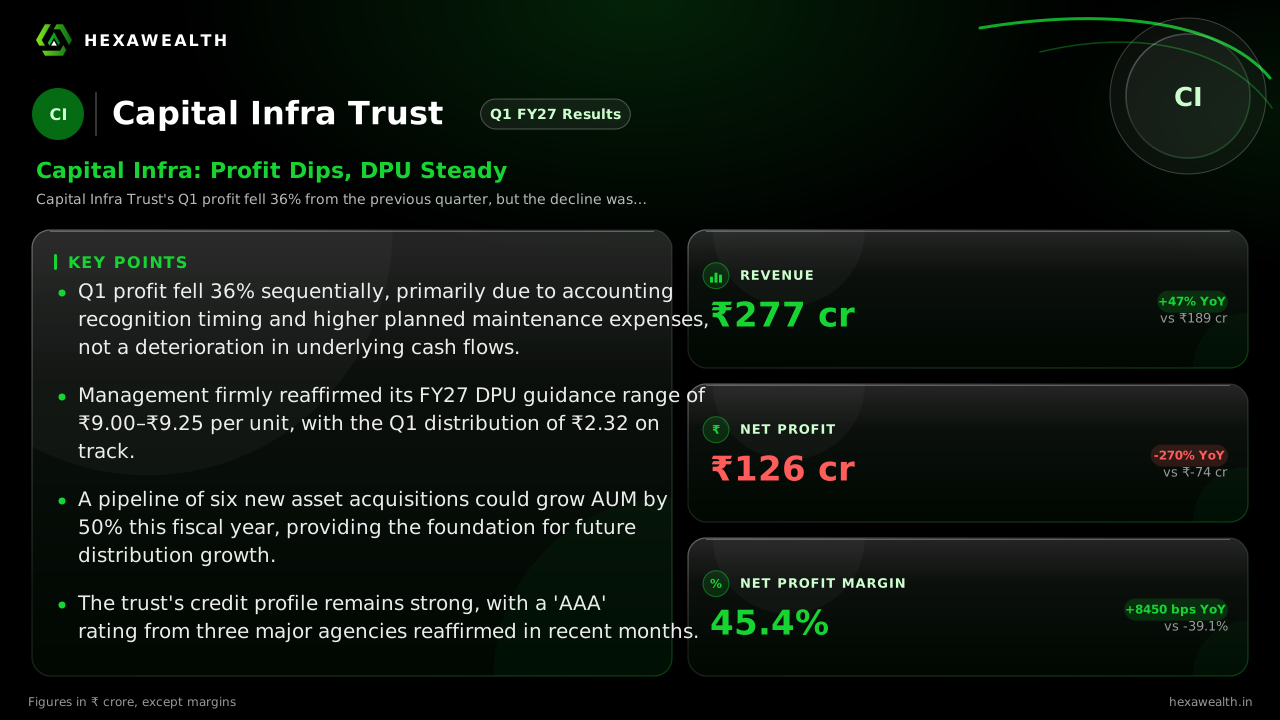
The numbers reveal a quarter of two halves. Revenue of ₹276.8 crore was up 47% from a year ago but dipped 2% sequentially. The real story is in profit, which fell 36% quarter-on-quarter to ₹125.6 crore. This follows an exceptionally strong Q4, creating a tough comparison.
Revenue & profit
Revenue (₹ Cr)
Profit (₹ Cr)
Net Profit Margin
| Metric | CurrentQ1 FY27 | PreviousQ4 FY26 | Same quarter LYQ1 FY26 |
|---|---|---|---|
| Revenue (₹ Cr) | 276.81YoY +47% | 282.93 | 188.70 |
| Profit (₹ Cr) | 125.62YoY +270% | 195.04 | -73.72 |
| Net Profit Margin | 45.4%YoY +216% | 68.9% | -39.1% |
Why the profit margin narrowed
Management, cited in an InvestorStack summary, attributed the sequential declines to accounting and timing. The trust uses percentage-of-completion accounting, so revenue and expense recognition can vary. From a cash perspective, annuity inflows of ₹2,162 million for the quarter were exactly in line with the business plan.
The sharp drop in other income—down 71% from Q4—and a 28% rise in total expenses for planned maintenance also squeezed the bottom line. The net profit margin compressed from 68.9% to 45.4% as a result. Analysts have noted the trust's operating expense ratio is higher than some peers, which management attributes to its accounting method and portfolio scale.
The cash flow story remains intact
Despite the profit dip, the distribution engine is unchanged. The board approved a payout of ₹2.32 per unit for Q1. CEO Hare Krishna, quoted in a company press release, said the portfolio of 12 operational HAM assets continues to generate predictable cash flows.
Critically, management reaffirmed its full-year Distribution Per Unit (DPU) guidance of ₹9.00 to ₹9.25. It also provided a directional outlook for 7-10% DPU growth in FY28. This confidence is rooted in a clear path for growth.
A transformative acquisition pipeline
FY27 is poised to be a year of significant scale. The trust is conducting due diligence on six sponsor-owned HAM assets. According to an Arthneeti.com presentation summary, this could increase Assets Under Management by nearly 50% to around ₹100 billion and expand the portfolio from 12 to 18 assets.
These acquisitions, targeted for completion in Q2 or Q3 FY27, would extend the trust's annuity visibility largely to 2040. Funding will come from a mix of debt and equity, with leverage targeted to rise from 41.1% toward 50-60%.
Key Points
- Q1 profit fell 36% sequentially, primarily due to accounting recognition timing and higher planned maintenance expenses, not a deterioration in underlying cash flows.
- Management firmly reaffirmed its FY27 DPU guidance range of ₹9.00–₹9.25 per unit, with the Q1 distribution of ₹2.32 on track.
- A pipeline of six new asset acquisitions could grow AUM by 50% this fiscal year, providing the foundation for future distribution growth.
- The trust's credit profile remains strong, with a 'AAA' rating from three major agencies reaffirmed in recent months.
Hexa Perspective
The quarter underscores the difference between accounting profit and distributable cash for an InvIT. The sequential profit decline looks stark, but management's explanation that annuity collections were on plan and its commitment to the full-year payout target are more relevant for income-focused unitholders.
The coming quarters will test the execution thesis. Successfully closing the six-asset acquisition at NAV-accretive terms is the key to achieving the guided DPU growth. Investors are weighing the promise of a larger, higher-yielding portfolio against the execution and integration risks of a near-50% expansion in scale.
Also read
Want this applied to your portfolio?
Talk to a HexaWealth advisor, or sync your mutual fund data for insights tailored to your holdings.