Barak Valley Cements (BVCL) Q2 FY27 Profit Drops 42% Sequentially Despite Strong YoY Turnaround
The cement maker's revenue held steady, but a sharp quarterly drop in profit highlights persistent margin pressure in a competitive regional market.
Barak Valley Cements reported a 29% yearly revenue jump but a 42% sequential profit fall. The quarter shows a return to profitability from last year's loss, yet margins tightened as costs rose faster than sales.
For Barak Valley Cements, the September quarter was a story of two comparisons. A strong yearly rebound from loss to profit was overshadowed by a sharp sequential decline, revealing the underlying strain of operating in the North East's cement market.
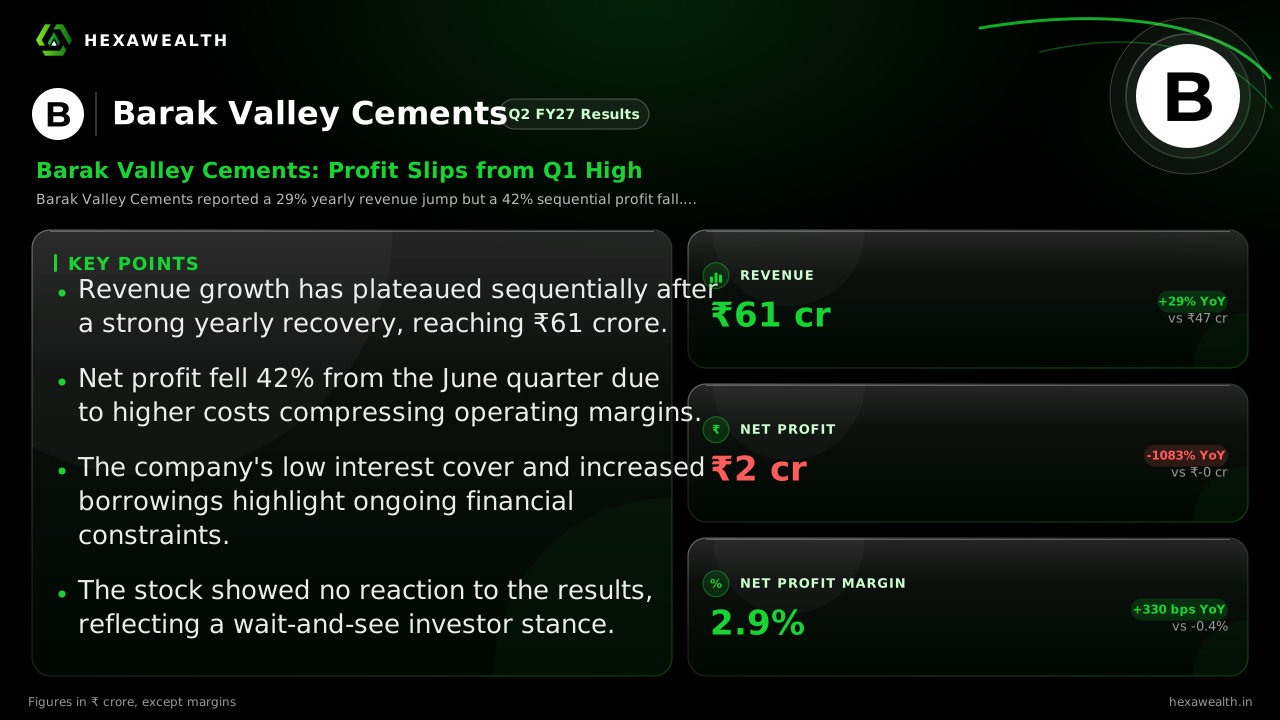
The numbers show the tension. Revenue grew 28.9% year-on-year to ₹61.05 crore, but was nearly flat compared to the June quarter. Net profit swung to ₹1.77 crore from a ₹0.18 crore loss a year ago, yet it fell 42.2% from the previous quarter's ₹3.06 crore. The net profit margin compressed to 2.9% from 5.0% in Q1.
Revenue & profit
Revenue (₹ Cr)
Net Profit (₹ Cr)
| Metric | CurrentQ2 FY27 (Sep '26) | PreviousQ1 FY27 (Jun '26) |
|---|---|---|
| Revenue (₹ Cr) | 61.05 | 60.87 |
| Net Profit (₹ Cr) | 1.77 | 3.06 |
| Net Margin (%) | 2.9 | 5.0 |
Why profit fell from the June peak
The profit drop stemmed from rising costs and a softer operating performance. Total expenses rose 4.2% quarter-on-quarter, outpacing the minimal revenue growth. According to reports from scanx.trade and ResultKal, operating profit (EBITDA) fell 35.8% sequentially to about ₹4 crore. This pushed the operating margin down to 6.4% from 10% in Q1.
A key support was a surge in other income, which jumped 473% QoQ to ₹0.67 crore, as noted by ResultKal. This non-operational boost helped cushion the pre-tax profit decline to 40%. Without it, the sequential profit fall would have been steeper.
The financial tightrope
Even with the yearly profit, the company's financial health remains delicate. The interest coverage ratio stands at a low 1.66 times, per the payload data. Chart Galaxy Radar rates its financial health as 'adequate', citing a debt-to-equity of 0.23 but a thin earnings buffer for interest costs.
Half-yearly cash flow was weak, and borrowings increased, according to details in the arthneeti.com results statement. This limits room for aggressive expansion or weathering prolonged cost pressure.
A muted market reaction
The stock market registered the mixed print with indifference. The share price was unchanged at ₹37.14 on the results date, as per MarketsMojo alerts. The lack of a major brokerage rating change or price target after the results, noted on Barron's, suggests limited institutional interest or conviction in the near-term trajectory.
Key Points
- Revenue growth has plateaued sequentially after a strong yearly recovery, reaching ₹61 crore.
- Net profit fell 42% from the June quarter due to higher costs compressing operating margins.
- The company's low interest cover and increased borrowings highlight ongoing financial constraints.
- The stock showed no reaction to the results, reflecting a wait-and-see investor stance.
Hexa Perspective
This quarter underscores Barak Valley Cement's position in a challenging niche. The yearly profit turnaround is a positive step, but the sequential decline shows how fragile that recovery is when sales volumes stall and costs creep up. The company's valuation, at a significant premium to the industry P/E, seems disconnected from its thin margins and tight cash flow.
The path forward hinges on two factors: sustaining sales volume growth in its regional market and managing input costs better than peers. With the broader cement sector expecting better pricing and lower fuel costs in the second half, Barak Valley needs those tailwinds to materialize in the North East to prevent further margin erosion.
Also read
Want this applied to your portfolio?
Talk to a HexaWealth advisor, or sync your mutual fund data for insights tailored to your holdings.