Bervin Investment & Leasing (BERVINL) Q2 FY27 Losses Deepen in Q2 Despite Lower Borrowing Costs
The pure-play investment firm saw its net loss triple year-on-year as fixed overheads overwhelmed savings from sharply lower interest expenses.
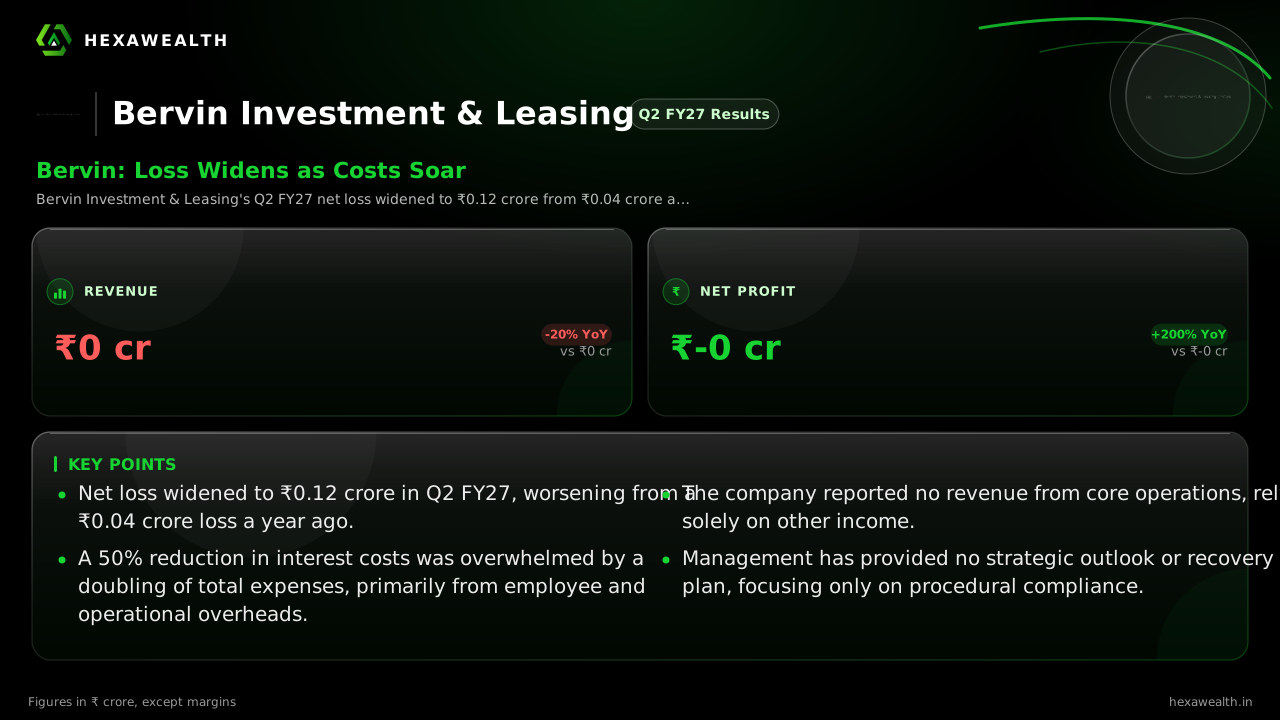
Bervin Investment & Leasing's Q2 FY27 net loss widened to ₹0.12 crore from ₹0.04 crore a year ago. A 50% drop in interest costs was more than offset by a doubling of total expenses, with no revenue from core operations.
For a company whose business is deploying funds in capital markets, a quarter where the Nifty fell 5% sets a difficult stage. Bervin Investment & Leasing's September quarter results show the strain, with losses widening despite a significant reduction in its cost of borrowing.
The numbers tell a story of static income and rising overheads. Revenue, entirely from other income, was flat sequentially and down 20% year-on-year at ₹0.04 crore. Meanwhile, the net loss deepened to ₹0.12 crore, nearly triple the ₹0.04 crore loss in Q2 FY26.
Revenue & profit
Revenue (₹ Cr)
Net Profit (₹ Cr)
| Metric | CurrentQ2 FY27 | PreviousQ1 FY27 | Same quarter LYQ2 FY26 |
|---|---|---|---|
| Period | Sep 2026 | Jun 2026 | Sep 2025 |
| Revenue (₹ Cr) | 0.04YoY -20% | 0.04 | 0.05 |
| Net Profit (₹ Cr) | -0.12YoY -200% | -0.11 | -0.04 |
The Cost Saving That Wasn't Enough
A near 50% year-on-year drop in interest expense offered a clear saving, as reported by scanx.trade. Yet total expenses still more than doubled. Employee costs and other operational overheads rose, consuming the benefit from lower finance charges. With no revenue from core investment or trading activities, these fixed costs directly pressure the bottom line.
A Strategy of Silence
Management commentary, as noted in a StockFin.ai analysis, has been absent. The company's recent communications emphasize governance and compliance but offer no forward-looking operational guidance or a articulated path to profitability. This leaves stakeholders with little visibility on how, or if, the firm plans to reactivate its investment mandate to generate returns.
The Market's Unforgiving Quarter
The weak quarter coincided with a tough market. As per a Univest report, the Nifty 50 fell about 5% in the September 2026 quarter, its worst September since 2018. For a portfolio reliant on market performance, such an environment provides little tailwind for investment income.
Key Points
- Net loss widened to ₹0.12 crore in Q2 FY27, worsening from a ₹0.04 crore loss a year ago.
- A 50% reduction in interest costs was overwhelmed by a doubling of total expenses, primarily from employee and operational overheads.
- The company reported no revenue from core operations, relying solely on other income.
- Management has provided no strategic outlook or recovery plan, focusing only on procedural compliance.
Hexa Perspective
The quarter underscores the vulnerability of a pure investment company with minimal active operations. Lower borrowing costs provide a financial reprieve, but without a growing asset base or trading gains, fixed costs erode equity. The lack of management guidance on strategy is as telling as the numbers themselves, suggesting the current trajectory of passive asset management and mounting losses may persist. For the story to change, either market fortunes must reverse sharply or the company must articulate and execute a new capital deployment plan.
Also read
Want this applied to your portfolio?
Talk to a HexaWealth advisor, or sync your mutual fund data for insights tailored to your holdings.