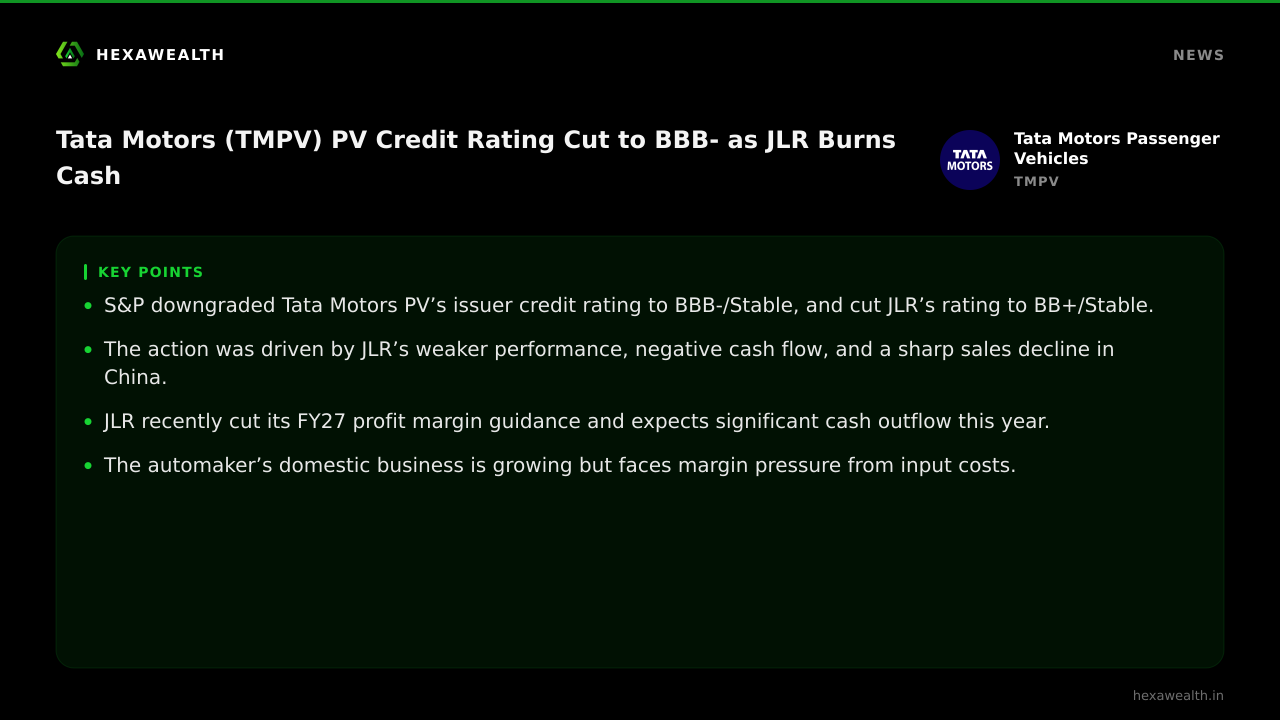
S&P Global Ratings has downgraded Tata Motors Passenger Vehicles’ credit rating, a direct consequence of mounting financial strain at its luxury car unit. The move reflects a tougher funding environment for the automaker as its key subsidiary, Jaguar Land Rover, burns through cash.
According to the NSE filing, the long-term issuer credit rating was revised from BBB/Negative to BBB-/Stable. For JLR, the rating was cut deeper, to BB+/Stable from BBB-/Negative. S&P’s rationale, reported by CNBC TV18, pointed to JLR’s weaker-than-expected operating performance and negative free operating cash flow, which it projects will be an outflow of about £1.4 billion this fiscal year.
The Pressure Points at JLR
The downgrade follows JLR’s recent guidance cut, where it lowered its adjusted EBIT margin outlook to 2-3%. S&P cited specific operational weaknesses, including a steep 46% year-on-year drop in sales of imported vehicles in China during the second quarter and the lingering effects of a 2025 cyber incident. The agency expects JLR’s net debt to rise significantly as cash outflows and investments in new electric models weigh on its balance sheet.
For the parent company, which posted a ₹5,451 crore net loss last quarter, the rating action is a formal acknowledgment of the financial drag from its global luxury arm. While the domestic business shows strong volume growth, its profitability is also under pressure from high commodity costs.
Key Points
- S&P downgraded Tata Motors PV’s issuer credit rating to BBB-/Stable, and cut JLR’s rating to BB+/Stable.
- The action was driven by JLR’s weaker performance, negative cash flow, and a sharp sales decline in China.
- JLR recently cut its FY27 profit margin guidance and expects significant cash outflow this year.
- The automaker’s domestic business is growing but faces margin pressure from input costs.
Hexa Perspective
The downgrade crystallizes the risk that has been building through JLR’s challenging year. While the stable outlook suggests S&P sees a path to recovery from fiscal 2028 via cost savings and new models, the near-term reality is a heavier debt burden and constrained financial flexibility. For Tata Motors PV, the rating now sits just one notch above the speculative-grade threshold, making the performance of its domestic engine critically important. The investment case must now hold through two concurrent tests: that JLR’s costly restructuring successfully stabilises cash flow before debt peaks, and that the domestic business can defend its margins against inflation to provide a reliable earnings base. A failure on either front would pressure the rating further.