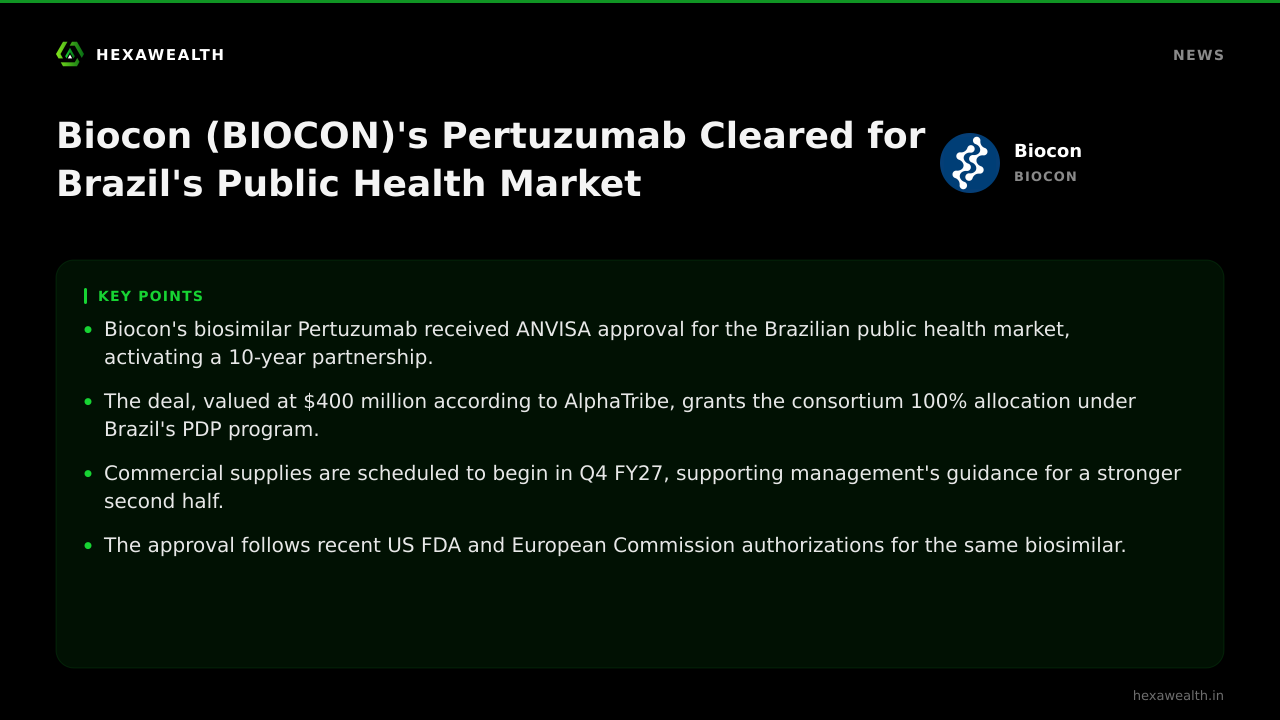
Biocon has secured a crucial regulatory green light in Brazil for its cancer biosimilar, activating a long-term partnership that management is counting on to help turn around a difficult year. The approval from Brazil's health regulator ANVISA allows its partner Bionovis to supply the Pertuzumab biosimilar, branded as Hertuzo, to the country's public healthcare system for treating HER2-positive breast cancer.
This clearance is the final step needed to begin a 10-year Productive Development Partnership with local firms Bionovis and Bahiafarma. According to the NSE filing, the partnership aims to supply locally manufactured biosimilar Pertuzumab. Research from AlphaTribe notes the total contract value is $400 million, with commercial supplies scheduled to begin this quarter.
The deal gives the consortium exclusive access to Brazil's public market, which PharmaSource reports makes up about 70% of national demand for such treatments. This provides a predictable revenue stream, a welcome development after a quarter where Biocon's net profit fell 57% year-on-year to ₹57 crore.
Key Points
- Biocon's biosimilar Pertuzumab received ANVISA approval for the Brazilian public health market, activating a 10-year partnership.
- The deal, valued at $400 million according to AlphaTribe, grants the consortium 100% allocation under Brazil's PDP program.
- Commercial supplies are scheduled to begin in Q4 FY27, supporting management's guidance for a stronger second half.
- The approval follows recent US FDA and European Commission authorizations for the same biosimilar.
Hexa Perspective
The Brazilian approval delivers on a specific promise from Biocon's weak September quarter, where management pointed to this launch as a key driver for recovery. Success now hinges on flawless execution of the supply ramp starting this quarter and the subsequent technology transfer to local manufacturing partners.
For a company whose profitability was just squeezed to a 1.3% net margin, this long-term, exclusive contract offers valuable revenue visibility. If the launch proceeds on schedule, it will help offset the structural cost pressures from higher depreciation. The catch is that the full annual run-rate, as noted by management, will only show in fiscal year 2028, requiring patience as the partnership scales.