Balu Forge has passed a key regulatory checkpoint for the $50 million fundraise it needs to execute its ambitious growth plans. The in-principle approvals from the NSE and BSE, detailed in the filing, clear the way for the company to finalise terms for its Foreign Currency Convertible Bonds (FCCBs).
Funding a Strategic Expansion
This capital is earmarked for a significant capacity build-out. According to an investor presentation cited by Arthneeti, the proceeds are allocated with 40% for capital expenditure, 30% for working capital, and 30% for general corporate purposes. The core of the planned ₹300 crore capex, as reported by Arthneeti, is for heavy forging lines and expanding defence ammunition capacity—critical for fulfilling its ₹2,400 crore order book.
The Terms and the Catch
The filing does not disclose final commercial terms like the coupon or conversion price. As Multibagg.ai notes, these details will determine the eventual cost of capital and potential equity dilution for shareholders. The company's strong balance sheet, with a low debt-to-equity ratio of 0.08, provides a solid foundation for taking on this foreign currency debt.
Key Points
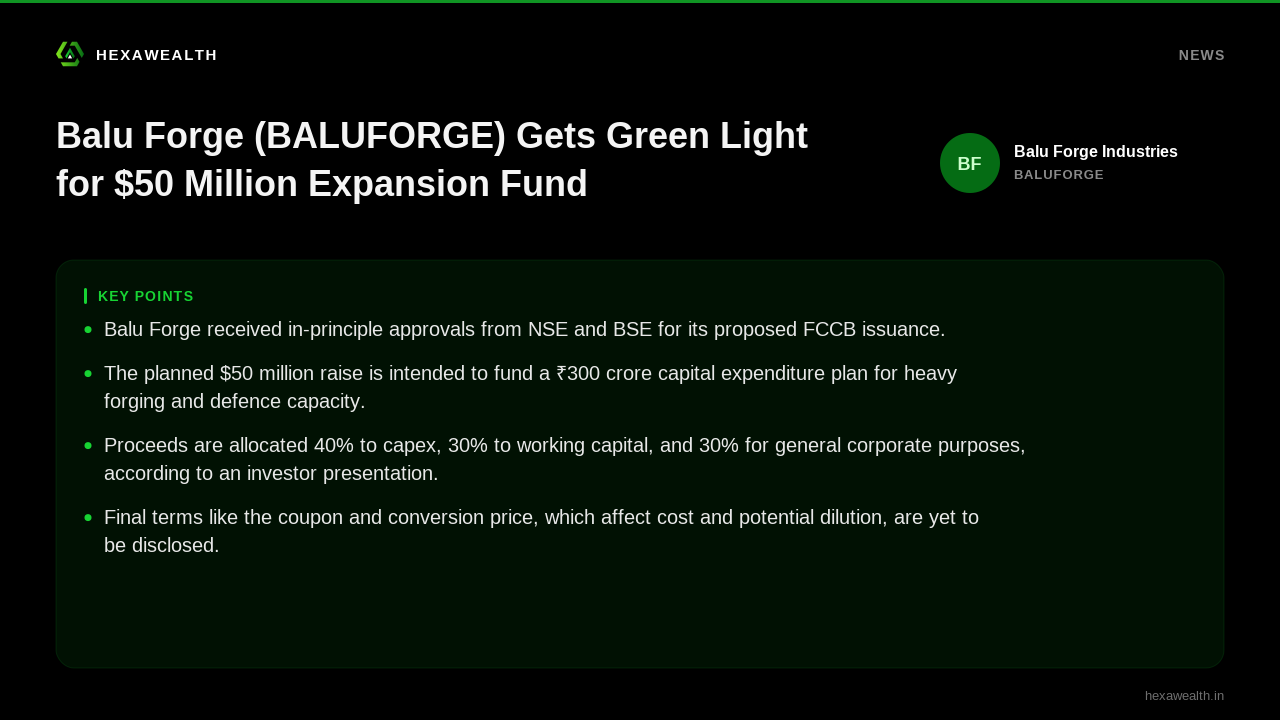
- Balu Forge received in-principle approvals from NSE and BSE for its proposed FCCB issuance.
- The planned $50 million raise is intended to fund a ₹300 crore capital expenditure plan for heavy forging and defence capacity.
- Proceeds are allocated 40% to capex, 30% to working capital, and 30% for general corporate purposes, according to an investor presentation.
- Final terms like the coupon and conversion price, which affect cost and potential dilution, are yet to be disclosed.
Hexa Perspective
This approval is a procedural but essential step, converting a stated funding plan into an executable one. For Balu Forge, the capital is targeted squarely at the high-value defence and engineering work that drives its growth outlook. The company's recent profit growth and robust order book justify the expansion, but the financial engineering now moves to the foreground. The final FCCB terms must stay competitive to avoid excessive future repayment risk or shareholder dilution. If the terms are prudent, this funding can be the fuel that turns its substantial order pipeline into sustained revenue and profit.