Siemens Energy India has crossed a major financial threshold, with annual revenue surpassing ₹10,000 crore for the first time in FY26. This milestone, detailed in a recent investor presentation, underscores the company's accelerating role in India's power infrastructure expansion, coming on the heels of a quarter where profit surged 81.5%.
The momentum is supported by a robust and growing order book. The company's order backlog stood at ₹14,580 crore at the end of FY26, an 11% increase from the prior year, providing clear visibility for future revenue. New order intake for the year reached ₹20,360 crore, a 25.6% rise.
Building for the Long Term
To meet this sustained demand, the company is making significant capacity investments. The board has approved a ₹2,060 crore investment for a new transformer factory in Ujjain. According to Transformer Magazine, this will add 30,000 MVA of large-transformer manufacturing capacity, with operations expected between 2030 and 2032. This expansion targets the massive grid upgrades needed to integrate renewable energy, a market the government plans to invest ₹9.15 lakh crore into by 2032, as per a PIB backgrounder.
Financially, the company appears well-positioned to fund this growth. MultibaggerHunt notes the capex is expected to be funded through internal accruals, supported by an 80% cash conversion ratio and a nearly debt-free balance sheet.
Key Points
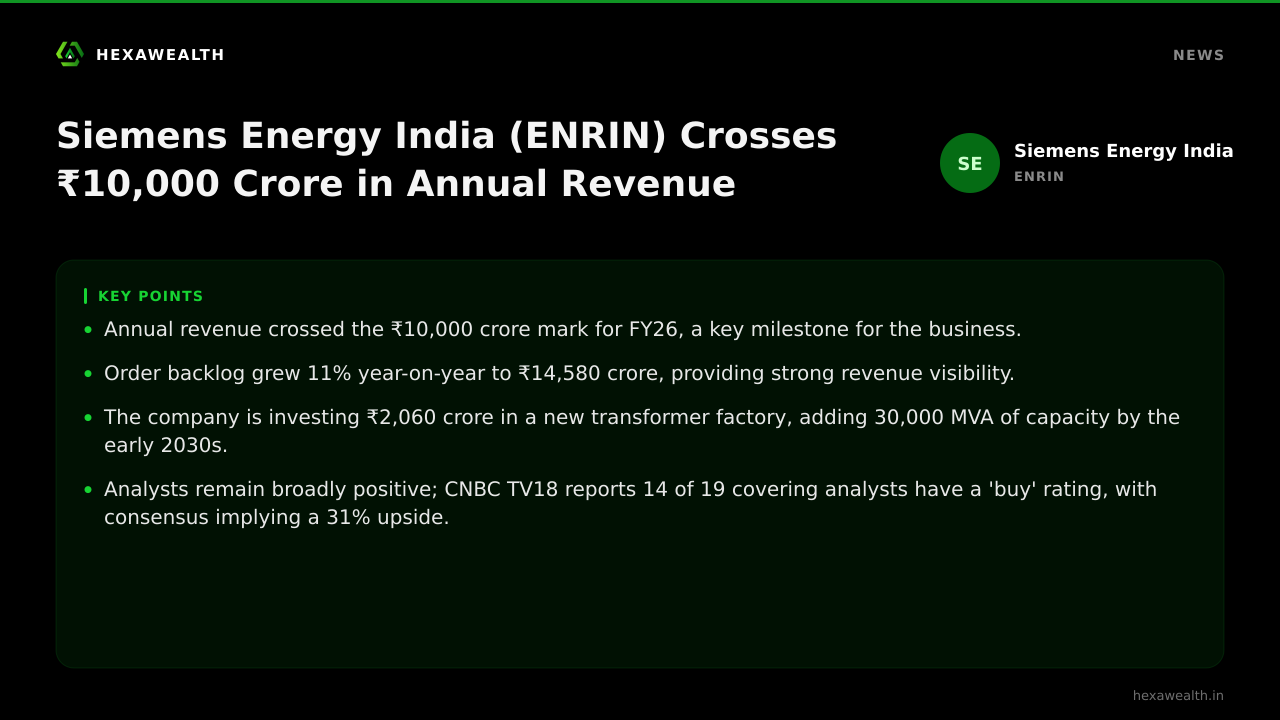
- Annual revenue crossed the ₹10,000 crore mark for FY26, a key milestone for the business.
- Order backlog grew 11% year-on-year to ₹14,580 crore, providing strong revenue visibility.
- The company is investing ₹2,060 crore in a new transformer factory, adding 30,000 MVA of capacity by the early 2030s.
- Analysts remain broadly positive; CNBC TV18 reports 14 of 19 covering analysts have a 'buy' rating, with consensus implying a 31% upside.
Hexa Perspective
The ₹10,000 crore revenue mark is a validation of Siemens Energy India's central role in a multi-year power transmission cycle. The record backlog and planned capacity investment lock in a long growth runway, directly tied to national goals for grid expansion and renewable integration.
The catch is timing and execution. The new factory's output is years away, placing the immediate burden on existing facilities to convert the current backlog efficiently. With the stock trading at a premium to the industry, as the payload shows, consistent quarterly execution is what must stay true to justify the market's confidence and fund future ambitions.