Gujarat Themis Biosyn is raising more debt to fund its costly expansion into Japan. The board approved issuing secured, unlisted non-convertible debentures worth up to ₹140 crore in a private placement, according to an NSE filing.
The funds will be invested in its wholly owned subsidiary, Themis Biosyn Japan Ltd. That unit will then extend financial assistance to MicroBiopharm Japan Co. Ltd for working capital and general corporate purposes. The company will raise the money in tranches, with specific terms like coupon rate and maturity to be set later.
This move follows a recent quarter where the company swung to a consolidated net loss of ₹13.84 crore. A key driver was a 367% sequential surge in interest expense to ₹8.36 crore, stemming from debt raised for the ₹1,300 crore acquisition of MicroBiopharm Japan (MBJ). As reported by Multibagg.ai, MBJ reported FY26 revenue of ₹557 crore with a 25% EBITDA margin, providing a revenue base for the parent company's new Japan-based contract development and manufacturing platform.
Key Points
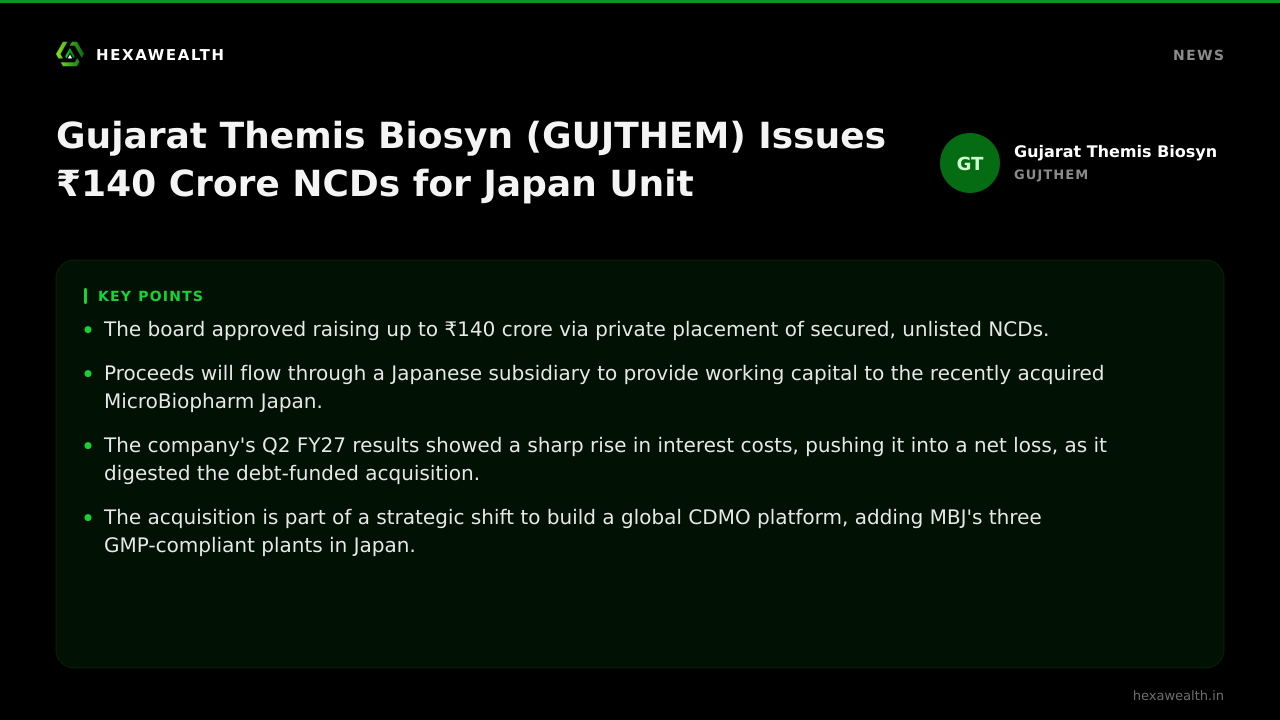
- The board approved raising up to ₹140 crore via private placement of secured, unlisted NCDs.
- Proceeds will flow through a Japanese subsidiary to provide working capital to the recently acquired MicroBiopharm Japan.
- The company's Q2 FY27 results showed a sharp rise in interest costs, pushing it into a net loss, as it digested the debt-funded acquisition.
- The acquisition is part of a strategic shift to build a global CDMO platform, adding MBJ's three GMP-compliant plants in Japan.
Hexa Perspective
This fundraising is a direct continuation of Gujarat Themis's debt-heavy strategy to transform its business. The company is layering more obligations onto a balance sheet already strained by acquisition financing, betting that the working capital infusion will help stabilize and grow its new Japanese asset. For the strategy to work, the operational benefits from integrating MBJ and its reported ₹557 crore revenue base must quickly outpace the mounting cost of debt. The company's path back to profitability now depends on its ability to generate cash from its expanded platform fast enough to service all its borrowings.