Follow Us

LinkedInInstagramX
News2 min read
BAJFINANCE company article
NEWS

Bajaj Finance (BAJFINANCE) Sets Up $5 Billion Foreign Debt Programme

Reviewed by Abhinav Swaroop, CFA, CBO Hexawealth

Add as preferred source on Google

Bajaj Finance has approved a $5 billion programme to raise debt from international investors, a move to diversify its funding as loan growth surges. The Euro Medium Term Note (EMTN) programme provides a ready framework to issue bonds overseas, subject to market conditions, according to the NSE filing.

A Tool for Diversified Growth

This step follows a quarter where the company’s assets under management grew 26% year-on-year. Management has already raised its full-year growth guidance, signaling a need for ample, cost-effective capital. The programme allows Bajaj Finance to tap foreign investors, potentially extending debt maturities and reducing reliance on domestic bank funding. Bloomberg Intelligence notes bond markets are becoming more important for NBFCs seeking cheaper and more diversified capital.

The Funding Calculus

The financial benefit will hinge on the final all-in cost. As reported by Elets BFSI, borrowers using a special RBI swap facility must weigh the foreign interest rate, a 1.5% annual swap premium, and other costs against domestic funding rates. The company is already bracing for margin pressure from rising interest rates, making the economics of each offshore drawdown critical.

Key Points

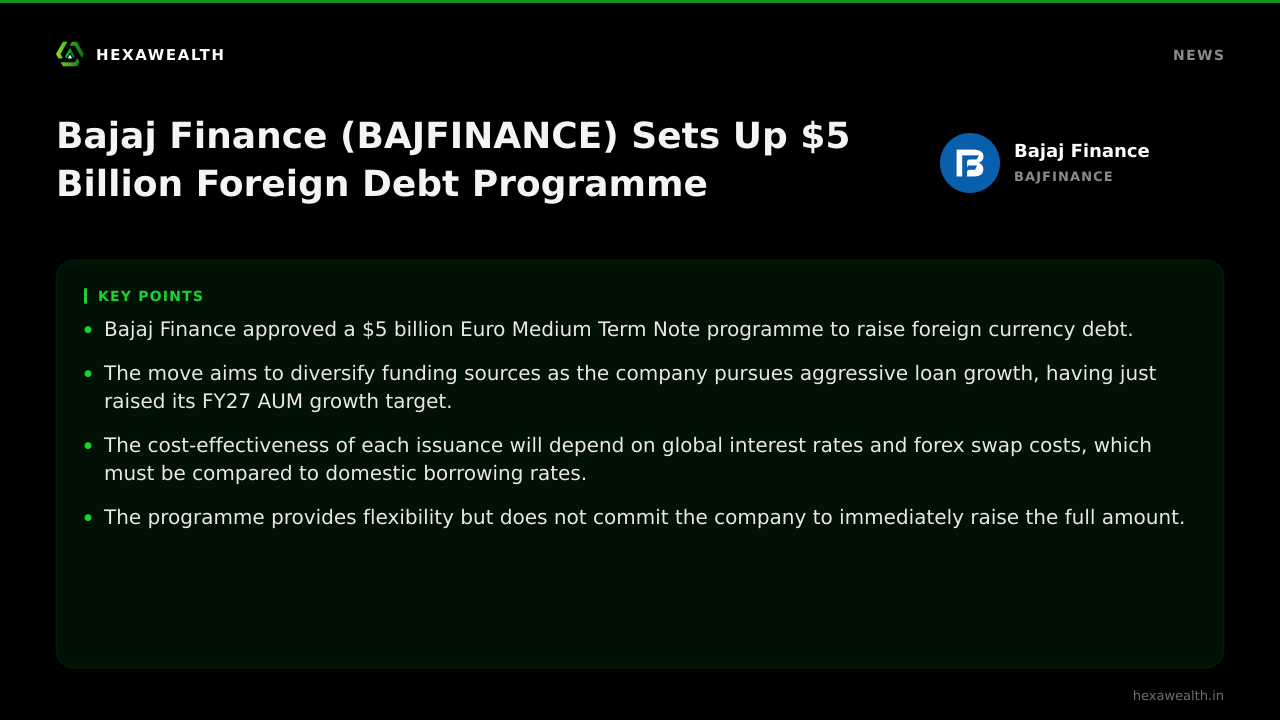
  • Bajaj Finance approved a $5 billion Euro Medium Term Note programme to raise foreign currency debt.
  • The move aims to diversify funding sources as the company pursues aggressive loan growth, having just raised its FY27 AUM growth target.
  • The cost-effectiveness of each issuance will depend on global interest rates and forex swap costs, which must be compared to domestic borrowing rates.
  • The programme provides flexibility but does not commit the company to immediately raise the full amount.

Hexa Perspective

Establishing this large debt programme is a logical, forward-looking step for a lender of Bajaj Finance’s scale and growth ambition. It builds an optionality bridge to deeper capital pools, which can support expansion and improve funding resilience. The catch is that this is merely a framework—its value will be realized only through disciplined execution. Each potential bond issue must clear a high bar on cost, especially as management has flagged expectations of domestic margin pressure. For the programme to be a net positive, the company must draw down only when the all-in cost of foreign debt, after hedging, is genuinely advantageous. Its success will be measured not by the size of the authorization, but by the prudence of its use.
Trending news


Want this applied to your portfolio?

Talk to a HexaWealth advisor, or sync your mutual fund data for insights tailored to your holdings.

Share or follow HexaWealth

Bajaj Finance (BAJFINANCE) Sets Up $5 Billion Foreign Debt Programme

Frequently asked questions

What is Bajaj Finance's Euro Medium Term Note programme?
Bajaj Finance has approved a $5 billion Euro Medium Term Note (EMTN) programme. This establishes a framework for the company to issue bonds in international markets, allowing it to raise foreign currency debt to fund its operations and growth, subject to market conditions.
Why did Bajaj Finance set up a $5 billion EMTN programme?
Bajaj Finance set up the programme to diversify its sources of funding. With the company reporting 26% year-on-year loan book growth and raising its full-year guidance, it needs ample capital. Tapping international debt markets can provide alternative funding and potentially longer-term money.
How much debt will Bajaj Finance raise immediately?
The $5 billion is the total size of the authorized programme, not an immediate fundraising. The NSE filing states the company may undertake drawdowns at its discretion and subject to market conditions. It is a framework for future bond issuances, not a single $5 billion loan.
What are the risks of Bajaj Finance raising foreign debt?
The main risk involves foreign exchange and interest costs. As noted by Elets BFSI, the all-in cost of foreign borrowing includes the interest rate, a potential currency swap premium, and other fees. If this total cost exceeds domestic funding rates, the financial benefit of the programme would be reduced.
How do analysts view Bajaj Finance's EMTN programme?
While specific reactions to this programme are not detailed in available reports, analysts like those at Bloomberg Intelligence highlight that bond markets are becoming more important for NBFCs. Better-rated companies are using them to diversify funding and extend debt maturities.
Has Bajaj Finance raised money overseas before?
The research does not specify previous overseas bond issuances by Bajaj Finance under an EMTN programme. However, other Indian NBFCs like Capri Global Capital and RBL Bank have recently tapped international debt markets, indicating a sector trend towards offshore funding.
What will Bajaj Finance use the EMTN money for?
The specific use of proceeds from the EMTN programme is not detailed in the NSE filing or available research. Typically, such funds can be used for general corporate purposes, which for a growing NBFC like Bajaj Finance would include lending, refinancing existing debt, and supporting expansion.