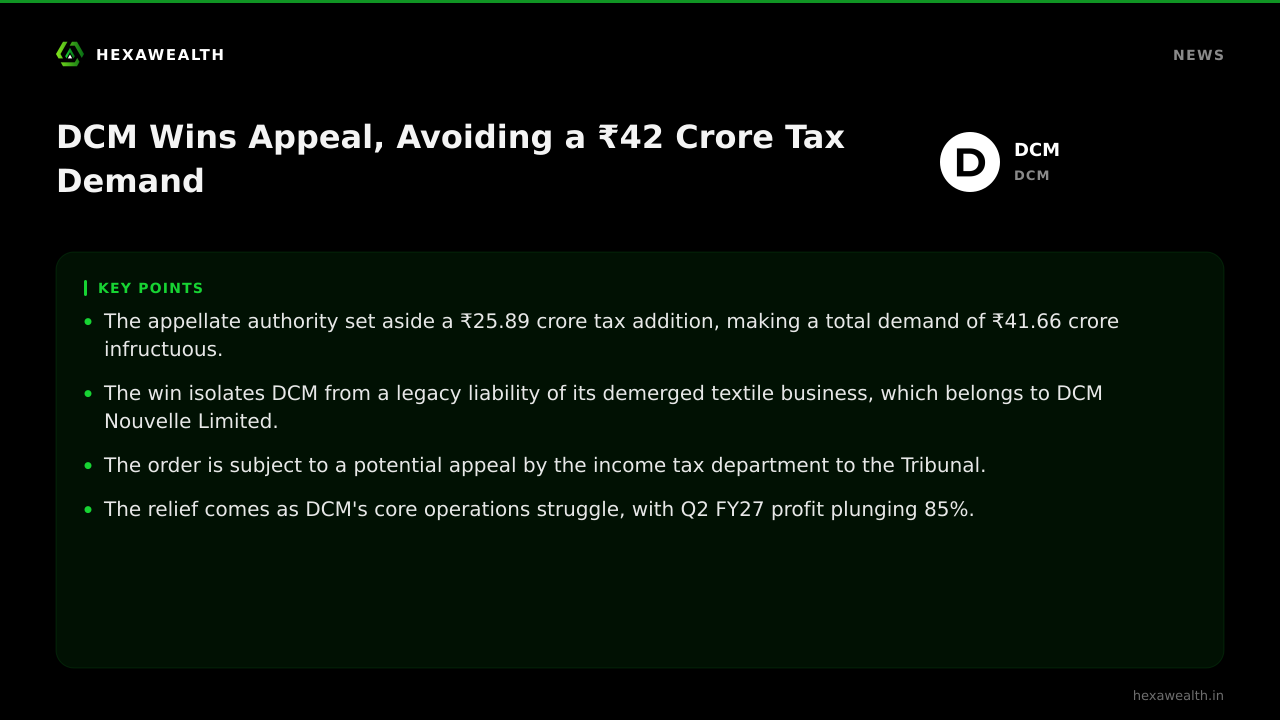
DCM Limited has secured a significant legal victory that removes a large potential liability from its books. The win provides crucial breathing room for a company whose core business is struggling to generate consistent profits.
The Commissioner of Income-tax Appeals set aside a tax addition of ₹25.89 crore, ruling that purchases from a specific supplier were genuine, according to the NSE filing. This decision makes a subsequent rectification order, which had raised a total tax demand of ₹41.66 crore, infructuous. The company stated it will file to have the demand deleted. However, the income tax department can still appeal this order before the Tribunal, as noted in the filing.
This relief is particularly timely. DCM's recent quarterly performance was dismal, with net profit crashing 85% year-on-year to just ₹0.22 crore, according to the numerical payload. The company has been planning to sell 38.38 acres of land in Vellore to address liquidity concerns, a process that remains subject to shareholder approval, reports Multibagg.ai.
Key Points
- The appellate authority set aside a ₹25.89 crore tax addition, making a total demand of ₹41.66 crore infructuous.
- The win isolates DCM from a legacy liability of its demerged textile business, which belongs to DCM Nouvelle Limited.
- The order is subject to a potential appeal by the income tax department to the Tribunal.
- The relief comes as DCM's core operations struggle, with Q2 FY27 profit plunging 85%.
Hexa Perspective
The appellate win is a clear positive, removing a major contingent overhang. For a company whose trailing-twelve-month profit is essentially zero, avoiding a cash outflow of this magnitude is material. However, it does not fix the operational fragility highlighted in the last quarter, where an 81% tax rate devoured earnings. The planned land sale remains a necessary step for liquidity, but sustainable value hinges on the IT unit driving consistent profitability. The relief will stand if the appellate order withstands any departmental challenge, allowing management to focus on stabilizing the business that actually generates its revenue.