BPCL has taken a decisive step toward its largest-ever expansion, with its board approving a new 9 million-tonne-per-year refinery and petrochemical complex. This massive ₹1.27 lakh crore project is a strategic bet on India's long-term fuel and petrochemical demand, aiming to diversify the company's product mix beyond the volatile marketing business that squeezed profits last quarter.
The board approved an equity infusion of up to ₹44,330 crore into a wholly-owned subsidiary for the project, though this funding is still subject to approval from the Cabinet Committee on Economic Affairs. Reports from The Economic Times note that BPCL is also seeking partners, with Oil India considering a 10-20% stake. The project has already secured key environmental and coastal clearances, as reported by Maritime Gateway and The New Indian Express, and is scheduled for commercial operation by July 2032.
Key Points
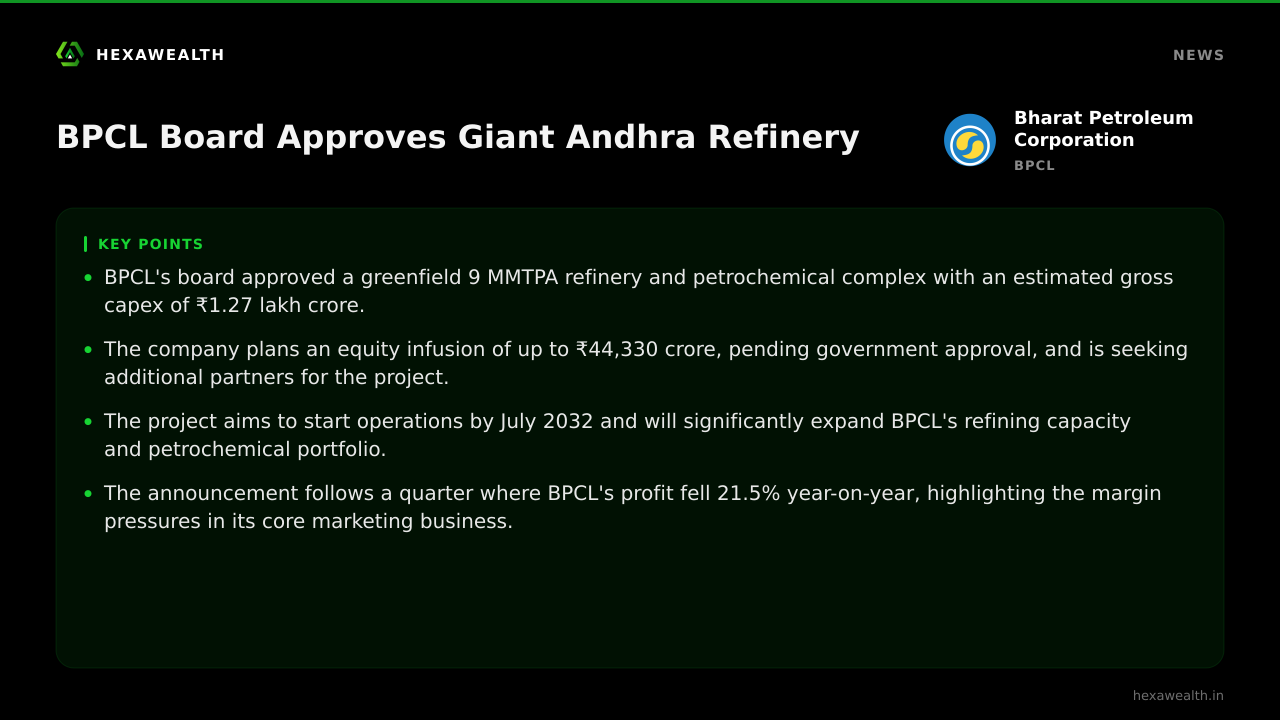
- BPCL's board approved a greenfield 9 MMTPA refinery and petrochemical complex with an estimated gross capex of ₹1.27 lakh crore.
- The company plans an equity infusion of up to ₹44,330 crore, pending government approval, and is seeking additional partners for the project.
- The project aims to start operations by July 2032 and will significantly expand BPCL's refining capacity and petrochemical portfolio.
- The announcement follows a quarter where BPCL's profit fell 21.5% year-on-year, highlighting the margin pressures in its core marketing business.
Hexa Perspective
This approval marks a pivotal, capital-intensive shift for BPCL. The move addresses a strategic need to build capacity and integrate into higher-margin petrochemicals, moving beyond the earnings volatility of fuel marketing. However, the scale of investment—against a backdrop of quarterly profit swings and a stock trading at a deep discount—introduces significant execution and financial risk.
The project's success now hinges on two critical conditions: securing the final government approval for the massive equity infusion and managing the balance sheet through this multi-year spend without compromising financial stability. For BPCL, the path forward requires navigating these approvals while maintaining its core operations, a dual challenge that will define its trajectory for the next decade.