V-Mart Retail (VMART) Q2 FY27's Loss Doubles Despite 18% Revenue Growth
V-Mart Retail's September quarter loss widened to ₹16.3 crore even as revenue grew 18% year-on-year, pressured by a festive calendar shift and rising depreciation from rapid expansion.
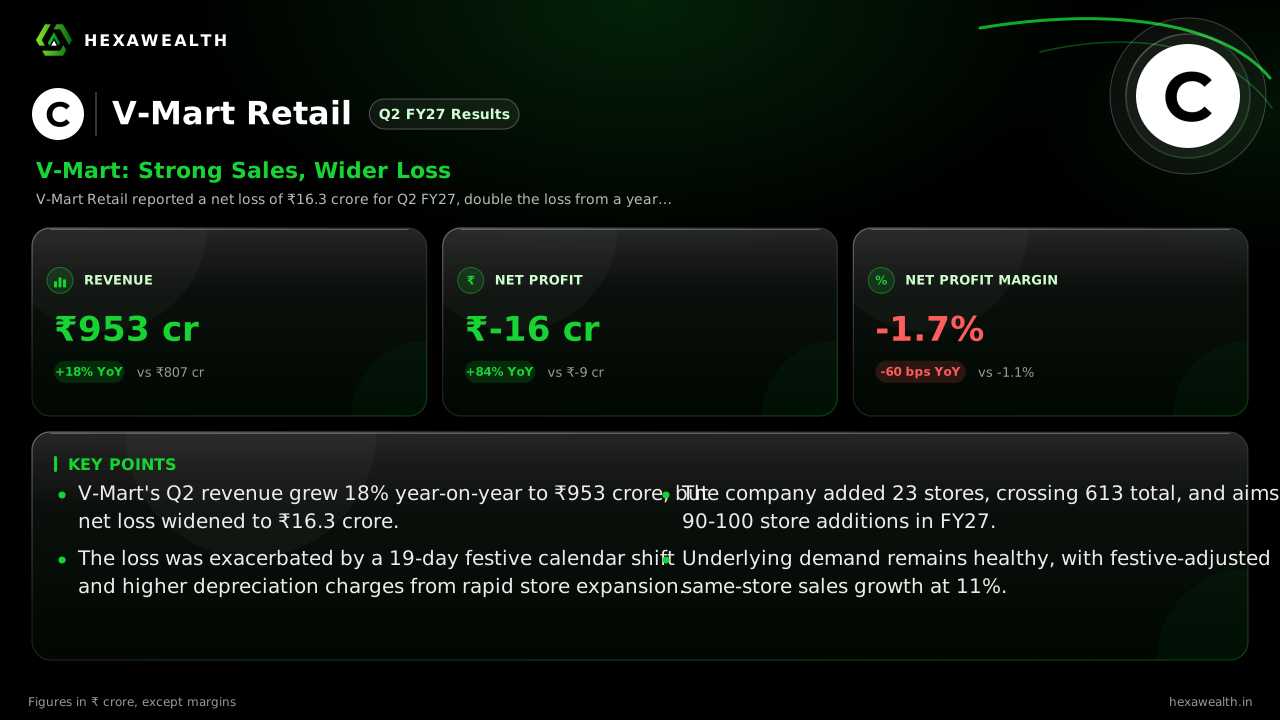
V-Mart Retail reported a net loss of ₹16.3 crore for Q2 FY27, double the loss from a year ago. Revenue grew 18% to ₹953 crore, but a shift in festive dates and higher depreciation from store additions weighed on profitability.
For value retailers like V-Mart, the September quarter is a critical test of festive season demand. This year, that test came with a 19-day calendar shift that pushed key shopping days into the next quarter, leaving a reported loss that doubled despite healthy underlying sales growth.
The numbers show a business expanding but not yet translating that growth to the bottom line. Revenue for Q2 FY27 stood at ₹953 crore, an 18% increase from the same period last year. Yet, the company posted a net loss of ₹16.3 crore, wider than the ₹8.9 crore loss in Q2 FY26. On a sequential basis, the swing from a ₹47.2 crore profit in Q1 to a loss highlights the quarter's seasonal weakness and cost pressures.
Revenue & profit
Revenue (₹ Cr)
Profit (₹ Cr)
Net Profit Margin (%)
| Metric | CurrentQ2 FY27 | PreviousQ1 FY27 | Same quarter LYQ2 FY26 |
|---|---|---|---|
| Revenue (₹ Cr) | 952.99YoY +18% | 1088.81 | 806.87 |
| Profit (₹ Cr) | -16.34YoY -84% | 47.21 | -8.87 |
| Net Profit Margin (%) | -1.7YoY -55% | 4.3 | -1.1 |
Why the Loss Widened on Higher Sales
The headline loss was driven by two main factors. First, the festive calendar shift, noted in the company's investor presentation, moved Navratri shopping into Q3. This depressed reported same-store sales growth to 3%, but management said the adjusted figure was a healthier 11%.
Second, and more structural, was a sharp rise in depreciation, which jumped 25% year-on-year to ₹88.8 crore. According to the earnings call transcript from AlphaStreet, this increase is largely due to accounting for a larger leased store network under Ind AS 116. On a pre-Ind AS basis, depreciation was flat at ₹28 crore.
The Cost of Rapid Expansion
V-Mart is opening stores at a brisk pace to capture demand in smaller towns, crossing the 600-store milestone this quarter. The company added 23 net new stores, taking the total to 613. Management, as cited by AlphaStreet, remains committed to opening 90-100 stores this fiscal year.
This expansion is capital-intensive. Net capital expenditure for the first half was ₹85 crore, up from ₹60 crore a year ago. While store productivity is improving—sales per square foot rose 5%—the associated non-cash charges are weighing on reported profits in the near term.
Working Capital and the Road Ahead
The aggressive growth has implications for cash flow. The company noted a controlled increase in working capital use due to festive inventory build-up and faster vendor payments. Short-term borrowings rose to ₹190 crore at quarter-end to fund this need, though it maintains no long-term debt.
Looking ahead, the focus is on the current festive quarter to recoup the delayed demand. The company targets 17-20% total sales growth over time. However, as a DFU Publications report notes, the broader value retail sector is capping price hikes to protect footfalls, which may limit margin expansion in a competitive landscape.
Key Points
- V-Mart's Q2 revenue grew 18% year-on-year to ₹953 crore, but net loss widened to ₹16.3 crore.
- The loss was exacerbated by a 19-day festive calendar shift and higher depreciation charges from rapid store expansion.
- The company added 23 stores, crossing 613 total, and aims for 90-100 store additions in FY27.
- Underlying demand remains healthy, with festive-adjusted same-store sales growth at 11%.
Hexa Perspective
The quarter underscores the tension between V-Mart's aggressive growth strategy and its near-term profitability. The core business is showing resilience, with adjusted same-store sales in double digits and the Unlimited format performing well. However, the accounting impact of lease capitalization and the sheer pace of expansion are masking operating improvements.
Investors are weighing whether the current margin compression is a temporary cost of building scale or a persistent challenge. The answer hinges on the new stores maturing quickly and the company's ability to manage working capital efficiently without relying heavily on short-term debt. The upcoming Q3, with its full festive slate, will be a crucial indicator of whether top-line momentum can finally flow through to the bottom line.
Also read
Want this applied to your portfolio?
Talk to a HexaWealth advisor, or sync your mutual fund data for insights tailored to your holdings.