True Green Bio Energy (TRUEGREEN) Q2 FY27 Profit Slips as Costs Bite into Ethanol Gains
The company's Q2 FY27 revenue surged over 10,000% year-on-year, but a sequential profit decline highlights margin pressure in its new biofuel venture.
True Green Bio Energy's transformation into ethanol production powered a massive revenue jump. However, profit fell 18% from the previous quarter as operating costs rose faster than sales, squeezing margins.
True Green Bio Energy’s quarter tells two stories. A year ago, it was a tiny textiles player; today, it is a biofuel producer with sales scaling exponentially. The headline growth, however, masks a tougher reality of rising costs and compressed profitability.
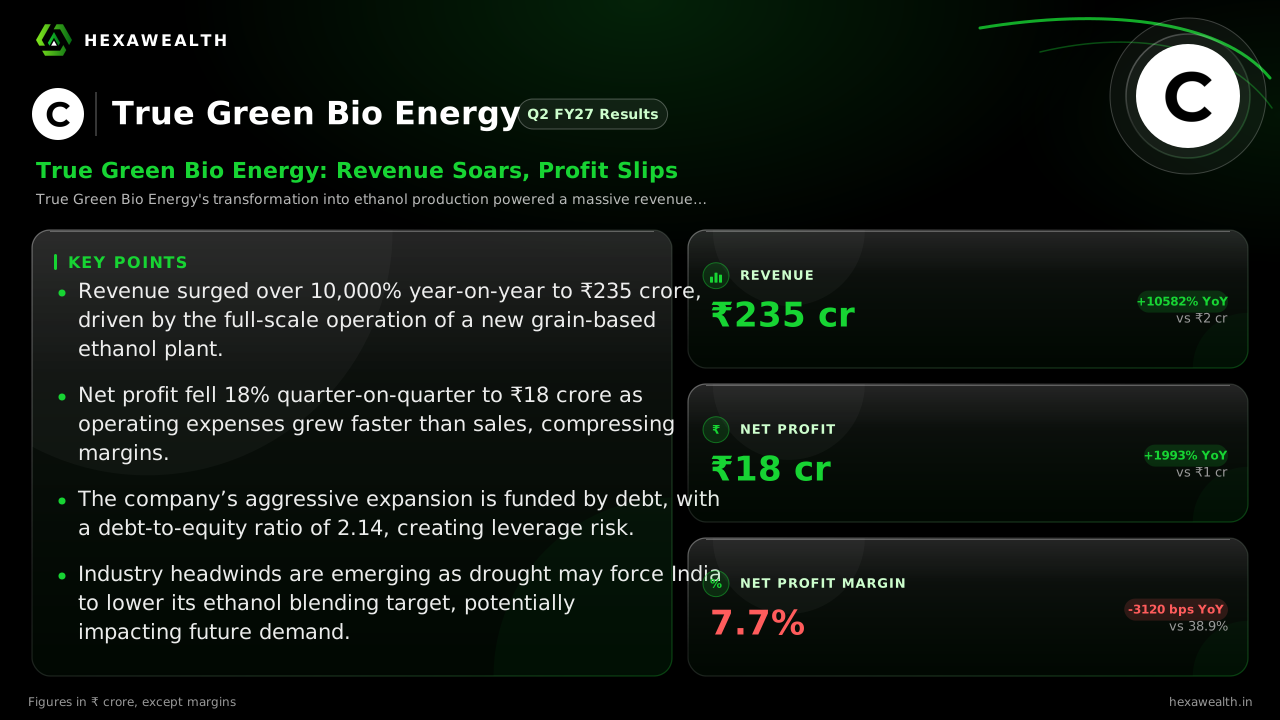
Revenue reached ₹235 crore, up a staggering 10,582% from a minuscule base a year ago. Sequentially, sales grew a modest 3.3%. Net profit for the September quarter was ₹18 crore, down 17.6% from the June quarter, as the net profit margin thinned to 7.7%.
Revenue & profit
Revenue (₹ Cr)
Profit (₹ Cr)
Net Profit Margin (%)
| Metric | CurrentQ2 FY27 (Sep 2026) | PreviousQ1 FY27 (Jun 2026) |
|---|---|---|
| Revenue (₹ Cr) | 235.0 | 227.6 |
| Profit (₹ Cr) | 18.0 | 21.9 |
| Net Profit Margin (%) | 7.7 | 9.6 |
The Margin Squeeze Behind the Growth
The explosive yearly growth stems from a strategic pivot. The company, formerly CIL Nova Petrochemicals, sold its old yarn unit to fund a new 300 KLPD grain-based ethanol plant in Gujarat, as detailed by StockFin.ai. This facility began commercial operations, driving revenue from near-zero.
Yet, profitability is moving in the opposite direction. The operating profit margin fell 330 basis points sequentially to 12.9%, according to Flash Finance. Total expenses rose 6.8% quarter-on-quarter, outpacing the 3.3% revenue growth. This points to structural cost pressures as the new plant scales.
A Debt-Fuelled Bet on Policy
The expansion is heavily leveraged. The company’s debt-to-equity ratio stands at 2.14, with borrowings of ₹340 crore funding the ethanol plant, notes SectorAlpha. This aggressive capital deployment bets on India’s ethanol blending mandate, which targets 20% ethanol in petrol.
That policy support now faces a headwind. A Reuters report highlights that a drought-induced crop shortage is pushing the government to prioritise food over fuel, potentially lowering the blending rate. This could squeeze industry capacity utilisation and realisation prices for producers like True Green.
The Market’s Cautious Read
Management has provided no formal guidance, increasing uncertainty. Flash Finance’s analysis notes the quarter’s sales were dramatically above the company’s own historical trend, but profit quality was almost entirely from core operations. The market sentiment appears guarded.
MarketsMojo maintains a ‘Sell’ rating on the stock, citing high promoter pledging and fair valuation as of November 4. The lack of clear cash flow visibility against rising debt underpins this caution, suggesting investors are weighing the growth story against financial sustainability.
Key Points
- Revenue surged over 10,000% year-on-year to ₹235 crore, driven by the full-scale operation of a new grain-based ethanol plant.
- Net profit fell 18% quarter-on-quarter to ₹18 crore as operating expenses grew faster than sales, compressing margins.
- The company’s aggressive expansion is funded by debt, with a debt-to-equity ratio of 2.14, creating leverage risk.
- Industry headwinds are emerging as drought may force India to lower its ethanol blending target, potentially impacting future demand.
Hexa Perspective
The quarter confirms True Green’s operational transformation but also its financial vulnerability. Revenue has arrived, yet profitability is retreating under the weight of scale-up costs and high leverage. The path forward hinges on two external forces: stable ethanol offtake from oil companies and manageable feedstock prices.
With government policy tilting towards food security, the demand outlook for biofuels has softened. For the debt-fuelled growth to pay off, the company must demonstrate it can widen margins in a less supportive environment—a test the next few quarters will define.
Also read
Want this applied to your portfolio?
Talk to a HexaWealth advisor, or sync your mutual fund data for insights tailored to your holdings.